“Reflective of the typically idiosyncratic way engineers of this era explored the human condition. The shitty gradient show’s the deep struggle with deadlines and their personal philosophy on the tyranny of the bourgeois. ” – An excerpt from a confused student’s art history paper after the standard is installed in the Louvre.
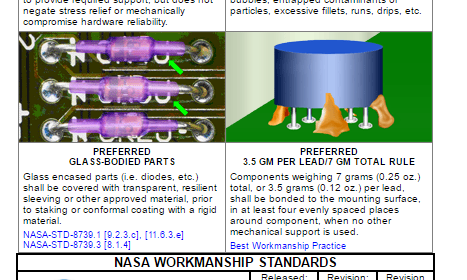
The NASA workmanship standards are absolutely beautiful. I mean that in the fullest extent of the word. If I had any say in the art that goes up in the Louvre, I’d put them up right beside Mona. They’re a model of what a standard should be. A clear instruction for construction, design, and inspection all at once. They’re written in clear language and contain all the vernacular one needs to interpret them. They’re unassuming. The illustrations are perfectly communicative. It’s a monument to the engineer’s art.
Around five years ago I had a problem to solve. Every time a device went into the field happily transmitting magic through its myriad connectors, it would inevitably come back red tagged, dusty, and sad. It needed to stop. I dutifully traced the problem to a connector, and I found the problem. A previous engineer had informed everyone that it was perfectly okay to solder a connector after crimping. This instruction was added because, previously, the crimps were performed with a regular pair of needle nose pliers and they came undone… a lot. Needless to say, the solder also interfered with their reliable operation, though less obviously. Stress failures and intermittent contact was common.
In case you missed it, the big news is that a minimal Arduino core is up and working on the ESP32. There’s still lots left to do, but the core functionality — GPIO, UART, SPI, I2C, and WiFi — are all up and ready to be tested out. Installing the library is as easy as checking out the code from GitHub into your Arduino install, so that’s exactly what I did.
I then spent a couple days playing around with it. It’s a work in progress, but it’s getting to the point of being useful, and the codebase itself contains some hidden gems. Come on along and take a sneak peek.
Your clever branding won’t work on me! *types caption in on iPhone, sips Starbucks*
I remember the first time I built a computer. My sister and I had our last fight about who would get to use the family computer, it was time I had one of my own. I knew a little bit, and I knew I wasn’t going to be one of those plebs that overpaid for a Gateway in its cow box. So I outsourced. One of the computer literate parents in my Scout Troop very kindly agreed to put together a list of components for me. I spent my Christmas money, birthday money, and a small mountain of money I had saved up. I remember getting the parts in the mail. I was so excited that a week earlier I had even bought one of those super lame computer tool kits to put it together.
I still remember how enormously frustrating the stand-offs for the mother board were to install. I think computers were still figuring out that they didn’t need ALL of the features of a mainframe. Anyway there was a 3mm screw on each side of a cm tall brass standoff. It also wanted me to put these little isolating paper washers on the assembly for some reason. Even with my then presidentially sized hands it took a long time. My Mom later told me that it was around this time she was certain the whole endeavour was going to end in tears.
Six hours of careful work later I had the computer together and running when I realized I had forgotten to buy an OS for it. She was nearly right.
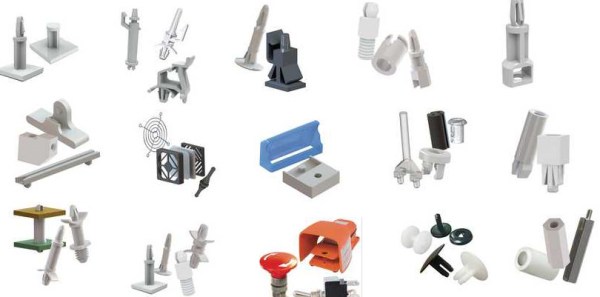
Regardless. My early experience with computer assembly left me with a love for standardized screws, a hate for excessive fasteners, and a deep loathing for improperly routed wires. I was a weird kid. Anyway, when it came time for me to start designing my own enclosures for circuit boards I had all the unique psychological damage and underpinnings I would need to waste a lot of time googling on the internet for an alternate, screwless, method of standing a board off from a surface.
Welcome back to the final chapter in our journey exploring two-stage tentacle mechanisms. This is where we arm you with the tools and techniques to get one of these cretins alive-and-kicking in your livingroom. In this last installment, I’ll guide us through the steps of building our very own tentacle and controller identical to one we’ve been discussing in the last few weeks. As promised, this post comes with a few bonuses:
Depending on your situation, some design files may be more important than others. If you just want to get parts made, odds are good that you can simply cut the pre-offset DXFs from the right plate thicknesses and get rolling. Of course, if you need to tune the files for a laser with a slightly different beam diameter, I’ve included the original DXFs for good measure. For the heavy-hitters, I’ve also included the original files if there’s something about this design that just deserves a tweak or two. Have at it! (And, of course, let us know how you improve it!)
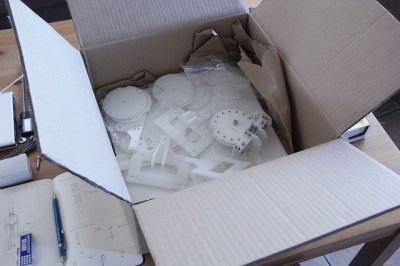
Ok, now that we’ve got the parts on-hand in a pile of pieces,let’s walk through the last-mile tweaks to making this puppet work: assembly and tuning. At this point, we’ve got a collection of parts, some laser-cut, some off the shelf. Now it’s time to string them together.
Today’s engineers are just as good as the ones that came before, but that should not be the case and there is massive room for improvement. Improvement that can be realized by looking for the best of the world to come and the one we left behind.
Hey kids! Let’s learn why the CE certifications exist!
Survivorship bias is real. When we look at the accomplishments of the engineers that came before us we are forced to only look at the best examples. It first really occurred to me that this was real when I saw what I still consider to be the most atrocious piece of consumer oriented engineering the world has yet seen: the Campbell’s soup warmer.
This soup warmer is a poor combination of aluminum and Bakelite forged into the lowest tier of value engineering during its age. Yet it comes from the same time that put us on the moon: we still remember and celebrate Apollo. It’s possible that the soup warmer is forgotten because those who owned it perished from home fires, electrocution, or a diet of Campbell’s soup, but it’s likely that it just wasn’t worth remembering. It was bad engineering.
In fact, there’s mountains of objects. Coffee pots whose handles fell off. Switches that burned or shocked us. Cars that were ugly and barely worked. Literal mountains of pure refuse that never should have seen the light of day. Now we are here.
The world of engineering has changed. My girlfriend and I once snuck into an old factory in Louisville, Kentucky. The place was a foundry and the only building that survived the fire that ended the business. It happened to be where they stored their professional correspondence and sand casting patterns. It was moldy, dangerous, and a little frightening but I saw something amazing when we cracked open one of the file cabinets. It was folders and folders of all the communication that went into a single product. It was an old enough factory that some of it was before the widespread adoption of telephony and all documents had to be mailed from place to place.
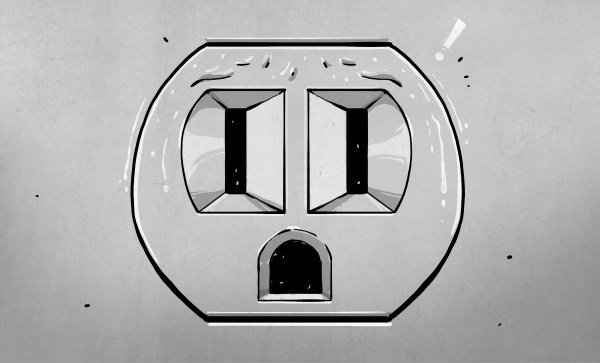
My introduction to circuit protection came at the tender age of eight. Being a curious lad with an inventive – and apparently self-destructive – bent, I decided to make my mother a lamp. I put a hose clamp around the base of a small light bulb, stripped the insulation off an old extension cord, and jammed both ends of the wires under the clamp. When I plugged my invention into an outlet in the den, I saw the insulation flash off the cord just before the whole house went dark. Somehow the circuit breaker on the branch circuit failed and I tripped the main breaker on a 200 amp panel. My mother has never been anywhere near as impressed with this feat as I was, especially now that I know a little bit more about how electricity works and how close to I came to being a Darwin Award laureate.
To help you avoid a similar fate, I’d like to take you on a trip (tee-hee!) through the typical household power panel and look at some of the devices that stand at the ready every day, waiting for a chance to save us from ourselves. As a North American, I’ll be focusing on the residential power system standards most common around here. And although there is a lot of technology that’s designed to keep you safe as a last resort, the electricity in your wall can still kill you. Don’t become casual with mains current!
We’ve all taken apart a small toy and pulled out one of those little can motors. “With this! I can do anything!” we proclaim as we hold it aloft. Ten minutes later, after we’ve made it spin a few times, it goes into the drawer never to be seen again.
It’s all their fault
It always seems like they are in everything but getting them to function usefully in a project is a fool’s errand. What the heck are they for? Where do people learn the black magic needed to make them function? It’s easy enough to pull out the specification sheet for them. Most of them are made by or are made to imitate motors from the Mabuchi Motor Corporation of Japan. That company alone is responsible for over 1.5 billion tiny motors a year.
More than Just the Specs
In the specs, you’ll find things like running speed, voltage, stall current, and stall torque. But they offer anything but a convincing application guide, or a basic set of assumptions an engineer should make before using one. This is by no means a complete list, and a skip over the electrics nearly completely as that aspect of DC motors in unreasonably well documented.
The paint mixers high running speed and infrequent use make it a decent candidate for hooking directly to the motor.
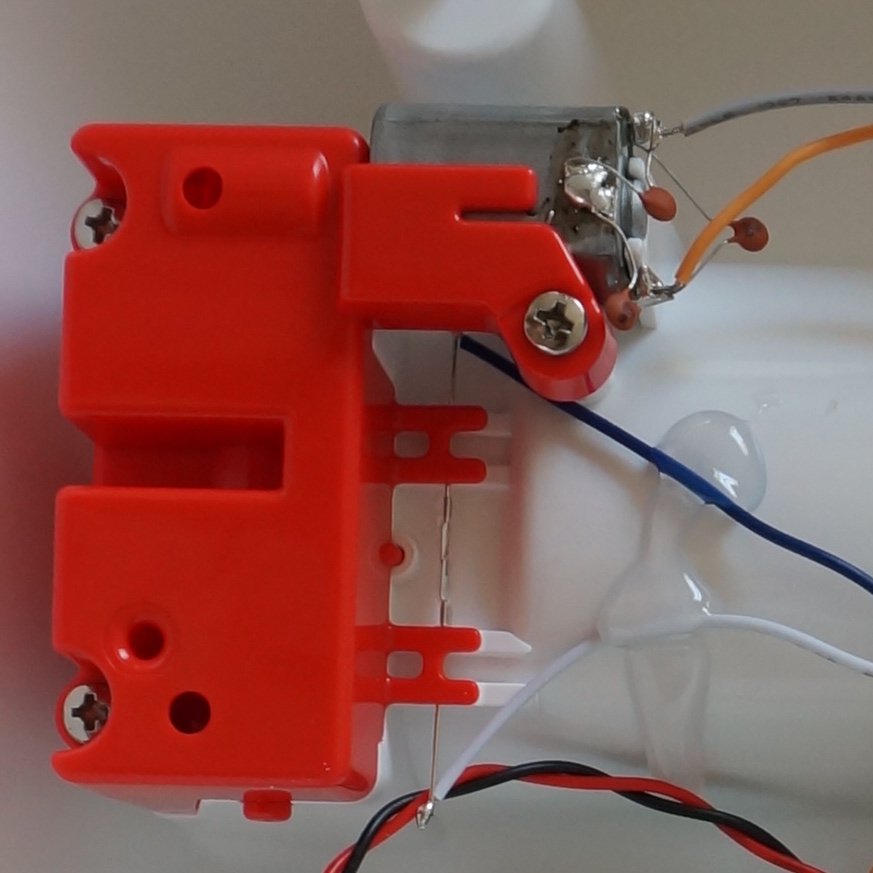
The first thing to note is that they really aren’t meant to drive anything directly. They are meant to be isolated from the actual driving by a gear train. This is for a lot of reasons. The first is that they typically spin very fast, 6,000 – 15,000 rpm is not atypical for even the tiniest motor. So even though the datasheet may throw out something impressive like it being a 3 watt motor, it’s not exactly true. Rather, it’s 3 N*m/s per 15,000 rotations per minute motor. Or a mere 1.2 milliwatt per rotation, which is an odd sort of unit that I’m just using for demonstration, but it gives you the feeling that there’s not a ton of “oomph” available. However, if you start to combine lots of rotations together using a gear train, you can start to get some real power out of it, even with the friction losses.
The only consumer items I can think of that regularly break this rule are very cheap children’s toys, which aren’t designed to last long anyway, and those powered erasers and coffee stirrers. Both of these are taking for granted that their torque needs are low and their speed needs are high, or that the motor burning out is no real loss for the world (at least in the short term).
This is because the motors derate nearly instantly. Most of these motors are hundreds of loops of very thin enameled wire wrapped around some silicon steel plates spot welded or otherwise coerced together. This means that even a small heat event of a few milliseconds could be enough to burn through the 10 micrometer thick coating insulating the coils from each other. Practically speaking, if you stall a little motor a few times in a row you might as well throw it away, because there’s no guessing what its actual performance rating is anymore. Likewise, consistently difficult start-ups, over voltage, over current, and other abuse can quickly ruin the motor. Because the energy it produces is meant to spread over lots of rotations, the motor is simply not designed (nor could it be reasonably built) to produce it all in one dramatic push.
Making Contact
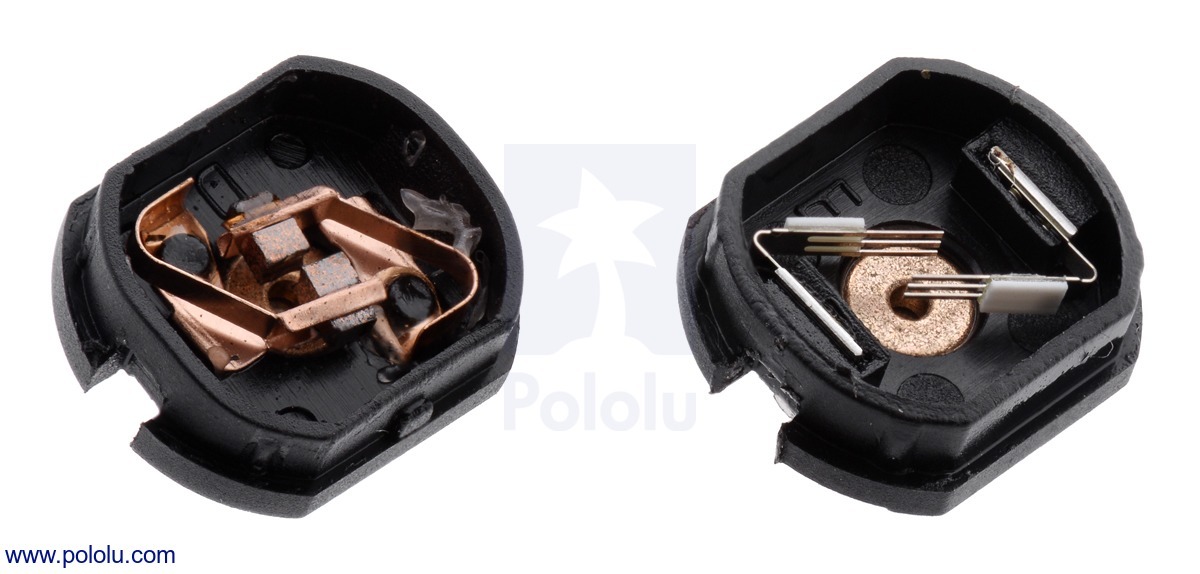
Pololu has the clearest picture of the different kind of brushes inside these small motors.
This brings me to another small note about these tiny motors. Most of them don’t have the carbon brushes one begins to expect from the more powerful motors. Mostly they have a strip of copper that’s been stamped to have a few fingers pressing against the commutator. There’s lots of pros to these metal contacts and it’s not all cost cutting, but unless you have managed to read “Electrical Contacts” by Ragnar Holm and actually understood it, they’re hard to explain. There’s all sorts of magic. For example, just forming the right kind of oxide film on the surface of the commutator is a battle all on its own.
It’s a weird trade off. You can make the motor cheaper with the metal contacts, for one. Metal contacts also have much lower friction than carbon or graphite brushes. They’re quieter, and they also transfer less current, which may seem like a bad thing, but if you have a stalled motor with hairlike strands transferring the pixies around the last thing you’d want to do is transfer as much current as possible through them. However, a paper thin sheet of copper is not going to last very long either.
So it comes down to this, at least as I understand it: if bursts of very fast, low energy, high efficiency motion is all that’s required of the motor over its operational life then the metal strip brushes are perfect. If you need to run the motor for a long stretches at a time and noise isn’t an issue then the carbon brush version will work, just don’t stall it. It will cost a little bit more.
Take Care of Your Tiny Motors
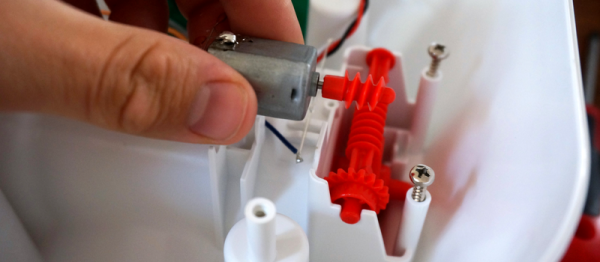
Here is one of these motors being restrained properly. Only torque on the case is restrained. The motor is otherwise free to move.
To touch one other small mechanical consideration. They are not designed to take any axial load at all, or really even any radial load either. Most of them have a plastic or aluminum bronze bushing, press-fit into a simple stamped steel body. So if you design a gearbox for one of these be sure to put as little force as possible on the bearing surfaces. If you’ve ever taken apart a small toy you’ve likely noticed that the motor can slide back and forth a bit in its mounting. This is why.
Lastly, because most of these motors are just not intended to run anywhere near their written maximum specifications it is best to assume that their specifications are a well intentioned but complete lie. Most designs work with the bottom 25% of the max number written on the spreadsheet. Running the motor anywhere near the top is usually guaranteed to brick it over time.
These are useful and ubiquitous motors, but unlike their more powerful cousins they have their own set of challenges to work with. However, considering you can buy them by the pound for cheaper than candy, there’s a good reason to get familiar with them.