Putting Crimpers To The Test: How Good Are Our Crimp Tools?

Almost every project of mine from the last quarter century, if it has contained any wiring, has featured somewhere at least one crimp connector. There are a multiplicity of different types of crimp, but in this case I am referring to the ubiquitous variety with a red, blue, or yellow coloured plastic sleeve denoting the wire size they are designed for. They provide a physically robust and electrically sound connection that is resistant to wire fatigue due to vibration, and that can carry hefty currents at high voltages without any problems.

You might expect this to now head off into the detail of crimp connection, but my colleague Dan has already detailed what makes a good or a bad crimp. Instead recently my constant searches for weird and wonderful things to review for your entertainment led me to a new crimp tool, and thence to a curiosity about the effectiveness of different styles of tool. So I’m going to evaluate the three different crimping methods available to me, namely my shiny new ratchet crimp pliers, my aged simple crimp pliers, and for comparison an ordinary pair of pliers. I’ll take a look at the physical strength of each crimping method followed by its electrical effectiveness, but first it’s worth looking at the tools themselves.

Continue reading “Putting Crimpers To The Test: How Good Are Our Crimp Tools?”

Lost In Space Gets 3D Printing Right

When it has become so common for movies and television to hyper-sensationalize engineering, and to just plain get things wrong, here’s a breath of fresh air. There’s a Sci-Fi show out right now that wove 3D printing into the story line in a way that is correct, unforced, and a fitting complement to that fictional world.

With the amount of original content Netflix is pumping out anymore, you may have missed the fact that they’ve recently released a reboot of the classic Lost in Space series from the 1960’s. Sorry LeBlanc fans, this new take on the space traveling Robinson family pretends the 1998 movie never happened, as have most people. It follows the family from their days on Earth until they get properly lost in space as the title would indicate, and is probably most notable for the exceptional art direction and special effects work that’s closer to Interstellar than the campy effects of yesteryear.

But fear not, Dear Reader. This is not a review of the show. To that end, I’ll come right out and say that Lost in Space is overall a rather mediocre show. It’s certainly gorgeous, but the story lines and dialog are like something out of a fan film. It’s overly drawn out, and in the end doesn’t progress the overarching story nearly as much as you’d expect. The robot is pretty sick, though.

No, this article is not about the show as a whole. It’s about one very specific element of the show that was so well done I’m still thinking about it a month later: its use of 3D printing. In Lost in Space, the 3D printer aboard the Jupiter 2 is almost a character itself. Nearly every member of the main cast has some kind of interaction with it, and it’s directly involved in several major plot developments during the season’s rather brisk ten episode run.

I’ve never seen a show or movie that not only featured 3D printing as such a major theme, but that also did it so well. It’s perhaps the most realistic portrayal of 3D printing to date, but it’s also a plausible depiction of what 3D printing could look like in the relatively near future. It’s not perfect by any means, but I’d be exceptionally interested to hear if anyone can point out anything better.

Continue reading “Lost In Space Gets 3D Printing Right”

This Is The Year Conference Badges Get Their Own Badges

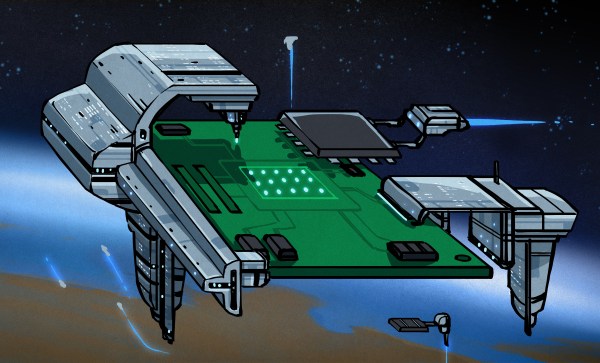
Over the last few years, the art and artistry of printed circuit boards has moved from business cards to the most desirable of all disposable electronics. I speak, of course, of badgelife. This is the community built on creating and distributing independent electronic conference badges at the various tech and security conferences around the globe.

Until now, badgelife has been a loose confederation of badgemakers and distributors outdoing themselves each year with ever more impressive boards, techniques, and always more blinky bling. The field is advancing so fast there is no comparison to what was being done in years past; where a simple PCB and blinking LED would have sufficed a decade ago, now we have customized microcontrollers direct from the factory, fancy new chips, and the greatest art you’ve ever seen.

Now we have reached a threshold. The badgelife community has gotten so big, the badges are getting their own badges. This is the year of the badge add-on. We’re all building tiny trinkets for our badges, and this time, they’ll all work together. We’re exactly one year away from a sweet Voltron robot made of badges.

Continue reading “This Is The Year Conference Badges Get Their Own Badges”

Make A Natural Language Phone Bot Like Google’s Duplex AI

After seeing how Google’s Duplex AI was able to book a table at a restaurant by fooling a human maître d’ into thinking it was human, I wondered if it might be possible for us mere hackers to pull off the same feat. What could you or I do without Google’s legions of ace AI programmers and racks of neural network training hardware? Let’s look at the ways we can make a natural language bot of our own. As you’ll see, it’s entirely doable.

Continue reading “Make A Natural Language Phone Bot Like Google’s Duplex AI”

Teardown: Box Of Pain (Gom Jabbar Sold Separately)

I immediately felt uncomfortable when I realized this thing is called the “Breo iPalm520 Acupressure Hand Massager”. You’re supposed to stick your hand into it, and through unknown machinations it performs some kind of pressure massage complete with heating action. It’s like one of those pain boxes from Dune. It’s all the more disturbing when you realize the red button on the thing is an emergency release. That’s right, once your hand is in this contraption you can’t take it out until the thing has had its way with you or you tap out.

Press to administer the Gom Jabbar

At least once a week I try to get to the local thrift store to look for interesting things. I’d like to be more specific than “interesting things”, but truth be told, I never really know what I’m looking for until I see it. Sure there’s the normal consumer electronics kind of stuff, but I’ve also found some very nice laboratory equipment, computer parts, software, technical books, etc. You just have to go regularly and keep an eye out for the occasional needle amongst the hay.

I want you to know, Dear Readers, that I did briefly summon the courage to put my hand into this thing and turn it on. Now I am not what one might call an overly brave man, and perhaps that might explain my personal experience. But when it started to hum and heat up, constricting around my hand to the point I couldn’t move my fingers, I screamed like a child and mashed the emergency button as if I was a pilot trying to eject from a mortally wounded aircraft. As far as Frank Herbert is concerned, I’m no human at all.

In an effort to better understand this torture device, lets open it up and see what lurks beneath that futuristic exterior.

Continue reading “Teardown: Box Of Pain (Gom Jabbar Sold Separately)”

Fatalities Vs False Positives: The Lessons From The Tesla And Uber Crashes

In one bad week in March, two people were indirectly killed by automated driving systems. A Tesla vehicle drove into a barrier, killing its driver, and an Uber vehicle hit and killed a pedestrian crossing the street. The National Transportation Safety Board’s preliminary reports on both accidents came out recently, and these bring us as close as we’re going to get to a definitive view of what actually happened. What can we learn from these two crashes?

There is one outstanding factor that makes these two crashes look different on the surface: Tesla’s algorithm misidentified a lane split and actively accelerated into the barrier, while the Uber system eventually correctly identified the cyclist crossing the street and probably had time to stop, but it was disabled. You might say that if the Tesla driver died from trusting the system too much, the Uber fatality arose from trusting the system too little.

But you’d be wrong. The forward-facing radar in the Tesla should have prevented the accident by seeing the barrier and slamming on the brakes, but the Tesla algorithm places more weight on the cameras than the radar. Why? For exactly the same reason that the Uber emergency-braking system was turned off: there are “too many” false positives and the result is that far too often the cars brake needlessly under normal driving circumstances.

The crux of the self-driving at the moment is precisely figuring out when to slam on the brakes and when not. Brake too often, and the passengers are annoyed or the car gets rear-ended. Brake too infrequently, and the consequences can be worse. Indeed, this is the central problem of autonomous vehicle safety, and neither Tesla nor Uber have it figured out yet.

Continue reading “Fatalities Vs False Positives: The Lessons From The Tesla And Uber Crashes”

Ask Hackaday: What Is The Future Of Implanted Electronics?

Biohacking is the new frontier. In just a few years, millions of people will have implanted RFID chips under the skin between their thumb and index finger. Already, thousands of people in Sweden have chipped themselves to make their daily lives easier. With a tiny electronic implant, Swedish rail passengers can pay their train ticket, and it goes without saying how convenient opening an RFID lock is without having to pull out your wallet.

That said, embedding RFID chips under the skin has been around for decades; my thirteen-year-old cat has had a chip since he was a kitten. Despite being around for a very, very long time, modern-day cyborgs are rare. The fact that only thousands of people are using chips on a train is a newsworthy event. There simply aren’t many people who would find the convenience of opening locks with a wave of a hand worth the effort of getting chipped.

Why hasn’t the most popular example of biohacking caught on? Why aren’t more people getting chipped? Is it because no one wants to be branded with the Mark of the Beast? Are the reasons for a dearth of biohacking more subtle? That’s what we’re here to find out, so we’re asking you: what is the future of implanted electronics?

Continue reading “Ask Hackaday: What Is The Future Of Implanted Electronics?”