Ecclesiastes 1:9 reads “What has been will be again, what has done will be done again; there is nothing new under the sun.” Or in other words, 5G is mostly marketing nonsense; like 4G, 3G, and 2G was before it. Let’s not forget LTE, 4G LTE, Advance 4G, and Edge.
Just a normal everyday antenna array in a Seattle parking garage.
Technically, 5G means that providers could, if they wanted to, install some EHF antennas; the same kind we’ve been using forever to do point to point microwave internet in cities. These frequencies are too lazy to pass through a wall, so we’d have to install these antennas in a grid at ground level. The promised result is that we’ll all get slightly lower latency tiered internet connections that won’t live up to the hype at all. From a customer perspective, about the only thing it will do is let us hit the 8Gb ceiling twice as faster on our “unlimited” plans before they throttle us. It might be nice on a laptop, but it would be a historically ridiculous assumption that Verizon is going to let us tether devices to their shiny new network without charging us a million Yen for the privilege.
So, what’s the deal? From a practical standpoint we’ve already maxed out what a phone needs. For example, here’s a dirty secret of the phone world: you can’t tell the difference between 1080p and 720p video on a tiny screen. I know of more than one company where the 1080p on their app really means 640 or 720 displayed on the device and 1080p is recorded on the cloud somewhere for download. Not a single user has noticed or complained. Oh, maybe if you’re looking hard you can feel that one picture is sharper than the other, but past that what are you doing? Likewise, what’s the point of 60fps 8k video on a phone? Or even a laptop for that matter?
Are we really going to max out a mobile webpage? Since our device’s ability to present information exceeds our ability to process it, is there a theoretical maximum to the size of an app? Even if we had Gbit internet to every phone in the world, from a user standpoint it would be a marginal improvement at best. Unless you’re a professional mobile game player (is that a thing yet?) latency is meaningless to you. The buffer buffs the experience until it shines.
So why should we care about billion dollar corporations racing to have the best network for sending low resolution advertising gifs to our disctracto cubes? Because 5G is for robots.
In the late nineteenth century, there was only one Earthly frontier left to discover: the North Pole. Many men had died or gone insane trying to reach 90°N, which, unlike the solidly continental South Pole, hides within a shifting polar sea.
One of history’s most driven Pole-seekers, Robert Peary, shocked the world when he announced that his wife Josephine would accompany him on his expedition to Greenland. The world responded, saying that she, a Washington socialite with no specialized training, had absolutely no business going there. But if it weren’t for Jo’s contributions, Robert would probably have never made it to the Pole, or even out of Greenland. Sewing and cooking skills may not seem like much, but they are vital for surviving in the Arctic climate. She also hunted, and managed the group’s Inuit employees.
Josephine Peary was more than just the woman behind the man. An Arctic explorer in her own right, she spent three winters and eight summers on the harsh and unforgiving frontier. Back at home, her Arctic accounts painted a picture of a frozen and far-off world that most could only wonder about. Jo’s writing career brought in expedition money for her husband, which sometimes turned into bailout money.
Josephine Cecilia Diebitsch was born May 22nd, 1863 to German immigrant parents who encouraged her to explore the world. Her father, Hermann, was a linguist at the Smithsonian Institute. Because of his position, the Diebitsch family rubbed elbows with much of high society. Though Jo was raised to be a Victorian lady and upheld those values, she had progressive ideas about what women could do with themselves in addition to being wives and mothers. Continue reading “Josephine Peary, First Lady Of The Arctic”→
It’s often said that engineers aren’t born, they’re made. Or more accurately, taught, tested, and accredited by universities. If you’re in high school, you’re probably starting to think about potential career paths and may be considering an engineering degree. A lot of work goes into a good college application, and it might seem like the hardest part is getting in. However, if your end goal is to get yourself a great engineering job at the end of your studies, it pays to have your head up from day 1!
I Just Need A Degree, Right?
Back in my freshman days, there was a saying that was popular on campus, particularly with those studying STEM topics. “Ps get degrees.” Your college’s grading system might use different letters, but the basic gist was that a pass mark was all that was required to get your piece of paper at the end of your four years. While this is technically true, it’s only really a useful ethos if your aim is to simply get a degree. If your goal is to use that degree to score yourself a plum job in your field, it would be unwise to follow this credo.
This attitude will net you plenty of wonderful memories at the bar, but it will dent your chances of landing a solid job upon graduation. All in moderation!
The reality of the modern job market is that it’s highly competitive. Recruiters can receive hundreds of applications for a single job, meaning the vast majority of applicants don’t even make it to the interview stage. To trim down the pile, various criteria are used to pick out the ideal candidates. An easy way to do this is to sort by grades. Having a low GPA can therefore see your application relegated to the trashcan, before you even get a chance to impress anyone with your carefully honed skills. Continue reading “The Young Engineers Guide To Career Planning”→
Your job might be tough, but spare a thought for any of the engineers involved in the Mars InSight lander mission when they learned that one of the flagship instruments aboard the lander, indeed the very instrument for which the entire mission was named, appeared to be a dud. That’s a bad day at work by anyone’s standards, and it happened over the summer when it was reported that the Mars Interior Exploration using Seismic Investigations, Geodesy and Heat Transport lander’s Heat Flow and Physical Properties Package (HP³), commonly known as “The Mole”, was not drilling itself into the Martian regolith as planned.
But now, after months of brainstorming and painstaking testing on Earth and on Mars, it looks as if the mole is working again. NASA has announced that, with a little help from the lander’s backhoe bucket, the HP³ penetrator has dug itself 2 cm into the soil. It’s a far cry from the 5-meter planned depth for its heat-transfer experiments, but it’s progress, and the clever hack that got the probe that far might just go on to salvage a huge chunk of the science planned for the $828 million program.
Everyone one of us is likely aware of what lead — as in the metal — is. Having a somewhat dull, metallic gray appearance, it occupies atomic number 82 in the periodic table and is among the most dense materials known to humankind. Lead’s low melting point and malleability even when at room temperature has made it a popular metal since humans first began to melt it out of ore in the Near East at around 7,000 BC in the Neolithic period.
Although lead’s toxicity to humans has been known since at least the 2nd century BC and was acknowledged as a public health hazard in the late 19th century, the use of lead skyrocketed in the first half of the 20th century. Lead saw use as a gasoline additive beginning in the 1920s, and the US didn’t abolish lead-based paint until 1978, nearly 70 years after France, Belgium and Austria banned it.
With the rise of consumer electronics, the use of lead-based solder became ever more a part of daily life during the second part of the 20th century, until an increase in regulations aimed at reducing lead in the environment. This came along with the World Health Organization’s fairly recent acknowledgment that there is truly no safe limit for lead in the human body.
In this article I’ll examine the question of why we are still using lead, and if we truly must, then how we can use this metal in the safest way possible.
However, this only tells part of the story. Carbon dioxide is not alone in its role as a greenhouse gas, with many others contributing significantly to global temperature rises. As humanity struggles to keep warming below 2 degrees C over the century, strategies will be needed to tackle the problem on all fronts.
There’s A Bad Smell Around Methane
Ruminant animals are a major source of greenhouse gas emissions, which is probably no surprise to some. Source: Peter van der Sluijs, CC-BA-SA-2.0
Methane is a remarkably potent greenhouse gas, having 28 times the warming potential of CO2 by weight over a 100-year period. Historically, it’s mostly been released from natural sources, like bacteria processing organic material in stagnant watercourses, or from thawing permafrost. However, scientists now consider around 60% of methane in the atmosphere to be a direct result of human activity.
Agriculture is a major contributor in this area. Ruminant animals raised for human consumption are major methane emitters, as the microbes in their digestive systems release the gas when breaking down plant material. With the demand for meat and dairy showing no signs of slowing down, this could prove difficult to tackle. There are a variety of other diffuse sources of the gas, too. Landfills and sewage plants have significant methane emissions of their own, and it’s also often released from oil and gas drilling operations, too.
Oil and gas operations release significant quantities of methane into the atmosphere, often due to leaks or plant malfunctions. Credit: Hugh Chevallier, CC:BA:SA-2.0
Levels of methane in the atmosphere have been low compared to carbon dioxide. Methane also tends to have a short life in the atmosphere, of around 9 years. These factors have meant that methane has historically been of lower concern to environmental organisations. However, after levels plateaued from the 1990s to the mid-2000s, they have once again begun to climb precipitously. Scientists have yet to identify the cause of this rise, and it has the potential to undo hard-fought gains in the fight against global warming on the CO2 front. Theories range from a reduced level of chemicals that break down methane in the atmosphere, to increased livestock production or the rise of the hydraulic fracturing industry.
Whatever the cause of the recent rise, stemming the increase will require significant work. The Environmental Defence Fund is launching MethaneSAT in an attempt to better locate and quantify releases to the atmosphere, aiming to stem easily-fixed leaks in fossil fuel operations. Other ideas include using antibiotics to reduce animal’s methane output, or to capture the emissions from landfills and use them as an energy source. It’s likely a rigorous approach to both monitoring and emissions reduction will be required to keep methane levels in check.
Nitrous Oxide
Nitrous oxide isn’t just the favorite gas of the Fast and the Furious. It’s also a potent greenhouse gas, with 300 times the warming potential of carbon dioxide, pound for pound. With plenty of staying power, it sticks around in the atmosphere for 114 years on average. With 40 percent of NOx emissions coming from human activity, it’s a significant player as far as greenhouse gases go.
Fertilizer use in agriculture is the major contributor to nitrous oxide releases into the atmosphere. As farms push for ever-greater yields, there has been a corresponding increase in the use of nitrogen-containing fertilizers. Other lesser sources include fossil fuel combustion and various chemical production processes.
Reducing nitrous oxide emissions to any major degree is a difficult problem. Reducing farm yields is impractical if we wish to continue feeding as many people as possible. Increasing the efficiency of fertiliizer application is instead a more viable way to go. By applying fertilizers in the right way, in the right quantities at the right time, has the benefit of both reducing nitrous oxide emissions as well as cutting costs for farming operations. Other gains in this space can be made by reducing fossil fuel use by switching to renewable energy production, or cleaner burning technologies. The famous catalytic converter, introduced to gasoline-powered vehicles in the 1970s, plays a major role in reducing these emissions, and urea injection does much the same for diesel engines, which we’ve talked about before.
Sulfur Hexa-what now?
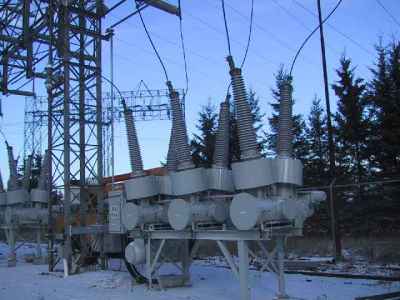
Sulfur hexafluoride is used heavily in high-voltage switchgear, as seen here in this hydroelectric installation. This circuit breaker is rated to run at 115 kV, 1200 A. Credit: Wtshymanski, public domain
Recently, sulfur hexafluoride has come under scrutiny. Also known by its chemical formula, SF6, it’s a highly potent greenhouse gas, with a warming potential of over 23,000 times that of CO2. Prized for its performance as a gaseous dielectric medium, it’s used heavily in high-voltage circuit breakers in modern electricity grids. It enables the construction of much more compact switchgear, while remaining safe and reliable in operation.
Concentrations of SF6 have begun to tick up in recent times, raising alarm bells. Speculation is that this is down to leaks of the gas from electrical equipment. As the world’s energy mix changes, grids have come to rely on more distributed generation, from sources like wind farms and solar. This mode of generation necessitates many more connections to the grid, which means more switchgear, and thus more SF6 out in the wild.
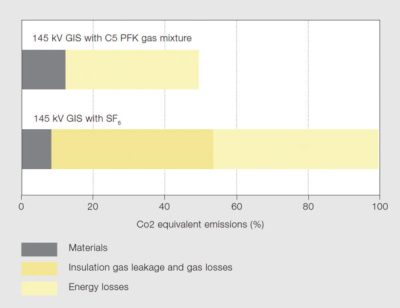
This graph shows the lifetime equivalent emissions of AirPlus versus SF6 technology. There are major gains to be had, thanks to the low global warming potential of AirPlus. Credit: 3M/ABB
Work is afoot to slow this trend before things get out of hand. A replacement has been developed in a collaboration between ABB and 3M, by the name of AirPlus. While the production process releases more CO2, over the lifecycle of an installation, AirPlus-based switchgear should have far lower impact on warming. This is due to the fact that when released into the atmosphere, AirPlus degrades under UV light exposure in just 15 days, versus 3200 years for SF6. Its global warming potential is less than 1, meaning it has less of a warming effect than even CO2, while delivering comparable dielectric performance to SF6. Variants are available for both medium and high voltage applications.
Over time, as goverments work to reduce the prevalance of SF6 in new installations, its likely that we’ll see AirPlus and other alternatives gain steam. The gas has already been banned in the EU for all non-electrical purposes, since 2014. Industry is typically slow to act unless there’s a strong business case, so government intervention is likely to be the game changer that pushes adoption of newer, cleaner technology in this space.
Other Fluorinated Gases
SF6 is just one of a series of fluorinated gases that have significant global warming potential. Many of these were introduced as replacements for chlorofluorocarbons (CFCs), which tend to eat a hole in the ozone layer. Thankfully, that problem was largely solved when production of CFCs was tailed off in 1996, but their replacements can still cause further troubles.
With lifetimes in the hundreds to thousands of years in the upper atmosphere, gases like hydrofluorocarbons and perfluorocarbons have an outsized effect on atmospheric warming, thousands of times that of CO2 on a per-molecule basis. They have applications as aerosol propellants, solvents, and fire retardants, but their primary use is as refrigerants in cooling systems. HFC-134a is the most well-known, used widely in air conditioning systems worldwide, and particularly in motor vehicles. This has led to its position as the most abundant HFC in the atmosphere.
Efforts are in place to limit the impact of these chemicals, through precautionary measures. This involves taking more care during the repair and disposal of HVAC systems, as well as designing systems to be more resilient of leaks in the first place. Recycling methods are also beneficial to ensure that where possible, these gases are captured rather then simply vented to the atmosphere. Enforcement on a broad scale remains a challenge.
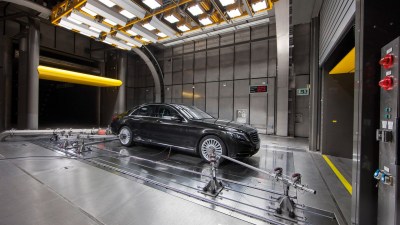
Automakers are already planning to switch air conditioning systems to use gases that have less global warming potential. Source: Mercedes Benz
Sometimes, it’s better to avoid the problem entirely. A transition away from using refrigerants like HFC-134a is in progress. The EPA has legislated that all light vehicles manufactured or sold in the USA by model year 2021 must no longer use HFC-134a. Instead, alternatives like HFO-1234yf, HFC-152a, and R-744 will be legal. The first two are mildly flammable, while the latter is simply another name for good old CO2. These refrigerants will require different technology to existing air conditioners. CO2-based systems in particular needing to operate at up to 10 times the pressure of traditional systems. However, progress in technology should allow these gases to take over, reducing the impact these refrigeration gases have on global warming.
The Fight Continues
CO2 is still the primary greenhouse gas, but it’s not the whole story. We’ve looked at a wide variety of chemicals, each with their own important roles and impact on the Earth’s atmosphere. This highlights the fact that there’s no single panacea to heading off global warming; instead, a broad spectrum approach across all aspects of human endeavour is required.
Halting the impacts of these chemicals is difficult, and will require decisive action by both government bodies, as well as cooperation from relevant industries. In some cases, there are additional gains to be had, while in others, the solution comes with high costs and painful changes. We engineered ourselves into this situation, so we can probably engineer ourselves out. Regardless, if humanity is to flourish in the next century, there remains much work to be done.
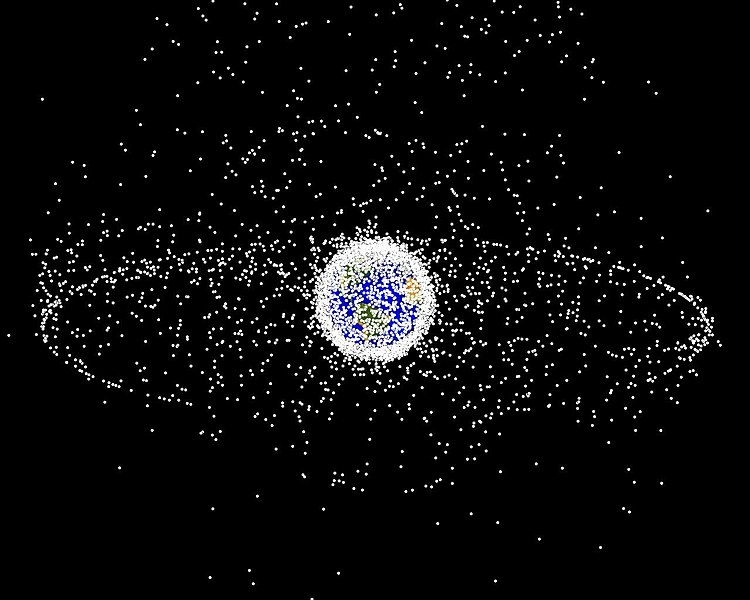
In the early days of spaceflight, when only the governments of the United States and the Soviet Union had the ability to put an object into orbit, even the most fanciful of futurists would have had a hard time believing that commercial entities would one day be launching sixty satellites at a time. What once seemed like an infinite expanse above our heads is now starting to look quite a bit smaller, and it’s only going to get more crowded as time goes on. SpaceX is gearing up to launch nearly 12,000 individual satellites for their Starlink network by the mid-2020s, and that’s just one of the “mega constellations” currently in the works.
Just some of the objects in orbit around the Earth
It might seem like overcrowding of Earth orbit is a concern for the distant future, but one needs only look at recent events to see the first hints of trouble. On September 2nd, the European Space Agency announced that one of its research spacecraft had to perform an evasive maneuver due to a higher than acceptable risk of colliding with one of the first-generation Starlink satellites. Just two weeks later, Bigelow Aerospace were informed by the United States Air Force that there was a 1 in 20 chance that a defunct Russian Cosmos 1300 satellite would strike their Genesis II space station prototype.
A collision between two satellites in orbit is almost certain to be catastrophic, ending with both spacecraft either completely destroyed or severely damaged. But in the worst case, the relative velocity between the vehicles can be so great that the impact generates thousands of individual fragments. The resulting cloud of shrapnel can circle the Earth for years or even decades, threatening to tear apart any spacecraft unlucky enough to pass by.
Fortunately avoiding these collisions shouldn’t be difficult, assuming everyone can get on the same page before it’s too late. The recently formed Space Safety Coalition (SSC) is made up of more than twenty aerospace companies that realize the importance of taking proactive steps to ensure humanity retains the unfettered access to outer space by establishing some common “Rules of the Road” for future spacecraft.