Try This For 3D Printing Without Support

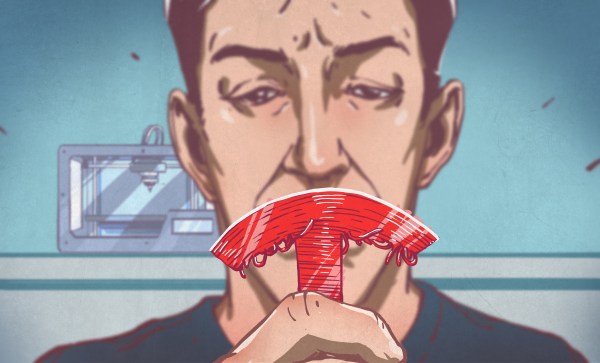
Have a look at the object to the right. Using a conventional fused deposition printer, how would you print the object? There’s no flat surface to lay on the bed without generating a lot of overhangs. That usually requires support.
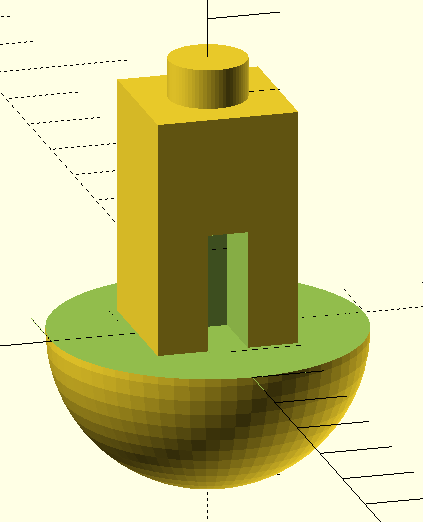
In theory, you might be able to print the bottom of the sphere down, but it is difficult to get that little spot to adhere to the bed. If you have at least two extruders and you are set up to print support material, that might even be the best option. However, printing support out of the same material you are printing with makes it hard to get a good clean print. There is another possibility. It does require some post-processing, but then again, not as much as hacking away a bunch of support material.

A Simple Idea

The idea is simple and — at first — it will sound like a lot of trouble. The basic idea is to cut the model in half at some point where both halves would be easy to print and then glue them together.  Stick around (no pun intended), though, because I’ll show you a way to make the alignment of the parts almost painless no matter how complex the object might be.

The practical problem with gluing together half models is getting the pieces in the exact position, but that turns out to be easy if you just make a few simple changes to your model. Another lesser problem is clamping a piece while gluing. You can use a vise, but some oddly-shaped parts are not conducive to traditional vise jaws.

In Practice

Starting with an OpenSCAD object, it is easy to cut the model in half. Actually, you could cut it anywhere. Then it is easy to rotate half of it so the cut line is at the bottom of each part. That doesn’t solve the alignment problem nor does it help you clamp when you glue.

The trick is to build a flange around each part. The flanges mate with a few screws after printing so alignment is perfect and bolts through the flange holes can keep the parts together and immobilized while your glue of choice sets. The kicker is that I even have an automated process to make the design side of this trick very easy.

Continue reading “Try This For 3D Printing Without Support”

Barbara McClintock: Against The Genetic Grain

The tale of much of Barbara McClintock’s life is that of the scientist working long hours with a microscope seeking to solve mysteries. The mystery she spent most of her career trying to solve was how all cells in an organism can contain the same DNA, and yet divide to produce cells serving different functions; basically how cells differentiate. And for that, she got a Nobel prize all to herself, which is no small feat either.

Becoming a Scientist

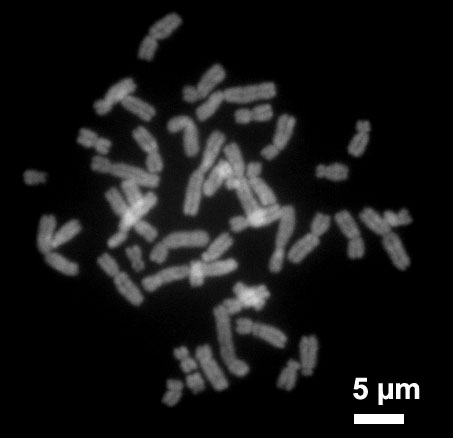
Human chromosomes, long strands of DNA
Human chromosomes, long strands of DNA by Steffen Dietzel CC BY-SA 3.0

McClintock was born on June 16, 1902, in Hartford, Connecticut, USA. From age three until beginning school, she lived with her aunt in Brooklyn, New York while her father strove financially to start up a medical practice. She was a solitary and independent-minded child, a trait she later called her “capacity to be alone”.

In 1919, she began her studies at Cornell’s College of Agriculture and took her first course in genetics in 1921. A year later, due to the interest she showed in genetics, she was invited to take the graduate genetics course at Cornell. It was here that she became interested in the new field of cytogenetics, specifically of maize or corn. Cytogenetics studies how the chromosomes relate to cell behavior, particularly during cell division. Chromosomes are the long strands of DNA within the nucleus of every cell and shown here in the photo at a time when they are condensed, or coiled up.

While still at Cornell she developed a number of methods for visualizing and characterizing maize which ended up in textbooks. She also became the first to describe the morphology of the ten maize chromosomes, basically their form and structural relationships, which then allowed her to discover more about the chromosomes. One of her colleagues observed that ten of the seventeen significant advances made in the field at Cornell between 1929 and 1935 were hers. This was only the first step in what would be the remarkable career of a very well respected scientist.

Continue reading “Barbara McClintock: Against The Genetic Grain”

Coin Cells: The Mythical Milliamp-Hour

Just how much metaphorical juice is in a coin cell battery? It turns out that this seemingly simple question is impossible to answer — at least without a lot of additional information. The problem is that the total usable energy in a battery depends on how you try to get that energy out, and that is especially true of coin cells.

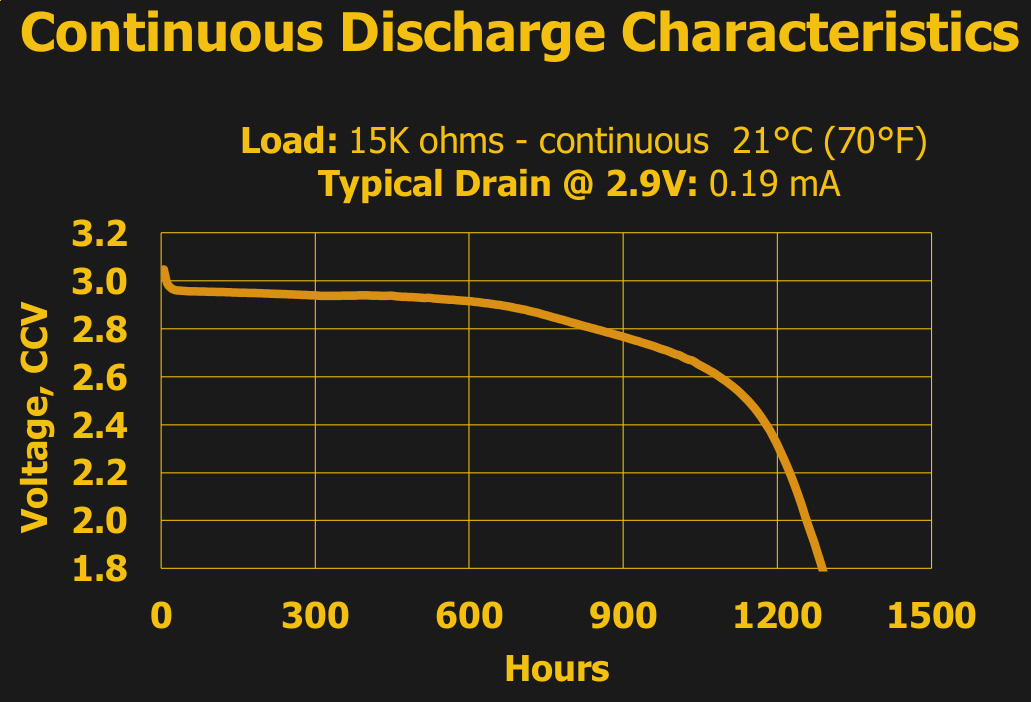
Energizer specs its 2032s at 0.2 mA

For instance, ask any manufacturer of the common 3 V lithium 2032 batteries, and they’ll tell you that it’s got 230 mAh. That figure is essentially constant across brands and across individual cells, and if you pull a constant 0.2 mA from the battery, at room temperature and pressure, you’ll get a bit more than the expected 1,150 hours before it dips below the arbitrary voltage threshold of 2.0 V. Just as it says on the tin.

What if you want to do anything else with a coin cell? Run an LED for a decade? Pull all the energy out right now and attempt to start a car? We had these sorts of extreme antics in mind when we created the Coin Cell Challenge, but even if you just want to do something mundane like run a low-power radio sensor node for more than a day, you’re going to need to learn something about the way coin cells behave in the real world. And to do that, you’re going to need to get beyond the milliamp hour rating. Let’s see how deep this rabbit hole goes.

Continue reading “Coin Cells: The Mythical Milliamp-Hour”

Ask Hackaday: Preserving Electronic Devices

Conventional wisdom holds that we no longer make things to last for the long haul, and that we live in a disposable world. It’s understandable — after all, most of us have a cell phone in our pocket that’s no more than a year or two old, and it’s often cheaper to buy a new printer than replace the ink cartridges. But most of that disposability is driven by market forces, like new software that makes a device obsolete long before it breaks down, or the razor and blades model that makes you pay through the nose for ink. It turns out that most electronic devices are actually pretty well engineered, and as long as they’re not abused can still be operating decades down the road.

But what happens when you want to put an electromechanical device away and preserve it for a rainy day? What can you do to make sure the device will operate again a few years down the road? Are there steps one can take beyond the typical “keep it in a cool, dry place” advice? In short, how do you preserve electronic devices?

Continue reading “Ask Hackaday: Preserving Electronic Devices”

Jerri Nielsen: Surviving The Last Place On Earth

There may be no place on Earth less visited by humans than the South Pole. Despite a permanent research base with buildings clustered about the pole and active scientific programs, comparatively few people have made the arduous journey there. From October to February, up to 200 people may be stationed at the Amundsen-Scott South Pole Station for the Antarctic summer, and tourists checking an item off their bucket lists come and go. But by March, when the sun dips below the horizon for the next six months, almost everyone has cleared out, except for a couple of dozen “winter-overs” who settle in to maintain the station, carry on research, and survive the worst weather Mother Nature brews up anywhere on the planet.

To be a winter-over means accepting the fact that whatever happens, once that last plane leaves, you’re on your own for eight months. Such isolation and self-reliance require special people, and Dr. Jerri Nielsen was one who took the challenge. But as she and the other winter-overs watched the last plane leave the Pole in 1998 and prepared for the ritual first-night screening of John Carpenter’s The Thing, she had no way of knowing what she would have to do to survive the cancer that was even then growing inside her.

Continue reading “Jerri Nielsen: Surviving The Last Place On Earth”

Thermistors And 3D Printing

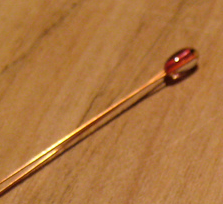
I always find it interesting that 3D printers — at least the kind most of us have — are mostly open-loop devices. You tell the head to move four millimeters in the X direction and you assume that the stepper motors will make it so. Because of the mechanics, you can calculate that four millimeters is so many steps and direct the motor to take them. If something prevents that amount of travel you get a failed print. But there is one part of the printer that is part of a closed loop. It is very tiny, very important, but you don’t hear a whole lot about it. The thermistor.

The hot end and the heated bed will both have a temperature sensor that the firmware uses to keep temperatures at least in the ballpark. Depending on the controller it might just do on-and-off “bang-bang” control or it might do something as sophisticated as PID control. But either way, you set the desired temperature and the controller uses feedback from the thermistor to try to keep it there.

If you print with high-temperature materials you might have a thermocouple in your hot end, but most machines use a thermistor. These are usually good to about 300 °C. What got me thinking about this was the installation of an E3D V6 clone hot end into my oldest printer which had a five-year-old hot end in it. I had accumulated a variety of clone parts and had no idea what kind of thermistor was in the heat block I was using.

Continue reading “Thermistors And 3D Printing”

Using Gmail With OAUTH2 In Linux And On An ESP8266

One of the tasks I dread is configuring a web server to send email correctly via Gmail. The simplest way of sending emails is SMTP, and there are a number of scripts out there that provide a simple method to send mail that way with a minimum of configuration. There’s even PHP mail(), although it’s less than reliable.

Out of the box, Gmail requires OAUTH2 for authentication and to share user data, which has the major advantage of not requiring that you store your username and password in the application that requires access to your account. While they have an ‘allow less secure apps’ option that allows SMTP access for legacy products like Microsoft Outlook, it just doesn’t seem like the right way forward. Google documents how to interact with their API with OAUTH2, so why not just use that instead of putting my username and password in plaintext in a bunch of prototypes and test scripts?

Those are the thoughts that run through my head every time this comes up for a project, and each time I’ve somehow forgotten the steps to do it, also forgotten to write it down, and end up wasting quite a bit of time due to my own foolishness. As penance, I’ve decided to document the process and share it with all of you, and then also make it work on an ESP8266 board running the Arduino development environment.

Continue reading “Using Gmail With OAUTH2 In Linux And On An ESP8266”