The name Gladys West is probably unfamiliar, but she was part of creating something you probably use often enough: GPS. You wouldn’t think a child who grew up on a sharecropping farm would wind up as an influential mathematician, but perhaps watching her father work very hard for very little and her mother working for a tobacco company made her realize that she wanted more for herself. Early on, she decided that education was the way out. She made it all the way to the Naval Surface Warfare Center.
While she was there she changed the world with — no kidding — mathematics. While she didn’t single-handedly invent satellite navigation, her work was critical to the systems we take for granted today.
In late June of 2021, GitHub launched a ‘technical preview’ of what they termed GitHub Copilot, described as an ‘AI pair programmer which helps you write better code’. Quite predictably, responses to this announcement varied from glee at the glorious arrival of our code-generating AI overlords, to dismay and predictions of doom and gloom as before long companies would be firing software developers en-masse.
As is usually the case with such controversial topics, neither of these extremes are even remotely close to the truth. In fact, the OpenAI Codex machine learning model which underlies GitHub’s Copilot is derived from OpenAI’s GPT-3 natural language model, and features many of the same stumbles and gaffes which GTP-3 has. So if Codex and with it Copilot isn’t everything it’s cracked up to be, what is the big deal, and why show it at all?
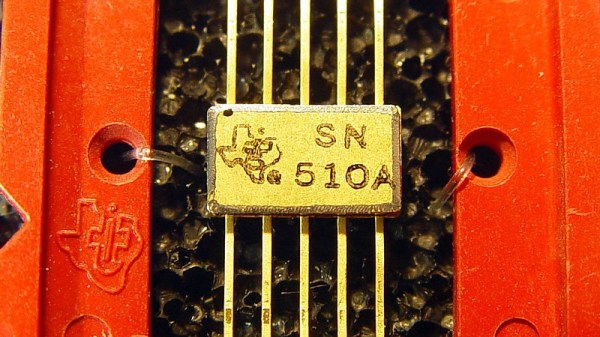
Over six decades of integrated circuit production we’ve become used to their extreme reliability and performance for a very reasonable price. But what about those first integrated circuits from the early 1960s? Commercial integrated circuits appeared in 1961, and recently Texas Instruments published a fascinating retrospective on the development of their first few digital ICs.
TI’s original IC product on the market was the SN502, a transistor flip-flop that debuted at $450 (about $4100 today), which caught the interest of NASA engineers who asked for logic functions with a higher performance level. The response was the development of the 51 series of logic chips, whose innovation included on-chip interconnects replacing the hand interconnects of the SN502. Their RCTL logic gave enough performance and reliability for NASA to use, and in late 1963 the Explorer 18 craft carried a telemetry system using the SN510 and SN514 chips into orbit. 52 and 53 series chips quickly followed, then in 1964 the 54 series TTL chips which along with their plastic-encapsulated 74 series equivalents are still available today.
Considering that in 1961 the bleeding edge of integrated circuit logic technology was a two-transistor chip with hand interconnects, it seems scarcely conceivable that by ten years later in 1971 the art had advanced to the point at which the first commercially available microprocessors would be produced. It’s unlikely that many of us will stumble upon any of the three-figure SN1-series logic chips, but to read about them is a fascinating reminder of this pivotal moment in the history of electronics.
The world of antique furniture and the world of hackers rarely coincide, and perhaps the allure of the latest tech is greater for most of us than that of a Chipendale cabinet. But there are times when there are analagous situations in both worlds, so it’s worth taking a moment to consider something.
This late-17th-century dressing box would not be of such value or interest were a restoration to strip it of its patina. Daderot, CC0.
Antique furniture has survived for hundreds of years before being owned by today’s collectors. Along the way it picks up bumps and scrapes, wear, and even the occasional repair. Valuable pieces turn up all the time, having been discovered in dusty attics, cowsheds, basements, and all sorts of places where they may have been misused in ways that might horrify those who later pay big money for them. Thus there is a whole industry of craft workers in the field of furniture restoration whose speciality lies in turning the wreck of a piece of furniture into a valuable antique for the showroom.
The parallel in our community if you hadn’t already guessed, can be found in the world of retrocomputers. They are the antiques we prize, they come to us after being abused by kids and then left to languish in a box of junk somewhere. Their capacitors are leaking, their cases may be cracked or dirty, and they often possess the signature look of old ABS mouldings, their characteristic yellowing. This is caused by the gradual release of small quantities of bromine as the fire retardant contained within the plastic degrades under UV light, and causes considerable consternation among some retrocomputing enthusiasts. Considerable effort goes into mitigating it, with the favourite technique involving so-called Retr0bright recipes that use hydrogen peroxide to bleach away the colour.
If you’re an automotive enthusiast of taste, you can’t stand the idea of fitting a janky aftermarket stereo into your nice, clean ride. Flashy, modern head units can spoil the look of a car’s interior, particularly if the car is a retro, classic, or vintage ride.
Thus, we’re going to look at how to modify your existing stock car stereo to accept an auxiliary cable input or even a Bluetooth module. This way, you can pump in the latest tunes from your smartphone without a fuss, while still maintaining an all-original look on the dash.
Fundamentals
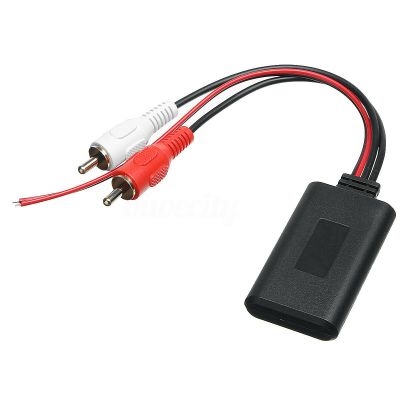
A simple Bluetooth module designed for wiring into car audio systems. There are two wires for 12 V power from the vehicle, and the audio signal is sent out over the RCA plugs. The RCA plugs can be cut off and the module hard wired inside your stereo if you have room. Cutting off the plastic case can help too.
Depending on your choice of audio player, you may prefer a 3.5 mm aux jack, or you might want to go with Bluetooth audio if your smartphone no longer has a headphone port. Whichever way you go, the process of modifying the stereo is largely the same. To achieve your goal, you need to find a way of injecting the audio signal into the head unit’s amplifier stage, while making sure no other audio sources are getting sent there as well.
Whether that audio source is a 3.5 mm jack or a Bluetooth module doesn’t matter. The only difference is, in the latter case, you’ll want to buy a Bluetooth module and hardwire it in to the auxiliary input you create, while also splicing the module into the stereo’s power supply. In the case of a simple headphone jack input, you simply need to wire up an aux cord or 3.5 mm jack somewhere you can get to it, and call it done.
This guide won’t cover every stereo under the sun, of course. Edge cases exist and depending on the minute specifics of how your original car radio works, these exact methods may or may not work for you. However, this guide is intended to get you thinking conceptually about how such mods are done, so that you can investigate the hardware in front of you and make your own decisions about how to integrate an external audio input that suits your usage case. Continue reading “How To Modify Your Car Stereo For Bluetooth Or Aux-In”→
Amidst the recent news about the Hubble Space Telescope’s troubles (and triumphant resurrection), it is sometimes easy to forget that although Hubble is a pretty unique telescope, it is just one of many space-based observatories that are currently zipping overhead right now or perched in a heliocentric orbit. So what is it that makes these observatories less known than the iconic Hubble telescope?
Hubble is one of the longest-lived space telescopes so far, and it is also the only space telescope that was both launched and serviced by the Space Shuttle. None of the other telescopes have this legacy, the high-profile, or troubled history of Hubble’s intended successor: the James Web Space Telescope (JWST).
Even so, the mission profiles of these myriad other observatories are no less interesting, least of the many firsts accomplished recently such as a long-term moon-based telescope (Chang’e 3’s LUT) and those of the many upcoming and proposed missions. Let’s take a look at the space observatories many of us have never heard of.
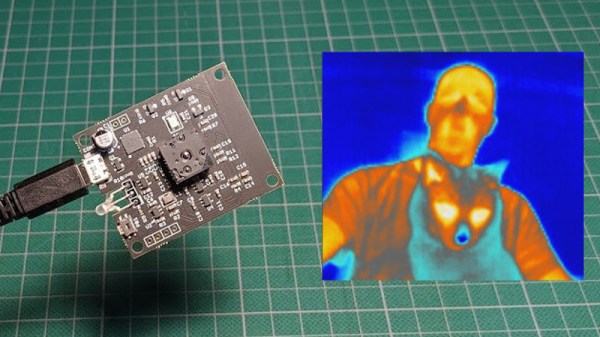
A thermal camera is a tool I have been wanting to add to my workbench for quite a while, so when I learned about the tCam-Mini, a wireless thermal camera by Dan Julio, I placed an order. A thermal imager is a camera whose images represent temperatures, making it easy to see things like hot and cold spots, or read the temperature of any point within the camera’s view. The main (and most expensive) component of the tCam-Mini is the Lepton 3.5 sensor, which sits in a socket in the middle of the board. The sensor is sold separately, but the campaign made it available as an add-on.
Want to see how evenly a 3D printer’s heat bed is warming up, or check whether a hot plate is actually reflowing PCBs at the optimal temperature? How about just seeing how weird your pets would look if you had heat vision instead of normal eyes? A thermal imager like the tCam-mini is the tool for that, but it’s important to understand exactly how the tCam-mini works. While it may look like a webcam, it does not work like one.