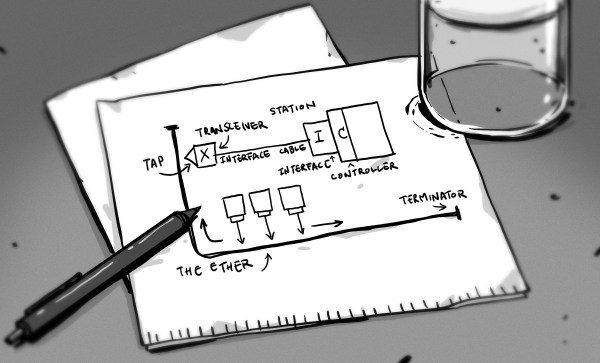
September 30th, 1980 is the day when Ethernet was first commercially introduced, making it exactly forty years ago this year. It was first defined in a patent filed by Xerox as a 10 Mb/s networking protocol in 1975, introduced to the market in 1980 and subsequently standardized in 1983 by the IEEE as IEEE 802.3. Over the next thirty-seven years, this standard would see numerous updates and revisions.
Included in the present Ethernet standard are not just the different speed grades from the original 10 Mbit/s to today’s maximum 400 Gb/s speeds, but also the countless changes to the core protocol to enable these ever higher data rates, not to mention new applications of Ethernet such as power delivery and backplane routing. The reliability and cost-effectiveness of Ethernet would result in the 1990 10BASE-T Ethernet standard (802.3i-1990) that gradually found itself implemented on desktop PCs.
In America, corn syrup is king, and real sugar hovers somewhere around prince status. We’re addicted to corn, and corn, in turn, is addicted to nitrogen. A long time ago, people figured out that by rotating crops, the soil will stay nutrient-rich, which helps to an extent by retaining nitrogen. Then we figured out how to make nitrogen fertilizer, and through its use we essentially doubled the average crop yield over the last hundred years or so.
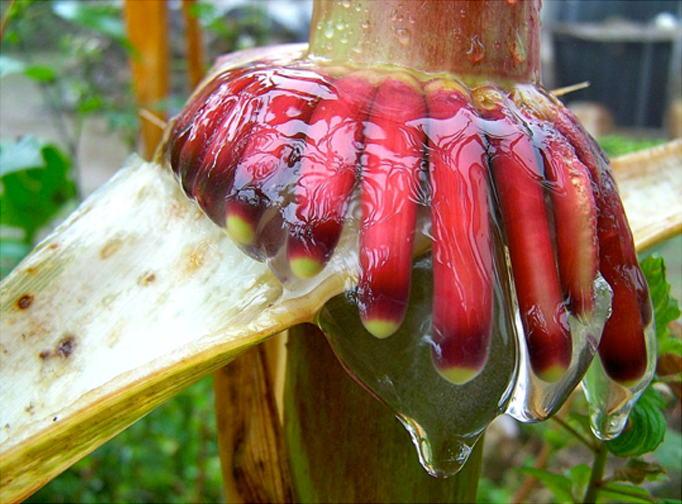
The aerial roots of the Sierra Mixe corn stalk help the plant produce its own nitrogen. Image via Wikimedia Commons
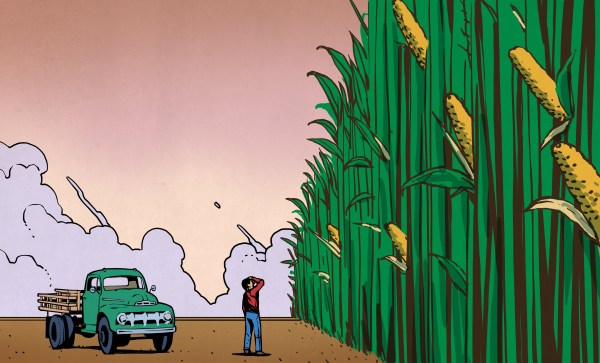
Not all plants need extra nitrogen. Legumes like beans and soybeans are able to make their own. But corn definitely needs nitrogen. In the 1980s, the now-chief of agriculture for Mars, Inc. Howard-Yana Shapiro went to Mexico, corn capital of the world, looking for new kinds of corn. He found one in southern Mexico, in the Mixes District of Oaxaca. Not only was this corn taller than American corn by several feet, it somehow grew to these dizzying heights in terrible soil.
So if we already have nitrogen fertilizer, why even look for plants that do it themselves? The Haber-Bosch fertilizer-making process, which is an artificial form of nitrogen fixation, does make barren soil less of a factor. But that extra nitrogen in ammonia-based fertilizer tends to run off into nearby streams and lakes, making its use an environmental hazard. And the process of creating ammonia for fertilizer involves fossil fuels, uses a lot of energy, and produces greenhouse gases to boot. All in all, it’s a horrible thing to do to the environment for the sake of agriculture. But with so many people to feed, what else is there to do?
Over the last decade, the UC Davis researchers use DNA sequencing to determine that the mucus on the Sierra Mixe variety of the plant provides microbes to the corn, which give it both sugars to eat and a layer of protection from oxygen. They believe that the plants get 30-80% of their nitrogen this way. The researchers also proved that the microbes do in fact belong to nitrogen-fixing families and are similar to those found in legumes. Most impressively, they were able to transplant Sierra Mixe corn to both Davis, California and Madison, Wisconsin, and have it grow successfully, proving that the nitrogen-fixing trick isn’t limited to the corn’s home turf. Now they are working to identify the genes that produce the aerial roots.
One Step in a Longer Journey of Progress
We probably won’t be switching over to Sierra Mixe corn anytime soon, however. It takes eight months to mature, which is much too slow for American appetites used to a three-month maturation period. If we can figure out how to make other plants do their own nitrogen fixation, who knows how far we could go? It seems likely that more people would accept a superpower grafted from a corn cousin instead of trying to use CRISPR to grant self-nitrogen fixation, as studies have shown a distrust of genetically modified foods.
The issue of intellectual property rights could be a problem, but the researchers started on the right foot with the Mexican government by putting legal agreements in place that ensure the Sierra Mixe community benefits from research and possible commercialization. We can’t wait to see what they’re able to do. If they’re unable to transplant the power of self-fixation to other plants, then perhaps there’s hope for improving the Haber-Bosch process.
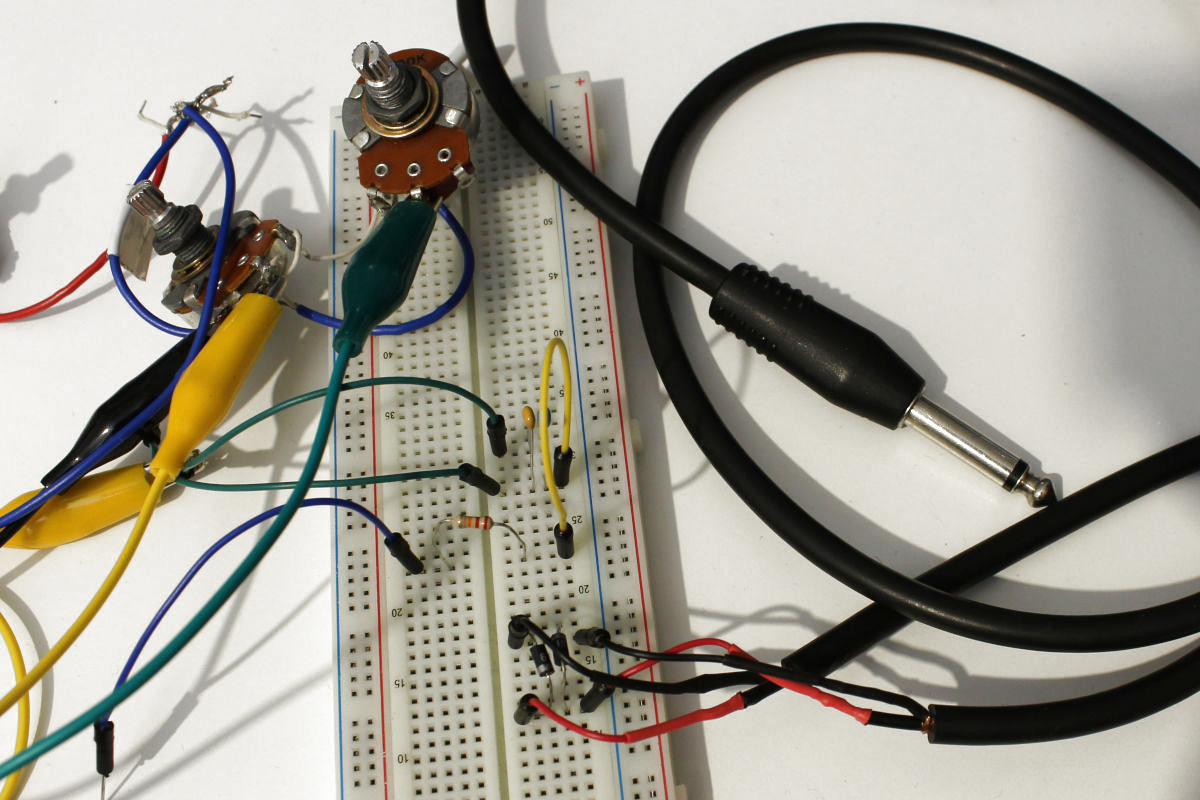
From a guitar hacking point of view, the two major parts that are interesting to us are the pickups and the volume/tone control circuit that lets you adjust the sound while playing. Today, I’ll get into the latter part and take a close look at the components involved — potentiometers, switches, and a few other passive components — and show how they function, what alternative options we have, and how we can re-purpose them altogether.
In that sense, it’s time to heat up the soldering iron, get out the screwdriver, and take off that pick guard / open up that back cover and continue our quest for new electric guitar sounds. And if the thought of that sounds uncomfortable, skip the soldering iron and grab some alligator clips and a breadboard. It may not be the ideal environment, but it’ll work.
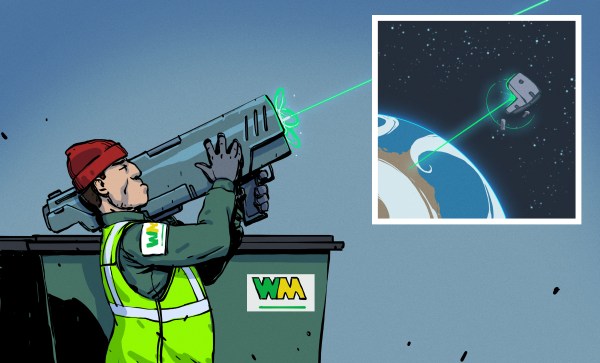
Space, as the name suggests, is mostly empty. However, since the first satellite launch in 1957, mankind began to populate the Earth orbit with all kinds of spacecraft. On the downside, space also became more and more cluttered with trash from defunct or broken up rocket stages and satellites. Moving at speeds of nearly 30,000 km/h, even the tiniest object can pierce a hole through your spacecraft. Therefore, space junk poses a real threat for both manned and unmanned spacecraft and that is why space agencies are increasing their efforts into tracking, avoiding, and getting rid of it. Continue reading “Getting Rid Of All The Space Junk In Earth’s Backyard”→
Decades ago, Einstein predicted the existence of something he didn’t believe in — black holes. Ever since then, people have been trying to get a glimpse of these collapsed stars that represent the limits of our understanding of physics.
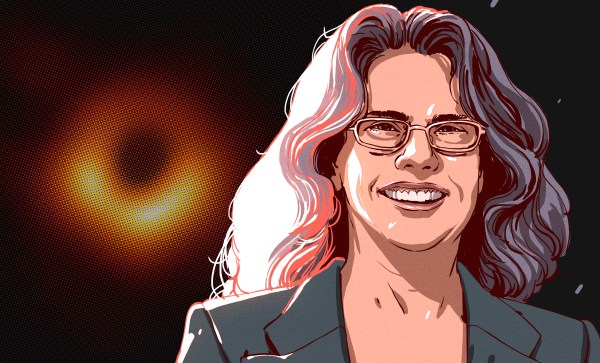
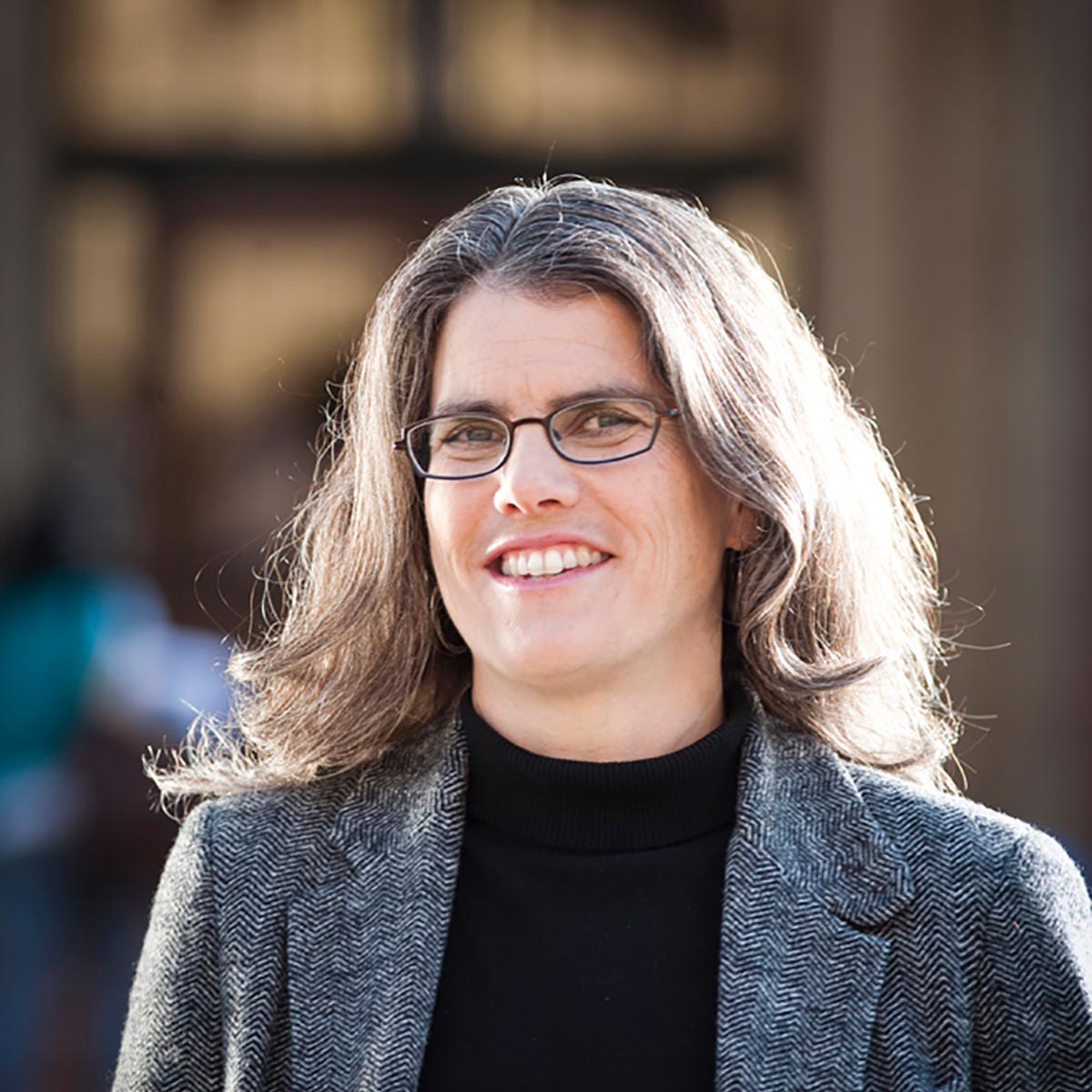
For the last 25 years, Andrea Ghez has had her sights set on the black hole at the center of our galaxy known as Sagittarius A*, trying to conclusively prove it exists. In the early days, her proposal was dismissed entirely. Then she started getting lauded for it. Andrea earned a MacArthur Fellowship in 2008. In 2012, she was the first woman to receive the Crafoord Prize from the Royal Swedish Academy of Sciences.
Now Andrea has become the fourth woman ever to receive a Nobel Prize in Physics for her discovery. She shares the prize with Roger Penrose and Reinhard Genzel for discoveries relating to black holes. UCLA posted her gracious reaction to becoming a Nobel Laureate.
A Star is Born
Andrea Mia Ghez was born June 16th, 1965 in New York City, but grew up in the Hyde Park area of Chicago. Her love of astronomy was launched right along with Apollo program. Once she saw the moon landing, she told her parents that she wanted to be the first female astronaut. They bought her a telescope, and she’s had her eye on the stars ever since. Now Andrea visits the Keck telescopes — the world’s largest — six times a year.
Andrea was always interested in math and science growing up, and could usually be found asking big questions about the universe. She earned a BS from MIT in 1987 and a PhD from Caltech in 1992. While she was still in graduate school, she made a major discovery concerning star formation — that most stars are born with companion star. After graduating from Caltech, Andrea became a professor of physics and astronomy at UCLA so she could get access to the Keck telescope in Mauna Kea, Hawaii.
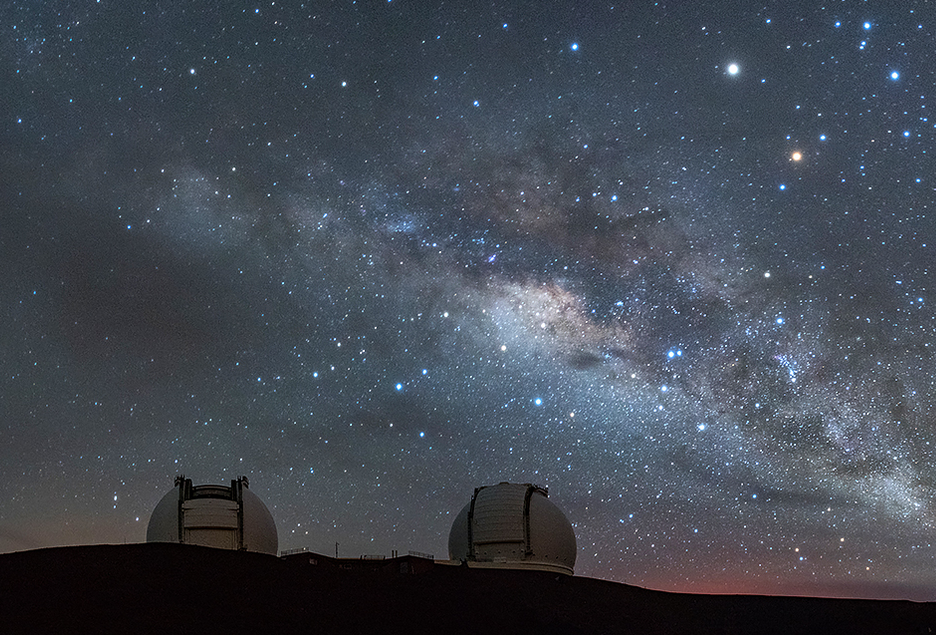
The Keck telescopes and the Milky Way. Image via Flickr
The Center of the Galaxy
Since 1995, Andrea has pointed the Keck telescopes toward the center of our galaxy, some 25,000 light years away. There’s a lot of gas and dust clouding the view, so she and her team had to get creative with something called adaptive optics. This method works by deforming the telescope’s mirror in real time in order to overcome fluctuations in the atmosphere.
Thanks to adaptive optics, Andrea and her team were able to capture images that were 10-30 times clearer than what was previously possible. By studying the orbits of stars that hang out near the center, she was able to determine that a supermassive black hole with four millions times the mass of the sun must lie there. Thanks to this telescope hack, Andrea and other scientists will be able to study the effects of black holes on gravity and galaxies right here at home. You can watch her explain her work briefly in the video after the break. Congratulations, Dr. Ghez, and here’s to another 25 years of fruitful research.
Currently, if you want to use the Autopilot or Self-Driving modes on a Tesla vehicle you need to keep your hands on the wheel at all times. That’s because, ultimately, the human driver is still the responsible party. Tesla is adamant about the fact that functions which allow the car to steer itself within a lane, avoid obstacles, and intelligently adjust its speed to match traffic all constitute a driver assistance system. If somebody figures out how to fool the wheel sensor and take a nap while their shiny new electric car is hurtling down the freeway, they want no part of it.
So it makes sense that the company’s official line regarding the driver-facing camera in the Model 3 and Model Y is that it’s there to record what the driver was doing in the seconds leading up to an impact. As explained in the release notes of the June 2020 firmware update, Tesla owners can opt-in to providing this data:
Help Tesla continue to develop safer vehicles by sharing camera data from your vehicle. This update will allow you to enable the built-in cabin camera above the rearview mirror. If enabled, Tesla will automatically capture images and a short video clip just prior to a collision or safety event to help engineers develop safety features and enhancements in the future.
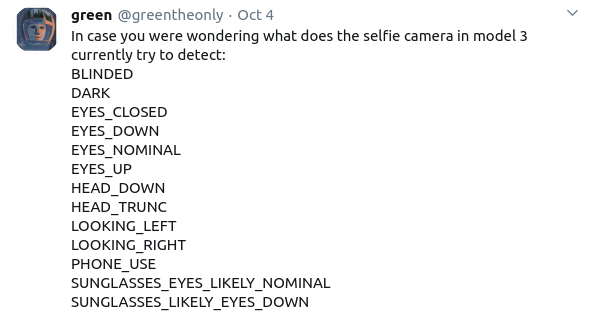
But [green], who’s spent the last several years poking and prodding at the Tesla’s firmware and self-driving capabilities, recently found some compelling hints that there’s more to the story. As part of the vehicle’s image recognition system, which usually is tasked with picking up other vehicles or pedestrians, they found several interesting classes that don’t seem necessary given the official explanation of what the cabin camera is doing.
If all Tesla wanted was a few seconds of video uploaded to their offices each time one of their vehicles got into an accident, they wouldn’t need to be running image recognition configured to detect distracted drivers against it in real-time. While you could make the argument that this data would be useful to them, there would still be no reason to do it in the vehicle when it could be analyzed as part of the crash investigation. It seems far more likely that Tesla is laying the groundwork for a system that could give the vehicle another way of determining if the driver is paying attention.
Walking is great exercise, but it’s good for the mind too: it gives one time to observe and to think. At least that’s what I do on my daily walks, and being me, what I usually observe and think about is the local infrastructure along my route. Recently, I was surprised to see a number of telephone company cabinets lying open next to the sidewalk. Usually when you see an open box, there’s a telephone tech right there, working on the system. But these were wide open and unattended, which I thought was unusual.
I, of course, took the opportunity to check out the contents of these pedestals in detail. Looking at the hundreds of pairs of brightly colored wire all neatly terminated and obviously installed and maintained at great expense, I was left wondering why someone would leave such a valuable asset exposed to the elements. With traditional POTS, or plain old telephone service, on the decline, the world may no longer have much use for the millions of miles of copper cable feeding back to telco central offices (COs) anymore. But there’s got to be something this once-vital infrastructure is still good for, leading me to ask: what’s to be done with the local loop?