SpaceX Offers NASA A Custom Moon Freighter

Under the current Administration, NASA has been tasked with returning American astronauts to the Moon as quickly as possible. The Artemis program would launch a crewed mission to our nearest celestial neighbor as soon as 2024, and establish a system for sustainable exploration and habitation by 2028. It’s an extremely aggressive timeline, to put it mildly.

To have any chance of meeting these goals, NASA will have to enlist the help of not only its international partners, but private industry. There simply isn’t enough time for the agency to design, build, and test all of the hardware that will eventually be required for any sort of sustained presence on or around the Moon. By awarding a series of contracts, NASA plans to offload some of the logistical components of the Artemis program to qualified companies and agencies.

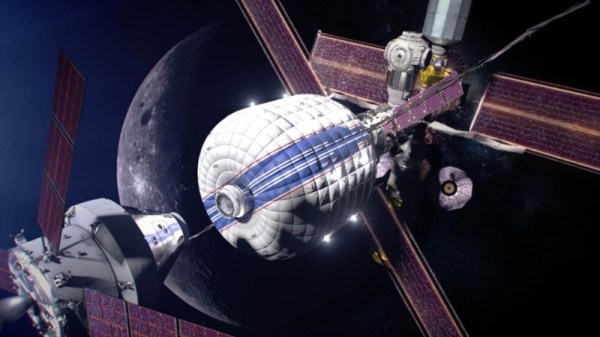
Artist’s Rendering of the Dragon XL

For anyone who’s been following the New Space race these last few years, it should come as no surprise to hear that SpaceX has already been awarded one of these lucrative logistics contracts. They’ve been selected as the first commercial provider for cargo deliveries to Gateway, a small space station that NASA intendeds to operate in lunar orbit. Considering SpaceX already has a contract to resupply the International Space Station, they were the ideal candidate to offer similar services for a future lunar outpost.

But that certainly doesn’t mean it will be easy. The so-called “Gateway Logistics Services” contract stipulates that providers must be able to deliver at least 3,400 kilograms (7,500 pounds) of pressurized cargo and 1,000 kilograms (2,200 pounds) of unpressurized cargo to lunar orbit. That’s beyond the capabilities of SpaceX’s Dragon spacecraft, which was only designed to service low Earth orbit.

To complete this new mission, the company is proposing a new vehicle they’re calling the Dragon XL that would ride to orbit on the Falcon Heavy booster. But even for this New Space darling, there’s not a lot of time to design, test, and build a brand-new spacecraft. To get the Dragon XL flying as quickly as possible, SpaceX is going to need to strip the craft down to the bare minimum.

Continue reading “SpaceX Offers NASA A Custom Moon Freighter”

The Smallest Large Display Is Projected Straight Onto Your Retina

For most of human history, the way to get custom shapes and colors onto one’s retinas was to draw it on a cave wall, or a piece of parchment, or on paper. Later on, we invented electronic displays and used them for everything from televisions to computers, even toying with displays that gave the illusion of a 3D shape existing in front of us. Yet what if one could just skip this surface and draw directly onto our retinas?

Admittedly, the thought of aiming lasers directly at the layer of cells at the back of our eyeballs — the delicate organs which allow us to see — likely does not give one the same response as you’d have when thinking of sitting in front of a 4K, 27″ gaming display to look at the same content. Yet effectively we’d have the same photons painting the same image on our retinas. And what if it could be an 8K display, cinema-sized. Or maybe have a HUD overlay instead, like in video games?

In many ways, this concept of virtual retinal displays as they are called is almost too much like science-fiction, and yet it’s been the subject of decades of research, with increasingly more sophisticated technologies making it closer to an every day reality. Will we be ditching our displays and TVs for this technology any time soon?

Continue reading “The Smallest Large Display Is Projected Straight Onto Your Retina”

Pluto Might Not Be A Planet, But It Is An SDR Transceiver

Many of the SDR projects we see use a cheap USB dongle. They are great, but sometimes you want more and — especially — sometimes you want to transmit. The Analog Devices ADALM-Pluto SDR is easily available for $200 and sometimes as low as $100 and it both transmits and receives using an Analog AD9363 and a Zynq FPGA. Although you normally use the device to pipe IQ signals to a host computer, you can run SDR applications on the device itself. That requires you to dig into the Zynq tools, which is fun but a topic for another time. In this post, I’m going to show you how you can use GNU Radio to make a simple Morse code beacon in the 2m ham band.

I’ve had one on my bench for quite a while and I’ve played with it a bit. There are several ways to use it with GNU Radio and it seems to work very well. You have to hack it to get the frequency range down a bit. Sure, it might not be “to spec” once you broaden the frequency range, but it seems to work fine. Instead of working from 325 MHz to 3,800 MHz with a 20 MHz bandwidth, the hacked device transceives 70 MHz to 6,000 MHz with 56 MHz bandwidth. It is a simple hack you only have to do once. It tells the device that it has a slightly better chip onboard and our guess is the chips are the same but sorted by performance. So while the specs might be a little off, you probably won’t notice.

Continue reading “Pluto Might Not Be A Planet, But It Is An SDR Transceiver”

So What Is Protein Folding, Anyway?

The current COVID-19 pandemic is rife with problems that hackers have attacked with gusto. From 3D printed face shields and homebrew face masks to replacements for full-fledged mechanical ventilators, the outpouring of ideas has been inspirational and heartwarming. At the same time there have been many efforts in a different area: research aimed at fighting the virus itself.

Getting to the root of the problem seems to have the most potential for ending this pandemic and getting ahead of future ones, and that’s the “know your enemy” problem that the distributed computing effort known as Folding@Home aims to address. Millions of people have signed up to donate cycles from spare PCs and GPUs, and in the process have created the largest supercomputer in history.

But what exactly are all these exaFLOPS being used for? Why is protein folding something to direct so much computational might toward? What’s the biochemistry behind this, and why do proteins need to fold in the first place? Here’s a brief look at protein folding: what it is, how it happens, and why it’s important.

Continue reading “So What Is Protein Folding, Anyway?”

Will 2020 (Finally) Be The Year Of Electronic Paper?

These days paper is being phased out whenever possible, and while we’re still far from being a completely digital society, the last decade or two has seen a huge reduction in the amount of paper the average person deals with on a daily basis. At the very least, we seem a lot closer to a future without the printed page than we are flying cars or any of the other concepts we generally associate with the far-flung future.

That said, there’s still something undeniably appealing about reading on paper. The idea of squirting ink on a piece of thin wood might seem increasingly archaic to us, but it sure does look nice when you hold it in your hand. Which is exactly why so much effort has been put into recreating the look of printed paper in electronic form; we all love the experience of paper, but the traditional execution doesn’t align itself particularly well with modern sensibilities.

Of course electronic “eReaders”, most notably the Kindle line from Amazon, have gone a long way towards making this a reality. At least for reading books, anyway. But what about magazines, newspapers, or even the lowly notebook we keep by the bench to jot down measurements or ideas? A PDF datasheet, with graphics where the grey tones matter? Being able to carry a whole bookshelf worth of novels in your bag is incredible, but despite what science fiction has promised us since 2001: A Space Odyssey, we’re still consuming plenty of media off of dead trees.

But that might be changing soon. This year will see the release of two tablets that promise to deliver an experience much closer to reading and writing on traditional paper than anything we’ve seen previously. They certainly aren’t cheap, and it’s too early to tell how much is just hype, but these devices could end up being an important step towards the paperless future we’ve been dreaming of.

Continue reading “Will 2020 (Finally) Be The Year Of Electronic Paper?”

COVID-19 And The State Of The Climate

The novel coronavirus sweeping the globe has led governments to institute widespread quarantines to stem the spread. Many industries have slowed production or shutdown entirely, and economic activity has slowed to a crawl. This has naturally led to a sudden reduction in greenhouse gas emissions. But how great will the effect be, and will it buy us any real time?

On The Ground

Nitrogen dioxide levels in China have dropped sharply with the reduction in industrial activity due to COVID-19. Image source: NASA

In the wake of COVID-19, good news stories have sprung up as people look for a silver lining. Unfortunately, these stories aren’t always true. There aren’t dolphins in the waters of Venice, though the water has cleared due to reduced boat activity. And drunken elephants did not begin roaming the mountains of China.

Despite this, there have been notable reductions in emissions in several areas due to government-mandated lockdowns. Northern Italy is seeing a much lower concentration of nitrogen dioxide, likely due to reduced industrial and vehicular activity. Carbon monoxide levels have similarly dropped in New York, while China has seen its carbon emissions temporarily drop by a full 25%.

On the surface of it, these are all promising numbers. Many are cautiously optimistic that this could be a major development to help stave off the worst of climate change for a little longer. Nonetheless, it’s early days yet, and what happens after the crisis passes is just as important as what’s happening now.

Continue reading “COVID-19 And The State Of The Climate”

No Windshield? No Problem, Says McLaren

All the best sports cars look like they’re moving when they’re just sitting there, and the lines on McLaren’s newest limited-edition plaything redefine that look of speed standing still. Maybe it’s the sneering headlights or the streamlined, reverse-1966 Batmobile styling. Whatever it is, the 804-horsepower two-seater project Elva looks like it’s leaping off the line into the future.

But this future is free from the last thing we’d expect to see removed from any vehicle, especially a $1.7 million supercar — the windshield. Now that the headphone jack has been deemed expendable, it seems that nothing is sacred. The Elva is already a permanent convertible with no windows.

Though McLaren didn’t start this weird and windowless fire, the Elva is meant to fan the flames of futurism. She joins the ranks of a few windshield-free models from Ferrari, Mercedes-Benz, and Aston Martin. In the other guy’s cars, you’ll need a helmet above 30MPH unless you love the thunderous sounds of air buffeting and blown-out hair. It’s a young idea with a few bugs to work out.

Continue reading “No Windshield? No Problem, Says McLaren”