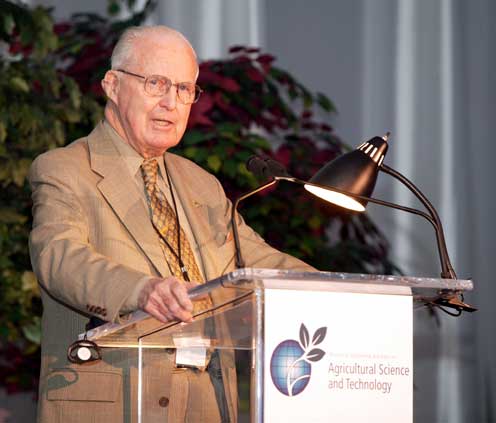
Everyone loves a hero. Save someone from a burning building, and you’ll get your fifteen minutes of fame. That’s why I’m always surprised that more people don’t know Norman Borlaug, who would have celebrated his 104th birthday on Sunday. He won the Nobel prize in 1970 and there’s good reason to think that his hacking efforts saved about a billion people from starving to death. A billion people. That’s not just a hero, that’s a superhero.
To understand why that claim is made, you have to go back to the 1970s. The population was growing and was approaching an unprecedented four billion people. Common wisdom was that the Earth couldn’t sustain that many people. Concerns about pollution were rampant and there were many influential thinkers who felt that we would not be able to grow enough food to feed everyone.
Paul Ehrlich, in particular, was a Stanford University biologist who wrote a book “The Population Bomb.” His forecast of hundreds of millions starving to death in the 1970s and 1980s, including 65 million Americans, were taken very seriously. He also predicted doom for India and that England would not exist by the year 2000.
Here we are 40 or 50 years later and while there are hungry people all over the world, there isn’t a global famine of the proportions many people thought was imminent. What happened? People are pretty good problem solvers and Norman Borlaug — along with others — created what’s known as the Green Revolution.
Building a robot that can do anything well is a tough challenge. Building one that can stand up to another robot trying to violently put it out of commission is an even harder task. But it makes for some entertaining television! It is this combination that thrust a few creative robot building teams into the world of Robot Wars.
SMIDSY in the pits for series 5 of the UK Robot Wars TV show. From left to right: [Andy Pugh], [Robin Bennett], and [Mik Reed]. RIP [Mik].SMIDSY, short for the insubstantial excuse heard by many a motorcyclist “Sorry Mate, I Didn’t See You”, is a robot that competed in several seasons of the British incarnation of the Robot Wars TV show. It wasn’t the most successful of machines because its weapons were slightly weedy compared to some of the competition, but it was one of the more robust and reliable platforms on the circuit at the time thanks to its combination of simple uncomplicated construction and extremely good design. I had the pleasure of being on the team that built and competed with SMIDSY and carry from it some of the more found memories from that decade.
A few weeks ago I learned that a friend from that period in my life had died following an illness. I hadn’t seen [Mik] for a few years as our lives had drifted apart, but if we were to turn back the clock nearly a couple of decades you would find us and about twenty other fellow members of the Ixion British motorcyclist’s mailing list hard at work building a Robot Wars robot.
The hard work and determination make this a great story. But even more so it’s fun to look back on the state of the art of the time and see some clever workarounds in a time when robot building was just starting to be approachable by the average engineer.
Zip ties, Ty-Raps, cable ties; call them what you will, but it’s hard to imagine doing without these ubiquitous and useful devices. Along with duct tape and hot glue, they’re part of the triumvirate of fasteners used to solve nasty problems quickly and cheaply. They’re next up on the list of mechanisms we find fascinating, and as it turns out, there’s more to these devices than meets the eye.
Lightning storm detectors have been around for a surprisingly long time. The early designs consisted of a pair of metal bells and a pendulum. When there was a charge applied, for example by connecting one bell to the ground and the other to a lightning rod, the bells would ring when a lightning storm was close by. In the mid 18th century, these devices were only practical for demonstration and research purposes, but very likely represent the earliest devices that convert electrostatic charge to mechanical force. A bit over a hundred years later, the first lightning detector was considered by some as the first radio receiver as well.
As soon as I found out about storm detector chips, I knew I would have to get one working. For about $25, I ordered an AMS AS3935 module from China. This chip has been featured before in a number of excellent projects such as Twittering lightning detectors, and networks of Sub-Saharan weather stations. While there’s an Arduino library for interfacing with this IC, I’m going to be connecting it up to an ESP8266 running the NodeMCU firware, which means digging into the datasheet and writing some SPI code. If any of the above tickles your fancy, read on! Continue reading “An Introduction To Storm Detector Modules”→
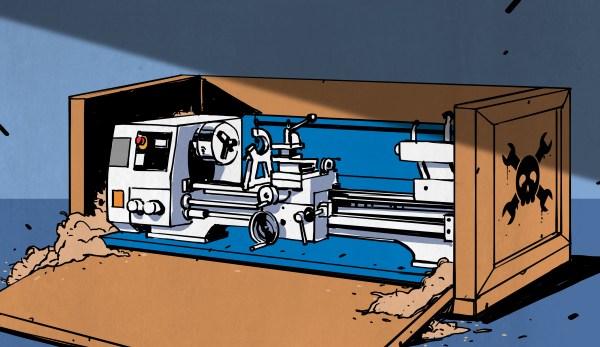
The last time we discussed machine tools, we talked about how to choose the size of the new metalworking lathe that your wallet is itching to pour itself into. The next big decision to make is “new or used?” If you’re in North America, this question has a lot of overlap with the classic question “Import or American?”. The answer boils down to what your needs are, and what you want to get out of this machine.
If you are new to machining, and want to learn the skills, I recommend starting with an Asian import machine. If you’re careful which one you select, you’ll end up with a very reasonably priced lathe that can do precise work right out of the crate. If your interest is in learning how these tools work, and in doing a restoration project, an old American machine is a great choice. Let’s look at these two routes in more detail.
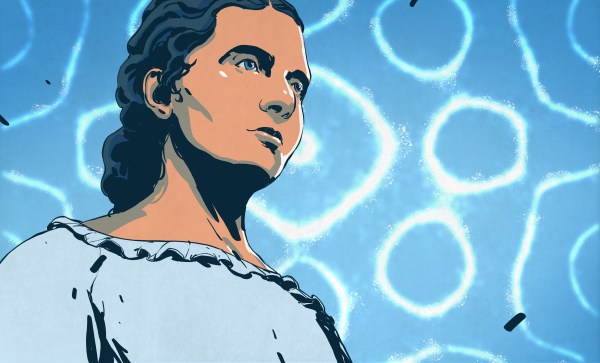
When a 13-year old Marie-Sophie Germain was stuck in the house because of the chaotic revolution on the streets of Paris in 1789, she found a refuge for her active mind: her father’s mathematics books. These inspired her to embark on pioneering a new branch of mathematics that focussed on modeling the real world: applied mathematics.
Post-revolutionary France was not an easy place for a woman to study mathematics, though. She taught herself higher maths from her father’s books, eventually persuading her parents to support her unusual career choice and getting her a tutor. After she had learned all she could, she looked at studying at the new École Polytechnique. Founded after the revolution as a military and engineering school to focus on practical science, this school did not admit women.
Anyone could ask for copies of the lecture notes, however, and students submitted their observations in writing. Germain got the notes and submitted her coursework under the pseudonym Monsieur Antoine-August Le Blanc. One of the lecturers that she impressed was Joseph Louis Lagrange, the mathematician famous for defining the mathematics of orbital motion that explained why the moon kept the same face to the earth. Lagrange arranged to meet this promising student and was surprised when Germain turned out to be a woman.
Gauss and Germain
‘Le Blanc’ also corresponded with German mathematician Carl Friedrich Gauss on number theory. When Napoleon’s armies occupied the town the famous mathematician lived in, Germain enlisted a family friend in the army to check that Gauss had not been harmed. Gauss didn’t realize who had helped him out, until he discovered that ‘Le Blanc’ was Sophie Germain, he wrote to her thanking her for her concern and praising her mathematical prowess given the hurdles set before her.
“How sweet is the acquisition of a friendship so flattering and precious to my heart. The lively interest you took during this terrible war deserves the most sincere recognition….But when a person of this sex, who, for our mores and prejudices, must recognize infinitely more obstacles and difficulties than men to become acquainted with these thorny searches, knows how to get rid of these obstacles and to penetrate what they have, most hidden, must undoubtedly, she has the most noble courage, talents quite extraordinary, genius superior.”
As well as working on the thorny and theoretical problems of number theory, Germain worked on applying mathematics to real world problems. One of these was a challenge set by the Paris Academy of Science to mathematically describe the elasticity of metal plates. An experimenter called Ernest Chladni had demonstrated that a metal plate would resonate in odd ways when vibrated at certain frequencies. If you put sand on the plate, it would collect in different patterns created by the resonance of the plate, called Chladni figures. To win the prize, the solution had to predict these figures.
The Mathematics of Stress and Strain
Mathematically predicting the behavior of metal plates could make it easier to design metal objects and predict how they would behave under stress. The prize was set in 1808 but was so difficult that Germain was the only one who decided to try to solve it, as it required coming up with a whole new way to analyze and describe how materials bend and change under stress.
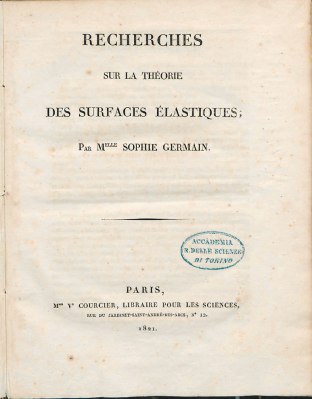
The first two solutions that she submitted were rejected due to mathematical errors, but the third version won her the prize in 1816. However, due to the Academy policy of not allowing women to join (and to only attend events if they were wives of members), Germain was not able to attend the ceremony where the prize was granted. She was also not allowed to attend meetings of the Academy. After the Academy failed to publish her prize-winning work, Germain had to pay to publish the work herself in 1821.
Later, her friend Joseph Fourier allowed her to attend meetings and presentations, but the mathematical establishment never really accepted her, or her work. In a letter to a colleague in 1826 she complained about the way they rebuffed her:
“These facts are my domain and it is to me alone that they remain hidden. That’s the privilege of the ladies: they get compliments and no real benefits.”
In the same letter, Germain complained of suffering fatigue and she was diagnosed with breast cancer shortly afterwards. She died in 1831. Her final years were spent working on a solution to Fermat’s Last Theorem, and just before her death she published a partial solution that was the basis for much research into the theorem, which was finally solved only with computer help in the late 1990s.
Although Sophie Germain never earned a degree in her lifetime, she was given an honorary degree in 1837 from the University of Göttingen at the suggestion of Gauss, who noted that
“she proved to the world that even a woman can accomplish something worthwhile in the most rigorous and abstract of the sciences and for that reason would well have deserved an honorary degree.”
The Academy that snubbed her also now offers an annual prize for mathematics in her name. Perhaps more importantly, her work formed the basis of the study of elasticity and stress in metals that allowed engineers to build larger objects and buildings. Creations such as the Eiffel tower in 1887 were directly influenced by her work, and it laid some of the groundwork for Einstein’s theory of General Relativity.
Modern scholars argue that Germain could have been more than she was: her work, they argue, was hamstrung by a limited understanding of some of the fundamental concepts that Gauss and others had described. Although her work was fundamental and important, if she had been given free access to the education that she wanted and deserved, it’s easy to imagine that she would have gone farther.
You have doubtlessly heard the news. A robotic Uber car in Arizona struck and killed [Elaine Herzberg] as she crossed the street. Details are sketchy, but preliminary reports indicate that the accident was unavoidable as the woman crossed the street suddenly from the shadows at night.
If and when more technical details emerge, we’ll cover them. But you can bet this is going to spark a lot of conversation about autonomous vehicles. Given that Hackaday readers are at the top of the technical ladder, it is likely that your thoughts on the matter will influence your friends, coworkers, and even your politicians. So what do you think?


 To understand why that claim is made, you have to go back to the 1970s. The population was growing and was approaching an unprecedented four billion people. Common wisdom was that the Earth couldn’t sustain that many people. Concerns about pollution were rampant and there were many influential thinkers who felt that we would not be able to grow enough food to feed everyone.
![SMIDSY in the pits for series 5 of the UK Robot Wars TV show. From left to right: [Andy Pugh], [Robin Bennett], and [Mik Reed]. RIP [Mik].](https://hackaday.com/wp-content/uploads/2018/03/smidsy-teamrw5-hires.jpg)


 The first two solutions that she submitted were rejected due to mathematical errors, but the third version won her the prize in 1816. However, due to the Academy policy of not allowing women to join (and to only attend events if they were wives of members), Germain was not able to attend the ceremony where the prize was granted. She was also not allowed to attend meetings of the Academy. After the Academy failed to publish her prize-winning work,