Calculus In 20 Minutes

If you went to engineering school, you probably remember going to a lot of calculus classes. You may or may not remember a lot of calculus. If you didn’t go to engineering school, you will find that there’s an upper limit to how much electronics theory you can learn before you have to learn calculus. Now imagine Khan Academy, run by an auctioneer and done without computers. Well, you don’t have to imagine it. Thinkwell has two videos that purport to teach you calculus in twenty minutes (YouTube, embedded below).

We are going to be honest. If you need a refresher, these videos might be useful. If you have no idea how to do calculus, maybe these are going to whiz by a little fast. However, either way, the videos have some humor value both from the FedEx commercial-style delivery to the non-computerized graphics (not to mention the glass-breaking sound effects). Of course, the video is about ten years old, but that’s part of its charm.

Continue reading “Calculus In 20 Minutes” →

There Is No Parity: Chien-Shiung Wu

Hold out your hands in front of you, palms forward. They look quite similar, but I’m sure you’re all too aware that they’re actually mirror images of each other. Your hands are chiral objects, which means they’re asymmetric but not superimposable. This property is quite interesting when studying the physical properties of matter. A chiral molecule can have completely different properties from its mirrored counterpart. In physics, producing the mirror image of something is known as parity. And in 1927, a hypothetical law known as the conservation of parity was formulated. It stated that no matter the experiment or physical interaction between objects – parity must be conserved. In other words, the results of an experiment would remain the same if you tired it again with the experiment arranged in its mirror image. There can be no distinction between left/right or clockwise/counter-clockwise in terms of any physical interaction.

Dr. Wu working with a particle accelerator via Biography.

The nuclear physicist, Chien-Shiung Wu, who would eventually prove that quantum mechanics discriminates between left- and right-handedness, was a woman, and the two men who worked out the theory behind the “Wu Experiment” received a Nobel prize for their joint work. If we think it’s strange that quantum mechanics works differently for mirror-image particles, how strange is it that a physicist wouldn’t get recognized just because of (her) gender? We’re mostly here to talk about the physics, but we’ll get back to Chien-Shiung Wu soon.

The End of Parity

Conservation of parity was the product of a physicist by the name of Eugene P. Wigner, and it would play an important role in the growing maturity of quantum mechanics. It was common knowledge that macro-world objects like planets and baseballs followed Wigner’s conservation of parity. To suggest that this law extended into the quantum world was intuitive, but not more than intuition. And at that time, it was already well known that quantum objects did not play by the same rules as classical objects. Would quantum mechanics be so strange as to care about handedness? Continue reading “There Is No Parity: Chien-Shiung Wu” →

The Engineering That Survives Hurricanes

Florida is a great place to live, especially around January when it’s sunny and 24 degrees outside (76F) while all of your friends from back home are dealing with scraping ice off of their windshields every morning. In the late summer, though, this pleasant tropical paradise can sometimes take a turn for the worse, because Florida is one of the handful of places that frequently see some of the worst storms on the planet: hurricanes. As a Floridian myself, perhaps I can shed some light on some of the ways that the various local governments and their residents have taken to mitigate the destruction that usually accompanies these intense tropical storms when it seems that, to outsiders, it might be considered unwise to live in such a place.

Continue reading “The Engineering That Survives Hurricanes” →

An Introduction To Solid State Relays

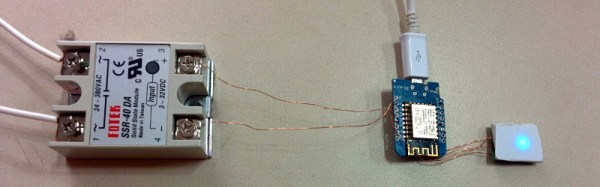
When we think of relays, we tend to think of those big mechanical things that make a satisfying ‘click’ when activated. As nice as they are for relay-based computers, there are times when you don’t want to deal with noise or the unreliability of moving parts. This is where solid-state relays (SSRs) are worth considering. They switch faster, silently, without bouncing or arcing, last longer, and don’t contain a big inductor.

Source Fotek SSR Specifications Sheet

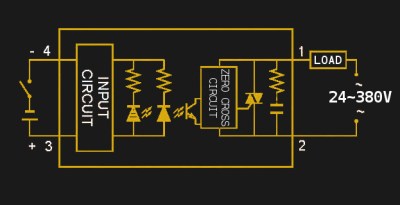
An SSR consists of two or three standard components packed into a module (you can even build one yourself). The first component is an optocoupler which isolates your control circuit from the mains power that you are controlling. Second, a triac, silicon controlled rectifier, or MOSFET that switches the mains power using the output from the optocoupler. Finally, there is usually (but not always) a ‘zero-crossing detection circuit’. This causes the relay to wait until the current it is controlling reaches zero before shutting off. Most SSRs will similarly wait until the mains voltage crosses zero volts before switching on.

If a mechanical relay turns on or off near the peak voltage when supplying AC, there is a sudden drop or rise in current. If you have an inductive load such as an electric motor, this can cause a large transient voltage spike when you turn off the relay, as the magnetic field surrounding the inductive load collapses. Switching a relay during a peak in the mains voltage also causes an electric arc between the relay terminals, wearing them down and contributing to the mechanical failure of the relay.

Continue reading “An Introduction To Solid State Relays” →

Cuban Embassy Attacks And The Microwave Auditory Effect

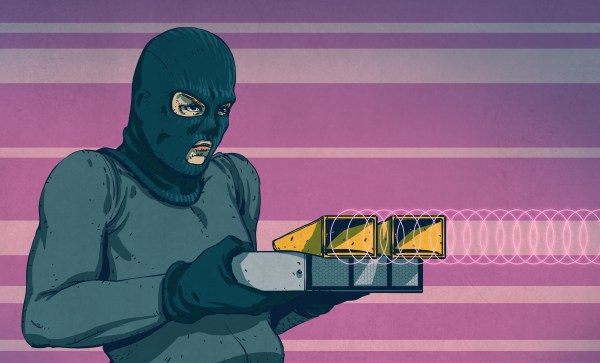
If you’ve been paying attention to the news, you may have seen a series of articles coming out about US staffers in Cuba. It seems that 21 staffers have suffered a bizarre array of injuries ranging from hearing loss to dizziness to concussion-like traumatic brain injuries. Some staffers have reported hearing incapacitating sounds in the embassy and in their hotel rooms. The reports range from clicking to grinding, humming, or even blaring sounds. One staffer described being awoken to a horrifically loud sound, only to have it disappear as soon as he moved away from his bed. When he got back into bed, the mysterious sound came back.

Cuba has denied any wrongdoing. However, the US has already started to take action – expelling two Cuban diplomats from the US in May. The question though is what exactly could have caused these injuries. The press has gone wild with theories of sonic weaponry, hidden bugs, and electronic devices, poisons, you name it. Even Julian Assange has weighed in, stating “The diversity of symptoms suggests that this is a pathogen combined with paranoia in an isolated diplomatic corps.”

So what’s going on? Bizarre accidents? Cloak and dagger gone awry? Mass hysteria among the US state department, or something else entirely? Continue reading “Cuban Embassy Attacks And The Microwave Auditory Effect” →

The Electronics Markets Of Ho Chi Minh City, Vietnam

When we think about world-famous electronics markets in Asia, usually Shenzhen, Tokyo’s Akihabara, or Shanghai’s Beijing Road come to mind.

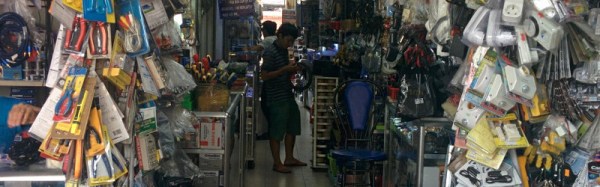
There’s another market that I’ve had my eye on for a few years: Nhật Tảo market in Ho Chi Minh City, Vietnam. It might not be as large or accessible as the more well-known markets, but it’s very much worth a visit if you’re in the area. I decided it was time to hop on my red motorbike (red things go faster) and give you a short tour of the central market, as well as some more hobbyist-friendly options.

Continue reading “The Electronics Markets Of Ho Chi Minh City, Vietnam” →

Ask Hackaday: Security Questions And Questionable Securities

Your first school. Your mother’s maiden name. Your favorite color. These are the questions we’re so used to answering when we’ve forgotten a password and need to get back into an account. They’re not a password, yet in many cases have just as much power. Despite this, they’re often based on incredibly insecure information.

Sarah Palin’s Yahoo account is perhaps the best example of this. In September 2008, a Google search netted a birthdate, ZIP code, and where the politician met her spouse. This was enough to reset the account’s password and gain full access to the emails inside.

While we’re not all public figures with our life stories splashed across news articles online, these sort of questions aren’t exactly difficult to answer. Birthdays are celebrated across social media, and the average online quiz would net plenty of other answers. The problem is that these questions offer the same control over an account that a password does, but the answers are not guarded in the same way a password is.

For this reason, I have always used complete gibberish when filling in security questions. Whenever I did forget a password, I was generally lucky enough to solve the problem through a recovery e-mail. Recently, however, my good luck ran out. It was a Thursday evening, and I logged on to check my forex trading account. I realised I hadn’t updated my phone number, which had recently changed.

Upon clicking my way into the account settings, I quickly found that this detail could only be changed by a phone call. I grabbed my phone and dialed, answering the usual name and date of birth questions. I was all set to complete this simple administrative task! I was so excited.

“Thanks Lewin, I’ll just need you to answer your security question.”

“Oh no.”

“The question is… Chutney butler?”

“Yes. Yes it is. Uh…”

“…would you like to guess?”

Needless to say, I didn’t get it.

I was beginning to sweat at this point. To their credit, the call center staffer was particularly helpful, highlighting a number of ways to recover access to the account. Mostly involving a stack of identification documents and a visit to the nearest office. If anything, it was a little reassuring that my account details required such effort to change. Perhaps the cellular carriers of the world could learn a thing or two.

In the end, I realised that I could change my security question with my regular password, and then change the phone number with the new security question. All’s well that ends well.

How do You Deal with Security Questions?

I want to continue taking a high-security approach to my security questions. But as this anecdote shows, you do occasionally need to use them. With that in mind, we’d love to hear your best practices for security questions on accounts that you care about.

Do you store your answers in a similar way to your passwords, using high entropy to best security? When you are forced to use preselected questions do you answer honestly or make up nonsensical answers (and how do you remember what you answered from one account to the next)? When given the option to choose your own questions, what is your simple trick that ensures it all makes sense to you at a later date?

We’d love to hear your best-practice solutions in the comments. While you ponder those questions, one mystery will remain, however — the answer to the question that nobody knows: Chutney butler?