A 3D Printer Alone Doesn’t Make A Hackspace

There was a time when hackspaces were few and far between — legendary environments that you’d read about online, where amazing projects were made by people who had come together to form communities of creative technology enthusiasts. Of course, they were always in places far afield, California, or Germany, never in provincial England where I call home. Eventually our movement spread its tentacles into the county towns, and several years later with a stint as a hackspace director behind me I sense that it is on the cusp of escaping its underground roots. Every month seems to bring news of yet another organisation wanting to open a makerspace of their own, be they universities, co-working spaces, enterprise centres, libraries, or even banks. It’s evident that our movement has attracted an aura of edginess when it comes to getting things done, and that these entities are anxious to secure a little piece of that for themselves.

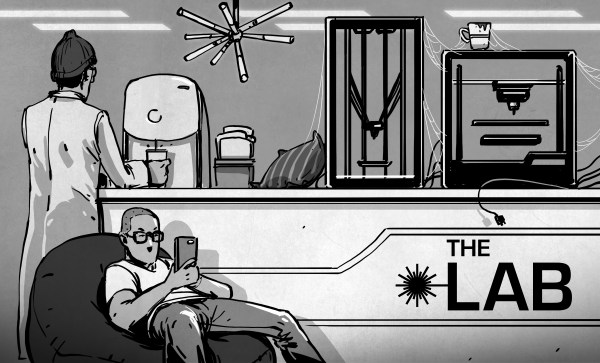
So within a few miles of most hackspaces will be several places where you can find a 3D printer, maybe a vinyl cutter, a CAD workstation, and a soldering iron. There will be a fancy hipster coffee machine and some futuristic furniture, and probably some kind of enclosed meeting pod of dubious design. All of which can no doubt be viewed through a glass wall, so that people in suits can watch all that raw #innovation sizzling away.

Viewed from within the movement, it’s easy to see all this activity on the edges of the world of making as a threat. A struggling community organisation survives on its wits alone, it doesn’t have a multi-million pound (or dollar) university or investor behind it. Its tools are hard-won and patched up, and its coffee machine is a battered electric kettle and a jar of supermarket instant coffee. When it comes to gleaming innovation spaces, a group of assorted makers simply can’t compete. Surely the arrival of these spaces will tempt members away, and the hackspace will inevitably wither, and die.

It’s worth taking a step back at this point, and considering what makes a hackspace. Specifically, what makes a good hackspace.

Continue reading “A 3D Printer Alone Doesn’t Make A Hackspace” →
The Art Of Blinky Business Cards

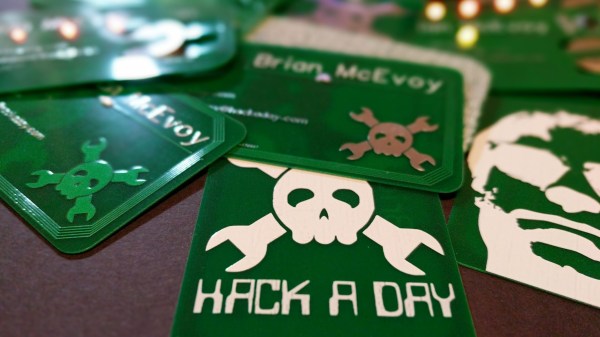
Business cards are stuck somewhere between antiquity and convenience. On one hand, we have very convenient paperless solutions for contact swapping including Bluetooth, NFC, and just saying, “Hey, put your number into my phone, please.” On the other hand, holding something from another person is a more personal and memorable exchange. I would liken this to the difference between an eBook and a paperback. One is supremely convenient while the other is tactile. There’s a reason business cards have survived longer than the Rolodex.

Protocols and culture surrounding the exchange of cards are meant to make yourself memorable and a card which is easy to associate with you can work long after you’ve given your card away. This may seem moot if you are assigned cards when you start a new job, but personal business cards are invaluable for meeting people outside of work and you are the one to decide how wild or creative to make them.

Continue reading “The Art Of Blinky Business Cards” →

Ben Franklin’s Weak Motor And Other Forgotten Locomotion

Most of the electric motors we see these days are of the electromagnetic variety, and for good reason: they’re powerful. But there’s a type of motor that was invented before the electromagnetic one, and of which there are many variations. Those are motors that run on high voltage, and the attraction and repulsion of charge, commonly known as electrostatic motors.

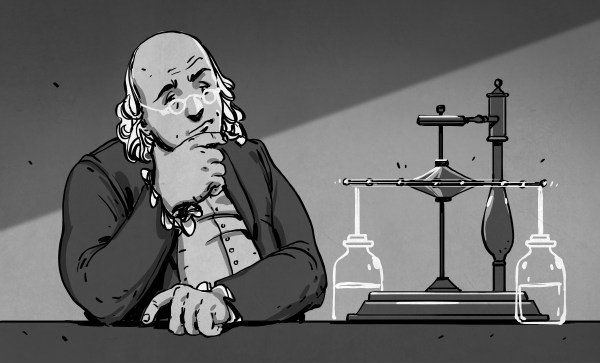
Ben Franklin — whose electric experiments are most frequently associated with flying a kite in a thunderstorm — built and tested one such high-voltage motor. It wasn’t very powerful, but was good enough for him to envision using it as a rotisserie hack. Food is a powerful motivator.

What follows is a walk through the development of various types of these motors, from the earliest ion propelled ones to the induction motors which most have never heard of before, even an HV hacker such as yours truly.

Continue reading “Ben Franklin’s Weak Motor And Other Forgotten Locomotion” →

Books You Should Read: Feynman’s Appendix To The Challenger Disaster Report

It isn’t really a book, but Richard Feynman’s Appendix to the Challenger Disaster Report is still definitely something you should read. It’s not particularly long, but it’s educational and relevant not just as an example of critical thinking in action, but as a reminder not to fool oneself; neither individually, nor on an organizational level. Sadly, while much was learned from the events leading to and surrounding the Challenger disaster, over thirty years later many of us can still find a lot of the same things to relate to in our own professional lives. There isn’t a single magic solution, because these problems are subtle and often masquerade as normal.

Feynman and the Challenger Disaster

Richard Feynman (1918-1988) was a Nobel Prize winning physicist and one of the best-known scientists of his time. In 1986 he somewhat reluctantly agreed to join the Rogers Commission, whose task was to investigate the Challenger disaster. The space shuttle Challenger had exploded a little more than a minute after launch, killing everyone on board. The commission’s job was to find out what had gone wrong and how it had happened, and figure out how to keep it from happening again.

Continue reading “Books You Should Read: Feynman’s Appendix To The Challenger Disaster Report” →

Manufacturing Your Own Single-Origin Tea

It’s nice to take a break from hacking together the newest bleeding-edge technology, relax, and enjoy a beverage. It’s no surprise that hacks devoted to beer and coffee roasting are popular. We’ve also seen a few projects helping brew the perfect cup of tea, but none involving the actual production of tea. Today we’re going to take a short recess from modernity and explore this ancient tradition.

Consumption of tea is about equal to all other manufactured beverages, such as coffee and alcohol, combined. It is hands-down the most popular manufactured beverage in the world, and we thought it would be interesting to make some ourselves. Also the local tea is so bitter that it’s used to clean things, and it works alarmingly well. To each their own!

I started by driving into Vietnam’s Central Highlands, down what Google simply refers to as ‘unnamed road’, to about 11°52’59.3″N 108°33’49.5″E. I asked around until I found a street vendor that knew a farmer at the nearby tea plantation, and would sell us five kilograms of fresh tea. I carried it 330 kilometers back to the city, because I’m a sane person that does normal things.

Continue reading “Manufacturing Your Own Single-Origin Tea” →

We’re Using The Word Firmware Wrong

I had an interesting discussion the other day about code written for an embedded system. I was speaking with Voja Antonic about ‘firmware’. The conversation continued forward but I noticed that he was calling it ‘software’. We later discussed it and Voja told me he thought only the parts of the code directly interacting with the microcontroller were firmware; the rest falls under the more generic term of software. It really had me wondering where firmware stops being firmware and is merely software?

The topic has remained on my mind and I finally got around to doing some dictionary searches. I’m surprised that I’ve been using the word differently and I think most of the people I’ve heard use it are doing the same — at least as far as dictionary definitions are concerned. My go to sources are generally Merriam-Webster and Oxford English dictionaries and both indicate that firmware is a type of software that is indelible:

Permanent software programmed into a read-only memory.

computer programs contained permanently in a hardware device (such as a read-only memory)

According to this definition, I have never written a single bit of firmware. Everything I have written has been embedded software. But surely this is a term that must change with the times as technology progress so I kept digging.

Continue reading “We’re Using The Word Firmware Wrong” →

The Hackers And The Hurricane

When natural disasters strike, particularly if they are in some of the less remote parts of the world, we see them unfolding in real-time on our television screens. They become a 24-hour rolling news exercise in disaster titillation, each fresh horror ghoulishly picked over by breathless reporters live-telecasting from windswept streets, and endlessly rehashed by a succession of in-studio expert guests.

Then once the required image of a dusty child being pulled from the rubble or a tearful mother describing her daughter being swept away is in the can, a politician somewhere is found in bed with a model or a tinpot dictator rattles his sabre, and the world moves on. The BAFTA or the Emmy is a certainty for this one, did you see the anguish!

Meanwhile on the ground, the situation remains the same. There is no power, no sanitation, no communications, no food, and help seems very far away. In the wake of the recent hurricane season across the Caribbean, there are millions of people whose worlds have been wrecked, and several international governments have faced significant criticism for their lethargic response.

In our world of hardware hackers and makers, we are on the whole practical people. We exist to make, and do, rather than to endlessly talk. Seeing the plight of the victims of Irma, Jose, or Maria leaves us wanting to do practical things to help, because that’s what we do. But of course, we can do nothing, because we’re thousands of miles away and probably lack whatever skills or training are in demand on the islands.

It’s heartening then to hear of just a few moments when our wider community has managed to be in the right place at the right time to offer some help. We’ve had a couple in our tips line lately we’d like to share.

[Csp3r] writes about the Derbycon conference held in Louisville, at which [Carlos Perez] and [Jose Quinones Borreros], information security specialists from Puerto Rico, were in attendance. They mentioned a need for emergency radios, and the community at the conference came together to raise money for much more than just a few radios. $15,000 was raised in all, spent on radios, solar chargers, generators, flashlights, USB battery packs, and tools. This amounted to a significant bulk, so Hackers For Charity helped secure some space on an aid flight to the island.

Then [Bruce Perens, K6BP] writes about a request from the American Red Cross to the ARRL for 50 radio amateurs to help with their relief efforts in Puerto Rico. They will perform the role you might expect of enabling essential communications, as well as to quote the ARRL: “help record, enter, and submit disaster-survivor information into the ARC Safe and Well system”. This is a request unprecedented in its scale, and reflects the level of damage across the island.

For most of us, the best we can do when helping out with these events will be to drop coins into an OXFAM or Red Cross collecting tin and leave it to the experts. But as we’ve noted above, for just a few of us the opportunity to do something a bit more useful presents itself. If you find yourself in that position, make it count!

We’ve looked at the role of amateur radio in public service before, and we’ve even featured it in one or two projects. This emergency box for example has all you’d need to provide this type of service.

Cyclone Catarina image from the ISS, [Public domain].