The Textile Bench

What’s on your bench? Mine’s mostly filled with electronic test equipment, soldering kit, and computers. I’m an electronic engineer by trade when I’m not writing for Hackaday, so that’s hardly surprising. Perhaps yours is like mine, or maybe you’ve added a 3D printer to the mix, a bunch of woodworking tools, or maybe power tools.

So that’s my bench. But is it my only bench? On the other side of the room from the electronics bench is a sturdy folding dining table that houses the tools and supplies of my other bench. I’m probably not alone in having more than one bench for different activities, indeed like many of you I also have a messy bench elsewhere for dismantling parts of 1960s cars, or making clay ovens.
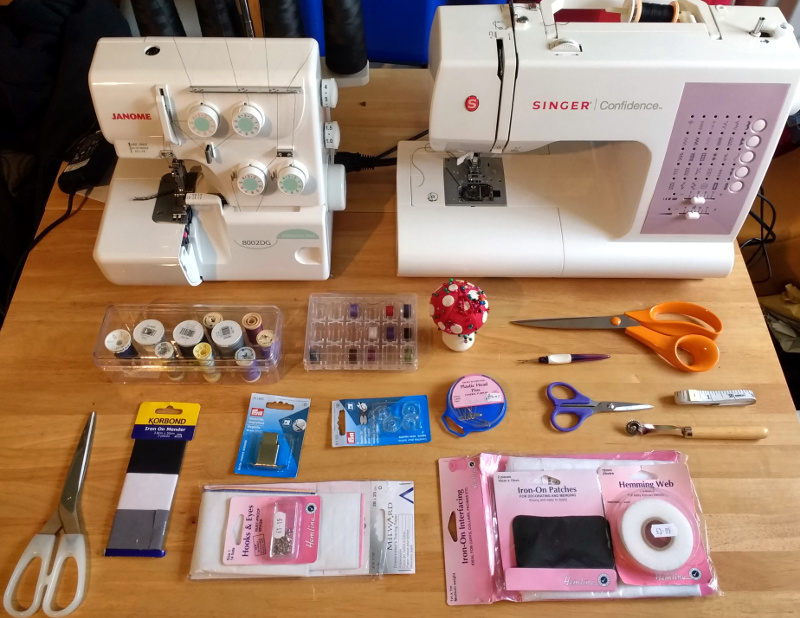
My textile bench, with a selection of the equipment used on it.

The other bench in question though is not for messy work, in fact the diametric opposite. This is my textile bench, and it houses the various sewing machines and other equipment that allow me to tackle all sorts of projects involving fabric. On it I’ve made, modified, and repaired all sorts of clothing, I’ve made not-very-successful kites, passable sandals, and adventurous tent designs among countless other projects.

Some of you might wonder why my textile bench is Hackaday fodder, after all it’s probably safe to assume that few readers have ever considered fabricating their own taffeta ball gown. But to concentrate only on one aspect of textile work misses the point, because the potential is there for so much cross-over between these different threads of the maker world. So I’m going to take you through my textile bench and introduce you to its main tools. With luck this will demystify some of them, and maybe encourage you to have a go.


Continue reading “The Textile Bench”

Stupid Git Tricks

My apologies if you speak the Queen’s English since that title probably has a whole different meaning to you than I intended. In fact, I’m talking about Git, the version control system. Last time I talked about how the program came to be and offered you a few tutorials. If you are a dyed-in-the-wool software developer, you probably don’t need to be convinced to use Git. But even if you aren’t, there are a lot of things you can do with Git that don’t fit the usual mold.

Continue reading “Stupid Git Tricks”

Wrap Your Mind Around Neural Networks

Artificial Intelligence is playing an ever increasing role in the lives of civilized nations, though most citizens probably don’t realize it. It’s now commonplace to speak with a computer when calling a business. Facebook is becoming scary accurate at recognizing faces in uploaded photos. Physical interaction with smart phones is becoming a thing of the past… with Apple’s Siri and Google Speech, it’s slowly but surely becoming easier to simply talk to your phone and tell it what to do than typing or touching an icon. Try this if you haven’t before — if you have an Android phone, say “OK Google”, followed by “Lumos”. It’s magic!

Advertisements for products we’re interested in pop up on our social media accounts as if something is reading our minds. Truth is, something is reading our minds… though it’s hard to pin down exactly what that something is. An advertisement might pop up for something that we want, even though we never realized we wanted it until we see it. This is not coincidental, but stems from an AI algorithm.

At the heart of many of these AI applications lies a process known as Deep Learning. There has been a lot of talk about Deep Learning lately, not only here on Hackaday, but all over the interwebs. And like most things related to AI, it can be a bit complicated and difficult to understand without a strong background in computer science.

If you’re familiar with my quantum theory articles, you’ll know that I like to take complicated subjects, strip away the complication the best I can and explain it in a way that anyone can understand. It is the goal of this article to apply a similar approach to this idea of Deep Learning. If neural networks make you cross-eyed and machine learning gives you nightmares, read on. You’ll see that “Deep Learning” sounds like a daunting subject, but is really just a $20 term used to describe something whose underpinnings are relatively simple.

Continue reading “Wrap Your Mind Around Neural Networks”

KiCAD Best Practices: Library Management

One common complaint we hear from most new KiCAD users relates to schematic and footprint libraries. The trick is to use just one schematic symbol and footprint library each with your project. This way any changes to the default schematic libraries will not affect your project and it will be easy to share your project with others without breaking it. I’ve spent some time refining this technique and I’ll walk you through the process in this article.

We have covered KiCAD (as well as other) Electronic Design Automation (EDA) tools several times in the past. [Brian Benchoff] did a whole series on building a project from start to finish using all the various EDA packages he could lay his hands on. No CAD or EDA software is perfect, and a user has to learn to get to grips with the idiosyncrasies of whichever program they decide to use. This usually leads to a lot of cussing and hair pulling during the initial stages when one can’t figure out “How the hell do I do that?”, especially from new converts who are used to doing things differently.

Read on to learn the best practices to use when using KiCAD and its library management.

Continue reading “KiCAD Best Practices: Library Management”

A Few Of Our Favorite Chips: 4051 Analog Mux

Raindrops on roses, and whiskers on kittens? They’re alright, I suppose. But when it comes down to it, I’d probably rather have a bunch of 4051, 4052, and 4053 analog multiplexers on the component shelf. Why? Because the ability to switch analog signals around, routing them at will, under control of a microcontroller is tremendously powerful.

Whether you want to read a capacitive-sensing keyboard or just switch among audio signals, nothing beats a mux! Read on and see if you agree.

Continue reading “A Few Of Our Favorite Chips: 4051 Analog Mux”

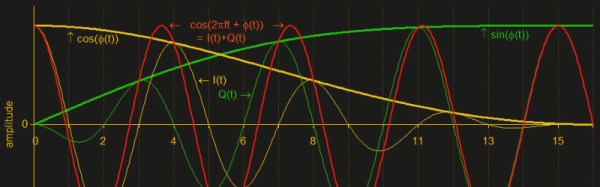
If The I And Q Of Software Defined Radio Are Your Nemesis, Read On

For those of us whose interests lie in radio, encountering our first software defined radio must have universally seemed like a miracle. Here is a surprisingly simple device, essentially a clever mixer and a set of analogue-to-digital or digital-to-analogue converters, that can import all the complex and tricky-to-set-up parts of a traditional radio to a computer, in which all signal procession can be done using software.

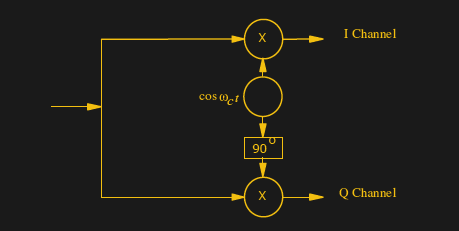
A quadrature mixer. Jugandi (Public domain).

When your curiosity gets the better of you and you start to peer into the workings of a software defined radio though, you encounter something you won’t have seen before in a traditional radio. There are two mixers fed by a two local oscillators on the same frequency but with a 90 degree phase shift, and in a receiver the resulting mixer products are fed into two separate ADCs. You encounter the letters I and Q in relation to these two signal paths, and wonder what on earth all that means.

Continue reading “If The I And Q Of Software Defined Radio Are Your Nemesis, Read On”

Don’t Be A Code Tyrant, Be A Mentor

Hardware hacking is a way of life here at Hackaday. We celebrate projects every day with hot glue, duct tape, upcycled parts, and everything in between. It’s open season to hack hardware. Out in the world, for some reason software doesn’t receive the same laissez-faire treatment. “Too many lines in that file” “bad habits” “bad variable names” the comments often rain down. Even the unsafest silliest of projects isn’t safe. Building a robot to shine lasers into a person’s eyes? Better make sure you have less than 500 lines of code per file!

Why is this? What makes readers and commenters hold software to a higher standard than the hardware it happens to be running on? The reasons are many and varied, and it’s a trend I’d like to see stopped.

Software engineering is a relatively young and fast evolving science. Every few months there is a new hot language on the block, with forums, user groups, and articles galore. Even the way software engineers work is constantly changing. Waterfall to agile, V-Model, Spiral model. Even software design methodologies change — from pseudo code to UML to test driven development, the list goes on and on.

Terms like “clean code” get thrown around. It’s not good enough to have software that works. Software must be well commented, maintainable, elegant, and of course, follow the best coding practices. Most of these are good ideas… in the work environment. Work is what a lot of this boils down to. Software engineers have to stay up to date with new trends to be employable.

There is a certain amount of “born again” mentality among professional software developers. Coders generally hate having change forced upon them. But when they find a tool or system they like, they embrace it both professionally, and in their personal projects. Then they’re out spreading the word of this new method or tool; on Reddit, in forums, to anyone who will listen. The classic example of this is, of course, editors like the vi vs emacs debate.

Continue reading “Don’t Be A Code Tyrant, Be A Mentor”