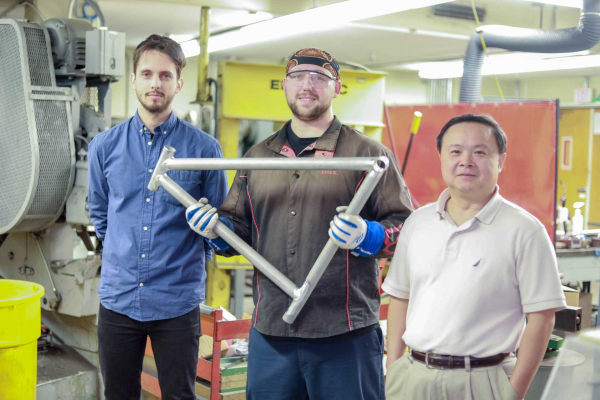
Though much of it is hidden from view, welding is a vital part of society. It’s the glue that holds together the framework of the cars we drive, the buildings we occupy, the appliances we use, and the heavy machinery that keeps us moving forward. Every year, the tireless search continues for stronger and lighter materials to streamline our journey into the future of transportation and space exploration.
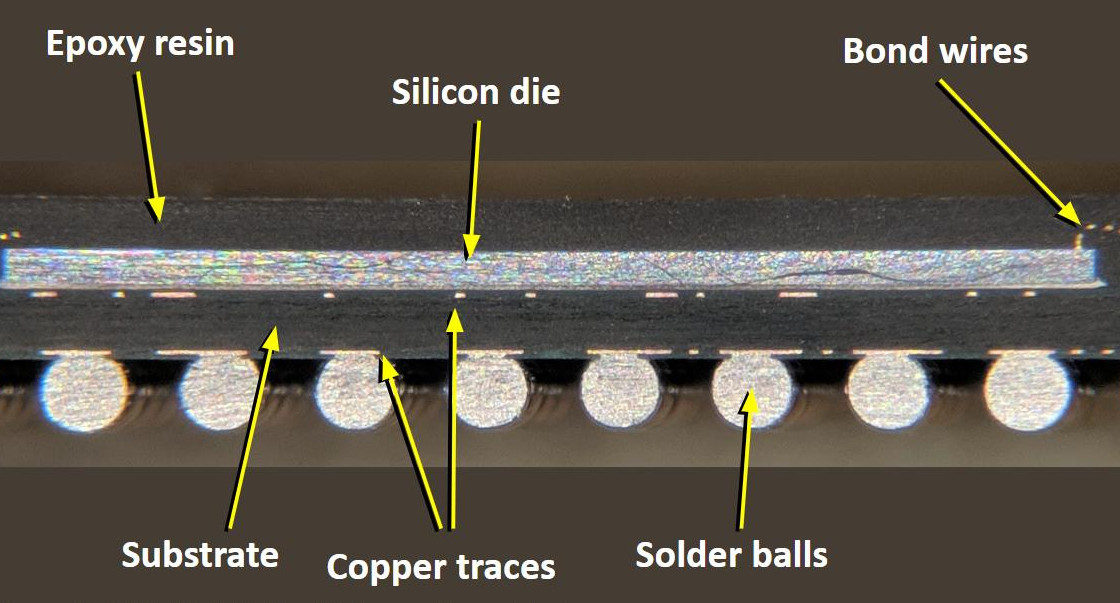
You may have heard the phrase “flip-chip” before: it’s a broad term referring to several integrated circuit packaging methods, the common thread being that the semiconductor die is flipped upside down so the active surface is closest to the PCB. As opposed to the more traditional method in which the IC is face-up and connected to the packaging with bond wires, this allows for ultimate packaging efficiency and impressive performance gains. We hear a lot about advances in the integrated circuits themselves, but the packages that carry them and the issues they solve — and sometimes create — get less exposure.
Cutaway view of traditional wire-bond BGA package. Image CC-BY-SA 4.0 @TubeTimeUS
Let’s have a look at why semiconductor manufacturers decided to turn things on their head, and see how radioactive solder and ancient Roman shipwrecks fit in.
With the destruction of the Microsat-R reconnaissance satellite on March 27th, India became the fourth country in history to successfully hit an orbiting satellite with a surface-launched weapon. While Microsat-R was indeed a military satellite, there was no hostile intent; the spacecraft was one of India’s own, launched earlier in the year. This follows the examples of previous anti-satellite (ASAT) weapons tests performed by the United States, Russia, and China, all of which targeted domestic spacecraft.
Yet despite the long history of ASAT weapon development among space-fairing nations, India’s recent test has come under considerable scrutiny. Historically, the peak of such testing was during the 1970’s as part of the Cold War rivalry between the United States and then Soviet Union. Humanity’s utilization of space in that era was limited, and the clouds of debris created by the destruction of the target spacecraft were of limited consequence. But today, with a permanently manned outpost in low Earth orbit and rapid commercial launches, space is simply too congested to risk similar experiments. The international community has strongly condemned the recent test as irresponsible.
For their part, India believes they have the right to develop their own defensive capabilities as other nations have before them, especially in light of their increasingly active space program. Prime Minister Narendra Modi released a statement reiterating that the test was not meant to be a provocative act:
Today’s anti-satellite missile will give a new strength to the country in terms of India’s security and a vision of developed journey. I want to assure the world today that it was not directed against anybody.
India has always been against arms race in space and there has been no change in this policy. This test of today does not violate any kind of international law or treaty agreements. We want to use modern technology for the protection and welfare of 130 million [1.3 Billion] citizens of the country.
Further, the Indian Space Research Organisation (ISRO) rejects claims that the test caused any serious danger to other spacecraft. They maintain that the test was carefully orchestrated so that any debris created would renter the Earth’s atmosphere within a matter of months; an assertion that’s been met with criticism by NASA.
So was the Indian ASAT test, known as Mission Shakti, really a danger to international space interests? How does it differ from the earlier tests carried out by other countries? Perhaps most importantly, why do we seem so fascinated with blowing stuff up in space?
Can you electronically enhance your brain? I’m not talking about surgically turning into a Borg. But are there electronic methods that can improve various functions of your brain? Fans of brainwave entrainment say yes.
There was an old recruiting ad for electrical engineers that started with the headline: The best electronic brains are still human. While it is true that even a toddler can do things our best computers struggle with, it is easy to feel a little inadequate compared to some of our modern electronic brains. Then again, your brain is an electronic device of sorts. While we don’t understand everything about how it works, there are definitely electric signals going between neurons. And where there are electric signals there are ways to measure them.
The tool for measuring electric signals in the brain is an EEG (electroencephalograph). While you can’t use an EEG to read your mind, exactly, it can tell you some pretty interesting information, such as when you are relaxed or concentrating. At its most basic we’ve seen toys and simple hobby projects that purport to be “mind controlled” but only at an incredibly rudimentary level.
Brainwave entrainment is a hypothesis that sending low frequency waves to your brain can give your mind a nudge and sync up brain activity with the equipment measuring it. The ability to synchronize with the brain could yield much better measurements for a meaningful interface between modern electronics and electric storm of thought happening in your head.
There’s a bug about to hit older GPS hardware that has echos of Y2K. Those old enough to have experienced the transition from the 1990s to the 2000s will no doubt recall the dreaded “Year 2000 Bug” that was supposed to spell the doom of civilization. Thanks to short-sighted software engineering that only recorded two digits for year, we were told that date calculations would fail en masse in software that ran everything from the power grid to digital watches. Massive remediation efforts were undertaken, companies rehired programmers whose outdated skills were suddenly back in demand, and in the end, pretty much nothing actually happened.
Yet another epoch is upon us, far less well-known but potentially deeper and more insidious. On Saturday April 6, 2019 — that’s tomorrow — GPS receivers may suffer from software issues due to rollover of their time counters. This could result in anything from minor inconvenience to major confusion, with an outside chance of chaos. Some alarmists are even stating that they won’t fly this weekend, for fear of the consequences.
So what are the real potential consequences, and what’s the problem with GPS in the first place? Unsurprisingly, it all boils down to basic math.
If you keep up with the field of web development, you may have heard of WebAssembly. A relatively new kid on the block, it was announced in 2015, and managed to garner standardised support from all major browsers by 2017 – an impressive feat. However, it’s only more recently that the developer community has started to catch up with adoption and support.
So, what is it? What use case is so compelling that causes such quick browser adoption? This post aims to explain the need for WebAssembly, a conceptual overview of the technical side, as well as a small hands-on example for context.
This is the 2019 Hackaday Prize, the worldwide hardware design contest focused on product development. We know you can build a working prototype, and we still want to see you do that. But a great idea should have reach beyond your own workshop. This year’s Hackaday Prize is about taking your product across the finish line, from concept to design for manufacture.
Prizes to Jump Start Your Product
$125,000 and a Supplyframe DesignLab Residency await the Best Product winner. There are five focus categories this year, with the winner of each receiving a $10,000 prize. And to help encourage those early beginnings, we have another $10,000 in seed funding set aside which means up to $500 for each of the top 20 entries who get in and gather those “likes” before June first.
There are a few areas of focus you should have in mind as you work on your products. These are Concept, Design, Production, Benchmark, and Communication. All entries are eligible to receive prizes related to these, and in addition to the $50,000 we mentioned above for the winner in each area, we have another $3,000 for each set aside to recognize an honorable mention.
Something amazing happened thirty years ago. A core of very motivated hackers took on the mantle of design, software, and even business skill, to build the computers that thrust us into a new information age. As these machines matured, a wave of software engineers picked up that torch, themselves embracing product and design thinking to accelerate the startup craze to new levels, again changing the world.
Ask yourself where we are right now. What are the hot new startups? The buzz now is all about billion dollar valuation but where is the substance? What we really need are the scrappy hackers who have a flag to plant to change the world. We’ve mistakenly been waiting for software companies to use their special sauce to lead a hardware renaissance, but instead it feels like we’re solving more and more trivial problems — where are the world-changers?
This is the hunger behind the 2019 Hackaday Prize. Three decades later, it is time for Hardware Engineers to be recognized as Innovators and leaders again. This is the call for the hardware community to come together, share knowledge, acquire new skills, and embark on a journey that uses the technological raw materials at our fingertips to invent the solutions that really matter. Make the idea and the execution happen now, and that enormous valuation will follow. Now is the time to change the world, you are the hackers who will do it, and this time around hardware will be leading the charge.
Improvisation, Mentorship, and Your Ability to Do Everything
We know you can build a working prototype of just about anything. But just like the creators of the Commodore, the Sinclair, Amiga, Apple, and Atari, you need to be more than a hardware designer. You need to know your users like you know yourself. You need an eye for industrial design — each of the machines mentioned above are iconic by how they look and not just by how they work. People behind these products knew what they were up against, and chose to make them stand-out designs in terms of performance, price, and how they fit into our lives.
You don’t have every skill necessary to make a great leap forward in every one of these areas — nobody does. But with the right community around you, you will learn some of them and find collaborators for the rest. Throughout the 2019 Hackaday Prize we’ll be pushing everyone to step past where you think your skills end, to learn what makes a product great, what makes it loved by the end user, and what makes it feasible to follow through to the end of the rainbow.
Get in early and take part in Prize demo days. Get matched up with world-class mentors and work with them in a masterclass situation from which everyone can learn. Show off your work and you’ll attract good ideas and good people. This is the Homebrew Computer Club of the new millennium. You’re going to find inspiration (and become the inspiration!) from everyone in the club. You’re going to riff on the breakthroughs of others, and together we’re all going to lead that Hardware Renaissance.