The Hacky Throttle Repair That Got Me On The Road Again

Old cars are great. For the nostalgia-obsessed like myself, getting into an old car is like sitting in a living, breathing representation of another time. They also happen to come with their fair share of problems. As the owner of two cars which are nearing their 30th birthdays, you start to face issues that you’d never encounter on a younger automobile. The worst offender of all is plastics. Whether in the interior or in the engine bay, after many years of exposure to the elements, parts become brittle and will crack, snap and shatter at the slightest provocation.

You also get stuck bolts. This was the initial cause of frustration with my Volvo 740 Turbo on a cold Sunday afternoon in May. As I tried in vain to free the fuel rail from its fittings, I tossed a spanner in frustration and I gave up any hope of completing, or indeed, starting the job that day. As I went to move the car back into the driveway, I quickly noticed a new problem. The accelerator was doing approximately nothing. Popping the hood, found the problem and shook my head in resignation. A Volvo 740 Turbo is fitted with a ball-jointed linkage which connects the accelerator cable to the throttle body itself. In my angst, the flying spanner had hit the throttle body and snapped the linkage’s plastic clips. It was at this point that I stormed off, cursing the car that has given me so much trouble over the past year.

Continue reading “The Hacky Throttle Repair That Got Me On The Road Again”

Pipelining Digital Logic In FPGAs

When you first learn about digital logic, it probably seems like it is easy. You learn about AND and OR gates and figure that’s not very hard. However, going from a few basic gates to something like a CPU or another complex system is a whole different story. It is like going from “Hello World!” to writing an operating system. There’s a lot to understand before you can make that leap. In this set of articles, I want to talk about a way to organize more complex FPGA designs like CPUs using a technique called pipelining.

These days a complex digital logic system is likely to be on an FPGA. And part of the reason we can get fooled into thinking digital is simple is because of the modern FPGA tools. They hide a lot of complexity from you, which is great until they can’t do what you want and then you are stuck. A good example of that is where you are trying to hit a certain clock frequency. If you aren’t careful, you’ll get a complaint from the tool that you can’t meet timing constraints.

Continue reading “Pipelining Digital Logic In FPGAs”

Hackaday guide to Lathes

Preparing For A Lathe: How To Move 3000 Pounds Of Iron

You say to yourself, “Self, I want, nay, need a lathe”. Being a good little trooper, you then did all your research, having chosen Import or American, Imperial or Metric, and all your feed options and such. You then pulled the trigger and the machine is en route to your shop. Now what?

Continue reading “Preparing For A Lathe: How To Move 3000 Pounds Of Iron”

A 100th Birthday Celebration For The Flip Flop

It’s easy to get caught up in the excitement of creation as we’re building our latest widget. By the same token, it’s sometimes difficult to fully appreciate just how old some of the circuits we use are. Even the simplest of projects might make use of elements that were once a mess on some physicist’s or engineer’s lab bench, with components screwed to literal breadboards and power supplied by banks of wet-cell batteries.

One such circuit turns 100 years old in June, which is surprising because it literally is the building block of every computer. It’s the flip-flop, and while its inventors likely couldn’t have imagined what they were starting, their innovation became the basic storage system for the ones and zeros of the digital age.

Continue reading “A 100th Birthday Celebration For The Flip Flop”

Raspberry Pi’s Power Over Ethernet Hardware Sparks False Spying Hubbub

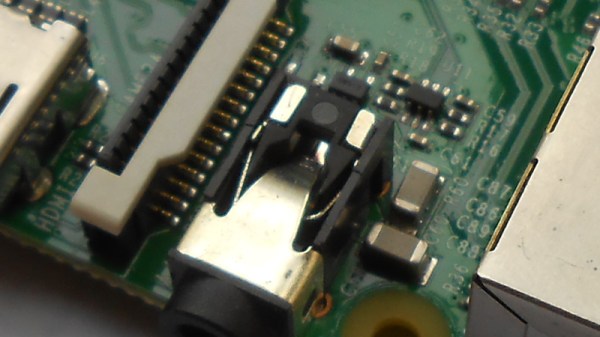
Have you ever torn open an Ethernet jack? We’d bet the vast majority of readers — even the ones elbow-deep into the hardware world — will answer no. So we applaud the effort in this one, but the conclusion landed way off the mark.

In the last few days, a Tweet showing a Raspberry Pi with its Ethernet socket broken open suggested the little PCB inside it is a hidden bug. With more going on inside than one might expect, the conclusion of the person doing the teardown was that the Raspberry Pi foundation are spying upon us through our Ethernet traffic. That’s just not the case. But we’re still excited about what was found.

Continue reading “Raspberry Pi’s Power Over Ethernet Hardware Sparks False Spying Hubbub”

Modular Robotics Made Easier With ROS

A robot is made up of many hardware components each of which requires its own software. Even a small robot arm with a handful of servo motors uses a servo motor library.

Add that arm to a wheeled vehicle and you have more motors. Then attach some ultrasonic sensors for collision avoidance or a camera for vision. By that point, you’ve probably split the software into multiple processes: one for the arm, another for the mobility, one for vision, and one to act as the brains interfacing somehow with all the rest. The vision may be doing object recognition, something which is computationally demanding and so you now have multiple computers.

Break all this complexity into modules and you have a use case for ROS, the Robot Operating System. As this article shows, ROS can help with designing, building, managing, and even evolving your robot.

Continue reading “Modular Robotics Made Easier With ROS”

Internet Of Smells: Giving A Machine The Job Of Sniffing Out Spoiled Food

Has the food in your pantry turned? Sometimes it’s the sickening smell of rot that tells you there’s something amiss. But is there a way to catch this before it makes life unpleasant? If only there were machines that could smell spoiled food before it stinks up the whole place.

In early May, I was lucky enough to attend the fourth FabLab Asia Network Conference (Fan4). The theme of their event this year was ‘Co-Create a Better World’. One of the major features of the conference was that there were a number of projects featured, often from rural areas, that were requesting assistance throughout the course of the conference.

Overall there were many bright people tackling difficult problems with limited resources. This is how I met [Yogesh Kulkarni] who runs a FabLab in Pabal, a farming community not far from Pune, India. [Yogesh] has also appeared on TED Talks (video here). He explained to me that in his area, vendors sell milk-based desserts. These are not exactly refrigerated, and sometimes people become ill from eating them. It would be nice if there was a way for the vendors to avoid selling the occasional harmful product.

I’ve had similar concerns with food safety in my area (Vietnam), and while it has been fine nearly all of the time, a few years ago I nearly died from a preventable food-borne illness. I had sufficient motivation to do a little research.

Continue reading “Internet Of Smells: Giving A Machine The Job Of Sniffing Out Spoiled Food”