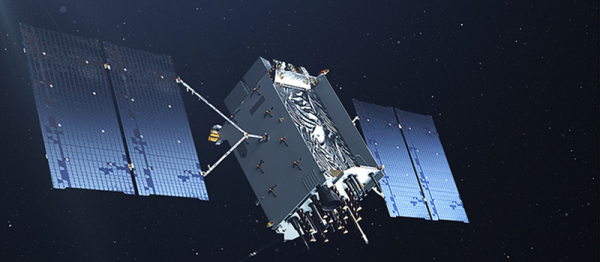
Imagine if you bought a new car but they keys were not going to be shipped to you until a few years later. That’s analogous to the situation the U.S. Air Force finds itself in. The first GPS III satellite is finally ready to launch today, December 18, 2018 — a little over 2 years beyond the original schedule. However, most of the unique GPS III features won’t be available until at least 2022, according to a 2017 Government Accounting Office (GAO) report to Congress.
GPS III is a project to launch 32 new satellites that will — for military users — be more difficult to jam. For civilian users, the new GPS satellites will be compatible with other systems, including the EU’s Galileo system. But the big draw? About three times the accuracy of the current system. For civilian use, that means 3 to 10 feet under good conditions as opposed to the current systems’ 10- to 33-foot resolution.
About an hour’s drive from where this is being written there is a car plant, and as you drive past its entrance you may notice an unobtrusive sign and an extra lane with the cryptic road marking “H2”. The factory is the Honda plant at Swindon, it produces some of Europe’s supply of Civics, and the lane on the road leads to one of the UK or indeed the world’s very few public hydrogen filling stations. Honda are one of a select group of manufacturers who have placed a bet on a future for environmentally sustainable motoring that lies with hydrogen fuel cell technologies.
The hydrogen-powered Honda Clarity FCV, a car most of us will probably never see. Lcaa9 [CC BY-SA 4.0].The trouble for Honda and the others is that if you have seen a Honda Clarity FCV or indeed any hydrogen powered car on the road anywhere in the world then you are among a relatively small group of people. Without a comprehensive network of hydrogen filling stations such as the one in Swindon there is little incentive to buy a hydrogen car, and of course without the cars on the road there is little incentive for the fuel companies to invest in hydrogen generating infrastructure such as the ITM Power electrolysis units that seem to drive so many of the existing installations. By comparison an electric car is a much safer bet; while the charging point network doesn’t rival the gasoline filling station network there are enough to service the electric motorist and a slow charge can be found from most domestic supplies. Continue reading “The Hydrogen Economy May Be Coming Through Your Cooker”→
During an earnings call on November 29th, CEO of AT&T Communications John Donovan effectively signed the death warrant for satellite television in the United States. Just three years after spending $67 billion purchasing the nations’s largest satellite TV provider, DirecTV, he made a comment which left little doubt about the telecom giant’s plan for the service’s roughly 20 million subscribers: “We’ve launched our last satellite.”
The news might come as a surprise if you’re a DirecTV customer, but the writing has been on the wall for years. When the deal that brought DirectTV into the AT&T family was inked, they didn’t hide the fact that the actual satellite content delivery infrastructure was the least of their concerns. What they really wanted was the installed userbase of millions of subscribers, as well as the lucrative content deals that DirecTV had already made. The plan was always to ween DirecTV customers off of their satellite dishes, the only question was how long it would take and ultimately what technology they would end up using.
Now that John Donovan has made it clear their fleet of satellites won’t be getting refreshed going forward, the clock has officially started ticking. It won’t happen this year, or even the year after that. But eventually each one of the satellites currently beaming DirecTV’s content down to Earth will cease to function, and with each silent bird, satellite television (at least in the United States) will inch closer to becoming history.
The greatest hardware hacks of all time were simply the result of finding software keys in memory. The AACS encryption debacle — the 09 F9 key that allowed us to decrypt HD DVDs — was the result of encryption keys just sitting in main memory, where it could be read by any other program. DeCSS, the hack that gave us all access to DVDs was again the result of encryption keys sitting out in the open.
Because encryption doesn’t work if your keys are just sitting out in the open, system designers have come up with ingenious solutions to prevent evil hackers form accessing these keys. One of the best solutions is the hardware enclave, a tiny bit of silicon that protects keys and other bits of information. Apple has an entire line of chips, Intel has hardware extensions, and all of these are black box solutions. They do work, but we have no idea if there are any vulnerabilities. If you can’t study it, it’s just an article of faith that these hardware enclaves will keep working.
Now, there might be another option. RISC-V researchers are busy creating an Open Source hardware enclave. This is an Open Source project to build secure hardware enclaves to store cryptographic keys and other secret information, and they’re doing it in a way that can be accessed and studied. Trust but verify, yes, and that’s why this is the most innovative hardware development in the last decade.
Here’s a fun exercise: take a list of the 20th century’s inventions and innovations in electronics, communications, and computing. Make sure you include everything, especially the stuff we take for granted. Now, cross off everything that can’t trace its roots back to the AT&T Corporation’s research arm, the Bell Laboratories. We’d wager heavily that the list would still contain almost everything that built the electronics age: microwave communications, data networks, cellular telephone, solar cells, Unix, and, of course, the transistor.
But is that last one really true? We all know the story of Bardeen, Brattain, and Shockley, the brilliant team laboring through a blizzard in 1947 to breathe life into a scrap of germanium and wires, finally unleashing the transistor upon the world for Christmas, a gift to usher us into the age of solid state electronics. It’s not so simple, though. The quest for a replacement for the vacuum tube for switching and amplification goes back to the lab of Julius Lilienfeld, the man who conceived the first field-effect transistor in the mid-1920s.
It would be really hard to go through a typical day in the developed world without running across something made from ABS plastic. It’s literally all over the place, from toothbrush handles to refrigerator interiors to car dashboards to computer keyboards. Many houses are plumbed with pipes extruded from ABS, and it lives in rolls next to millions of 3D-printers, loved and hated by those who use and misuse it. And in the form of LEGO bricks, it lurks on carpets in the dark rooms of children around the world, ready to puncture the bare feet of their parents.
ABS is so ubiquitous that it makes sense to take a look at this material in terms of its chemistry and its properties. As we’ll see, ABS isn’t just a single plastic, but a mixture that takes the best properties of its components to create one of the most versatile plastics in the world.
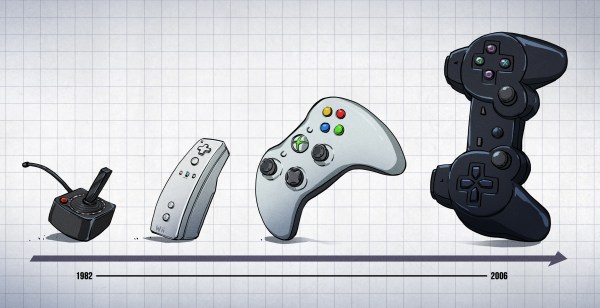
The story goes that Atari was developing a premium model of their popular home video game console, the Atari 2600, for the 1981 fiscal year. Internally known as the Stella RC, this model revision promised touch sensitive game selection toggles, LED indicators, and onboard storage for the controllers. The focus of the project, however, was the “RC” in Stella RC which stood for remote control. Atari engineers wanted to free players from the constraints of the wires that fettered them to their televisions.
Problem with the prototypes was that the RF transmitters in the controllers were powerful enough to send a signal over a 1000 ft. radius, and they interfered with a number of the remote garage door openers on the market. Not to mention that if there were another Stella RC console on the same channel in an apartment building, or simply across the street, you could be playing somebody else’s Pitfall run. The mounting tower of challenges to making a product that the FCC would stamp their approval on were too great. So Atari decided to abandon the pioneering Stella RC project. Physical proof of the first wireless game controllers would have been eliminated at that point if it were created by any other company… but prototypes mysteriously left the office in some peculiar ways.
“Atari had abandoned the project at the time…[an Atari engineer] thought it would be a great idea to give his girlfriend’s son a videogame system to play with…I can’t [comment] about the relationship itself or what happened after 1981, but that’s how this system left Atari…and why it still exists today.”
– Joe Cody, Atari2600.com
Atari did eventually get around to releasing some wireless RF 2600 joysticks that the FCC would approve. A couple years after abandoning the Stella RC project they released the Atari 2600 Remote Control Joysticks at a $69.95 MSRP (roughly $180 adjusted for inflation). The gigantic price tag mixed with the video game market “dropping off the cliff” in 1983 saw few ever getting to know the bliss of wire-free video game action. It was obvious that RF game controllers were simply ahead of their time, but there had to be cheaper alternatives on the horizon.
Out of Sight, Out of Control with IR Schemes
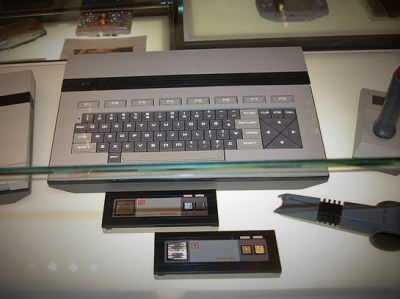
Nintendo AVS console deck and IR controller on display.
Video games were a dirty word in America in 1985. While games themselves were still happening on the microcomputer platforms, the home console business was virtually non-existent. Over in Japan, Nintendo was raking in money hand over fist selling video games on their Famicom console. They sought to replicate that success in North America by introducing a revised model of the Famicom, but it had to impress the tech journos that would be attending its reveal at the Consumer Electronics Show (CES).
The prototype system was called the Nintendo Advanced Video System (AVS). It would feature a keyboard, a cassette tape drive, and most importantly two wireless controllers. The controllers used infrared (IR) communication and the receiver was built-into the console deck itself. Each controller featured a square metallic directional pad and four action buttons that gave the impression of brushed aluminum. The advancement in video game controller technology was too good to be true though, because the entire system received a makeover before releasing as the Nintendo Entertainment System (NES) that Christmas. The NES lacked the keyboard, the tape drive, and the IR controllers and its change in materials hardly captured the high-end flash of the AVS. The removal of IR meant the device was cheaper to manufacture. A decision that ultimately helped the NES to become a breakout success that in turn brought back dedicated video game consoles single-handedly.