When I first started getting into 3D printed projects that would require final assembly from multiple parts, I wanted to make sure I had an adhesive that would really hold up. I couldn’t imagine anything worse than spending 10’s of hours printing and assembling something, only to have it fall apart because my adhesive wasn’t up to the task. So I spent a lot of time trolling 3D printing message boards and communities trying to find the best way of gluing PLA. It should come as no surprise that, like everything else in the world, there are a ridiculous number of opinions on the subject.
If you’re printing with ABS, the general wisdom is that solvent welding with acetone is the best bet. You put some acetone on the printed parts, rub them together, and the plastic fuses together. This happens because the ABS melts slightly when exposed to the acetone, so they end up essentially melding into one piece. This sounded like exactly what I wanted, but unfortunately, acetone doesn’t have this same effect on PLA.
After some more research I found people suggesting Weld-On #16, an acrylic adhesive that will actually melt PLA. A little of this applied to the parts, they said, and you can solvent weld PLA just like acetone on ABS. Sure enough, the stuff works great and I’ve used it to put together nearly everything I’ve printed in PLA over the last few years. Only problem is, this stuff is a bit nasty, takes 24 hours to fully cure, and nobody has it locally.
So as an experiment I thought I’d take a look at a few adhesives sold at the local big box retailer and see if I couldn’t find something comparable. Do I need to keep ordering this nasty goop online every time, or can I pick something up off the shelf? More to the point, is solvent welding PLA really any better than just gluing it?
From the time Mae Jemison was a little girl, she was convinced that she would go to space. No one could tell her otherwise. She was sure that space travel would be as common as air travel by the time she was an adult. That prediction didn’t pan out, but that confidence combined with her intellect, curiosity, and the above-average encouragement of her parents drove Mae to do everything she wanted, including space travel.
Some people might become a doctor or a researcher, a dancer or an astronaut. But Mae became all of these things. Not everyone supported her non-traditional path—many people just pick a career and stick with it. Her path is impressive and through it all she gained a really interesting perspective on how education is approached, and what effects that approach has on society. After practicing medicine, joining a shuttle mission, appearing in Star Trek, and retiring from NASA, she became a voice for minority students and an advocate for integrating the arts and sciences in the standard curriculum.
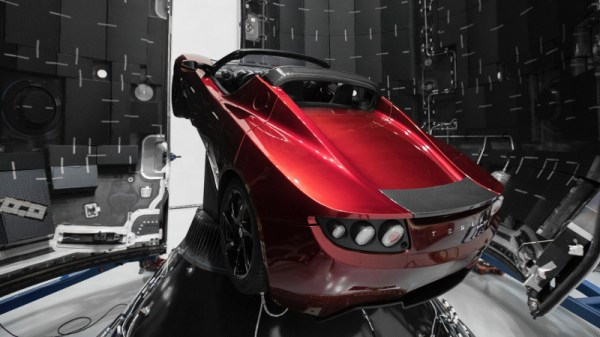
We’ve been having a lively discussion behind the scenes here at Hackaday, about SpaceX’s forthcoming launch of their first Falcon Heavy rocket. It will be carrying [Elon Musk]’s red Tesla Roadster, and should it be a successful launch, it will place the car in an elliptical orbit round the Sun that will take it to the Martian orbit at its furthest point.
On one hand, it seems possible that [Musk]’s sports car will one day be cited by historians as the exemplar of the excesses of the tech industry in the early 21st century. After all, to spend the millions of dollars required to launch the largest reusable space launch platform ever created, and then use it to hurl an electric vehicle into orbit round the Sun seems to be such a gratuitous waste of resources, an act of such complete folly as to be criminal.
Surely even given that there is a reasonable chance of a first launch ending in fiery destruction it must be worth their while canvassing the universities and research institutions of the world with the offer of a free launch, after all there must be a significant amount of science that would benefit from some cost-free launch capacity! It seems a betrayal of the famous “Why explore space” letter from the associate science director of NASA to a nun who questioned the expenditure while so many in the developing world were starving.
Testing
But on the other hand, first launches of rockets are a hazardous endeavour, as the metaphorical blue touchpaper is lit on the world’s largest firework for the first time. Satellites are expensive devices, and it would be a foolhardy owner who entrusted their craft to a launch vehicle with a good chance of a premature splashdown.
Launch of first Arianne 5. Not where you want your pricey satellite.
First launches traditionally carry a ballast rather than a payload, for example NASA have used tanks of water for this purpose in the past. SpaceX has a history of novelty payloads for their test launches; their first Dragon capsule took a wheel of cheese into space and returned it to Earth. We picture Musk looking around a big warehouse and saying, “well, we got a lot of cars!”
There is a fascinating question to be posed by the launch of the car, just what did they have to do to it to ensure that it could be qualified for launch? Satellite manufacture is an extremely exacting branch of engineering, aside from the aspect of ensuring that a payload will work it must both survive the launch intact and not jeopardise it in any way. It’s safe to say that the Roadster will not have to function while in orbit as the roads of California will be far away, but cars are not designed with either the stresses of launch or the transition to zero gravity and the vacuum of space in mind. Will a glass windscreen originally specified for a Lotus Elise on the roads of Norfolk shatter during the process and shower the inside of the craft with glass particles, for example? There must have been an extensive space qualification programme for it to pass, from vibration testing through removal of any hazards such as pressurised gases or corrosive chemicals, if only the folks at SpaceX would share some its details that would make for a fascinating story in itself.
Space Junk
So the Tesla Roadster is a huge publicity stunt on behalf of SpaceX, but it serves a purpose that would otherwise have to have been taken by an unexciting piece of ballast. It will end up as space junk, but in an orbit unlikely to bring it into contact with any other craft. If its space-suited dummy passenger won’t be providing valuable data on the suit’s performance we’d be extremely surprised, and when it is finally retrieved in a few centuries time it will make a fascinating exhibit for the Smithsonian.
Given a huge launch platform and the chance to fill it with a novelty item destined for orbit,the Hackaday team stepped into overdrive with suggestions as to what might be launched were they in charge. They varied from Douglas Adams references such as a heart of gold or a whale and a bowl of petunias should the rocket abort and the payload crash to earth, to a black monolith and a few ossified ape remains to confuse space historians. We briefly evaluated the theory that the Boring Company is in fact a hiding-in-plain-sight construction organisation for a forthcoming Evil Lair beneath the surface of Mars, before concluding that maybe after all the car is a pretty cool thing to use as ballast for a first launch.
It may be reaching towards seven decades since the first space programmes successfully sent rockets beyond the atmosphere with the aim of exploration, but while the general public has become accustomed to them as routine events they remain anything but to the engineers involved. The Falcon Heavy may not have been developed by a government, but it represents every bit as astounding an achievement as any of its predecessors. Flinging an electric vehicle into orbit round the Sun is a colossal act of showmanship and probably a waste of a good car, but it’s also more than that. In hundreds of years time the IoT devices, apps, 3D printers, quadcopters or whatever else we toil over will be long forgotten. But there will be a car orbiting the Sun that remains a memorial to the SpaceX engineers who made its launch possible, assuming it doesn’t blow up before it gets there. What at first seemed frivolous becomes very cool indeed.
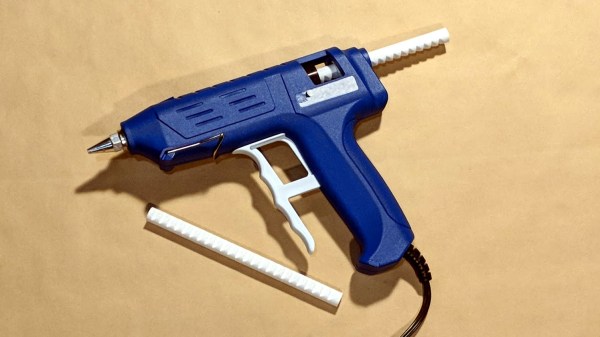
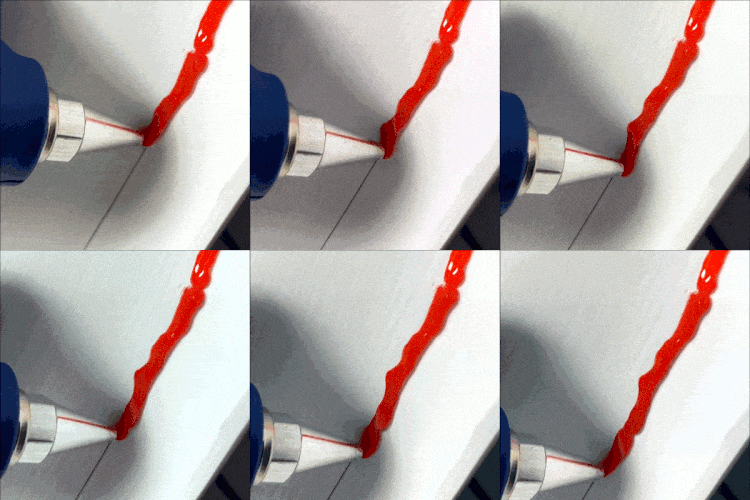
When is a hot glue stick not a hot glue stick? When it’s PLA, of course! A glue gun that dispenses molten PLA instead of hot glue turned out to be a handy tool for joining 3D-printed objects together, once I had figured out how to print my own “glue” sticks out of PLA. The result is a bit like a plus-sized 3D-printing pen, but much simpler and capable of much heavier extrusion. But it wasn’t quite as simple as shoving scrap PLA into a hot glue gun and mashing the trigger; a few glitches needed to be ironed out.
Why Use a Glue Gun for PLA?
Some solutions come from no more than looking at two dissimilar things while in the right mindset, and realizing they can be mashed together. In this case I had recently segmented a large, hollow, 3D model into smaller 3D-printer-sized pieces and printed them all out, but found myself with a problem. I now had a large number of curved, thin-walled pieces that needed to be connected flush with one another. These were essentially butt joints on all sides — the weakest kind of joint — offering very little surface for gluing. On top of it all, the curved surfaces meant clamping was impractical, and any movement of the pieces while gluing would result in other pieces not lining up.
An advantage was that only the outside of my hollow model was a presentation surface; the inside could be ugly. A hot glue gun is worth considering for a job like this. The idea would be to hold two pieces with the presentation sides lined up properly with each other, then anchor the seams together by applying melted glue on the inside (non-presentation) side of the joint. Let the hot glue cool and harden, and repeat. It’s a workable process, but I felt that hot glue just wasn’t the right thing to use in this case. Hot glue can be slow to cool completely, and will always have a bit of flexibility to it. I wanted to work fast, and I wanted the joints to be hard and stiff. What I really wanted was melted PLA instead of glue, but I had no way to do it. Friction welding the 3D-printed pieces was a possibility but I doubted how maneuverable my rotary tool would be in awkward orientations. I was considering ordering a 3D-printing pen to use as a small PLA spot welder when I laid eyes on my cheap desktop glue gun.
“If I have seen further than others, it is by standing upon the shoulders of giants.” This famous quote by Isaac Newton points to an axiom that lies at the heart of The Sciences — knowledge precedes knowledge.
What we know today is entirely based upon what we learned in the past. This general pattern is echoed throughout recorded history by the revelation of one scientific mystery leading to other mysteries… other more compounding questions. In the vast majority of cases these mysteries and other questions are sprung from the source of an experiment with an unexpected outcome sparking the question: “why the hell did it do that?” This leads to more experiments which creates even more questions and next thing you know we go from moving around on horse-drawn carriages to landing drones on Mars in a few generations.
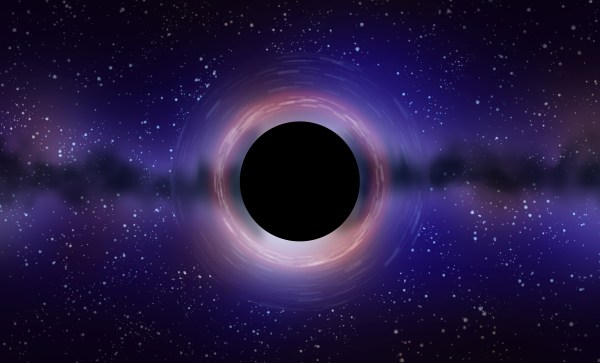
The observant of you will have noticed that I preceded a statement above with “the vast majority of cases.” Apart from particle physics, almost all scientific discovery throughout recorded history has been made via experiment and observation. There are a few, however, that have been discovered hidden within the confines of an equation, only later to be confirmed with observation. One such discovery is the Black Hole, and how it was stumbled upon on a dusty chalkboard in the early 1900s will be the focal point of today’s article.
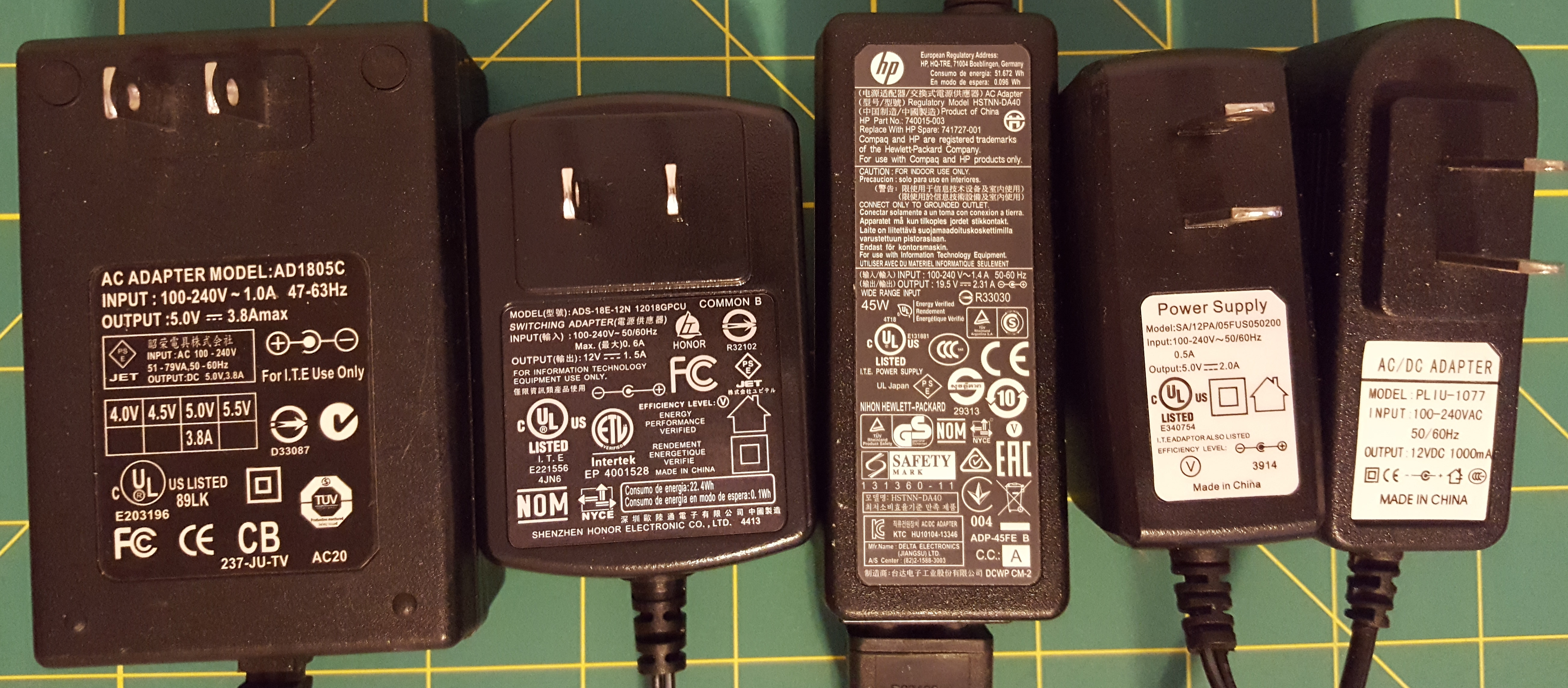
Look on the back of your laptop charger and you’ll find a mess of symbols and numbers. We’d bet you’ve looked at them before and gleaned little or no understanding from what they’re telling you.
These symbols are as complicated as the label on the tag of your shirt that have never taught you anything about doing laundry. They’re the marks of standardization and bureaucracy, and dozens of countries basking in the glow of money made from issuing certificates.
The switching power supply is the foundation of many household electronics — obviously not just laptops — and thus they’re a necessity worldwide. If you can make a power supply that’s certified in most countries, your market is enormous and you only have to make a single device, possibly with an interchangeable AC cord for different plug types. And of course, symbols that have meaning in just about any jurisdiction.
In short, these symbols tell you everything important about your power supply. Here’s what they mean.
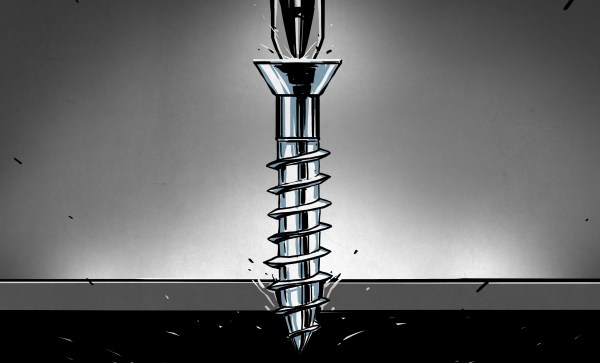
They hold together everything from the most delicate watch to the largest bridge. The world is literally kept from coming apart by screws and bolts, and yet we don’t often give a thought to these mechanisms. Part of that is probably because we’ve gotten so good at making them that they’re seen as cheap commodities, but the physics and engineering behind the screw thread is interesting stuff.
We all likely remember an early science lesson wherein the basic building blocks of all mechanisms laid out. The simple machines are mechanisms that use an applied force to do work, such as the inclined plane, the lever, and the pulley. For instance, an inclined plane, in the form of a splitting wedge, directs the force of blows against its flat face into a chunk of wood, forcing the wood apart.
Screw threads are another simple machine, and can be thought of as a long, gently sloped inclined plane wrapped around a cylinder. Cut a long right triangle out of paper, wrap it around a pencil starting at the big end, and the hypotenuse forms a helical ramp that looks just like a thread. Of course, for a screw thread to do any work, it has to project out more than the thickness of a piece of paper, and the shape of the projection determines the mechanical properties of the screw.





 Some solutions come from no more than looking at two dissimilar things while in the right mindset, and realizing they can be mashed together. In this case I had recently segmented a large, hollow, 3D model into smaller 3D-printer-sized pieces and printed them all out, but found myself with a problem. I now had a large number of curved, thin-walled pieces that needed to be connected flush with one another. These were essentially butt joints on all sides — the weakest kind of joint — offering very little surface for gluing. On top of it all, the curved surfaces meant clamping was impractical, and any movement of the pieces while gluing would result in other pieces not lining up.