If you are an electronic engineer or received an education in electronics that went beyond the very basics, there is a good chance that you will be familiar with the Fairchild μA723. This chip designed by the legendary Bob Widlar and released in 1967 is a kit-of-parts for building all sorts of voltage regulators. Aside from being a very useful device, it may owe some of its long life to appearing as a teaching example in Paul Horowitz and Winfield Hill’s seminal text, The Art Of Electronics. It’s a favourite chip of mine, and I have written about it extensively both on these pages and elsewhere.
The Fairchild switching regulator circuit. From the μA723 data sheet in their 1973 linear IC databook, page 194 onwards.
For all my experimenting with a μA723 over the decades there is one intriguing circuit on its data sheet that I have never had the opportunity to build. Figure 9 on the original Fairchild data sheet is a switching regulator, a buck converter using a pair of PNP transistors along with the diode and inductor you would expect. Its performance will almost certainly be eclipsed by a multitude of more recent dedicated converter chips, but it remains the one μA723 circuit I have never built. Clearly something must be done to rectify this situation.
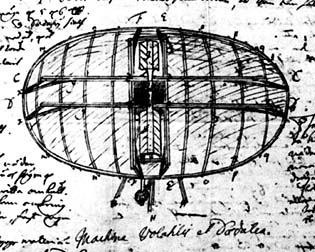
We think of hovercraft as a modern conveyance. After all, any vision of the future usually includes hovercraft or flying cars along with all the other things we imagine in the future. So when do you think the hovercraft first appeared? The 1960s? The 1950s? Maybe it was a World War II development from the 1940s? Turns out, a human-powered hovercraft was dreamed up (but not built) in 1716 by [Emanuel Swedenborg]. You can see a sketch from his notebook below. OK, that’s not fair, though. Imagining it and building one are two different things.
[Swedenborg] realized a human couldn’t keep up the work to put his craft on an air cushion for any length of time. Throughout the 1800s, though, engineers kept thinking about the problem. Around 1870, [Sir John Thornycroft] built several test models of ship’s hulls that could trap air to reduce drag — an idea called air lubrication, that had been kicked around since 1865. However, with no practical internal combustion engine to power it, [Thornycroft’s] patents didn’t come to much. In America, around 1876 [John Ward] proposed a lightweight platform using rotary fans for lift but used wheels to get forward motion. Others built on the idea, but they still lacked the engines to make it completely practical.
But even 1940 is way too late for a working hovercraft. [Dagobert Müller] managed that in 1915. With five engines, the craft was like a wing that generated lift in motion. It was a warship with weapons and a top speed of around 32 knots, although it never saw actual combat. Because of its physical limitations it could only operate over water, unlike more modern craft.
When you think about space stations, which ones come to mind first? You might think Skylab, the International Space Station (ISS), or maybe Russia’s Mir. But before any of those took to the heavens, there was Salyut.
Russia’s Salyut 1 was humankind’s first space station. The ensuing Salyut program lasted fifteen years, from 1971 to 1986, and the lessons learned from this remarkable series of experiments are still in use today in the International Space Station (ISS). The program was so successful at a time when the US manned space program was dormant that one could say that the Russians lost the Moon but won the space race.
Early Bird tickets for Hackaday Belgrade have just gone on sale, but they will not last long. This is Hackaday’s premier European hardware conference with talks, workshops, great food and drink, entertainment, and a hardware badge for hacking and demos. Festivities will go all day on 26 May and carry long into the night. The last time we did this was two years ago and it was completely sold out — now’s the time to get in on the fun.
Who’s speaking, what are the workshops all about, what does the hardware badge do, and what music do you have lined up? Trust your gut — we’ll have more details soon enough but you know this conference will be epic and it’s worth your time and treasure to be there. To reward your enthusiasm, Early Bird tickets are a much better deal than general admission.
Our Call for Proposals is now open. We seek talks and workshops exploring the most interesting uses of technology and the culture that goes along with it.
The Circle of Friends You May Not Have Met
You know those people just outside of the Hackaday orbit who are tired of hearing about the stuff you build and the coding tricks you discover? Those people won’t be there. Everywhere you turn at Hackaday Belgrade, fascinating conversations await. You’ll want it to last a week but it’s just one day… plus a little more.
Plan to arrive in Belgrade on Friday. There will be an unofficial meetup at a bar (last time we took over most of the place). The weather in Springtime is amazing and having pivo on the porch until far too late in the evening was a blast.
Hackaday Belgrade Badge prototype. Voja Antonic, creator of the Galaksija computer — now in museums around the world — just Tweeted this teaser image of the conference badge design.
Things get started, not too early, on Saturday around 10 AM, and we’ll have coffee and treats to kick off the day. The baristas in 2016 were incredible, and the food — lunch and dinner — were as well. These amenities ring the socializing area of the conference in the lobby of the main hall. Talks and workshops will go all day but at 7 PM it’s all about hacking while our crew lay down a live IDM set. At 11 PM the badge hacking demos begin and the live DJ steps up at midnight.
See the Sights
Don’t let things end there. I vaguely remember a 3 or 4 AM ćevapi run after the last Hackaday Belgrade conference, and there were multiple groups planning museum trips the next day. Belgrade has a wonderful Museum of Science and Technology (I made it to that one), a Nikola Tesla Museum (I’m planning to get there this time), and a multitude of interesting attractions. I’ll save you from having to see my gallery of food photos, but the city is fun, inexpensive, and has really delicious cuisine.
It’s an entertaining pastime when browsing the array of wonders available from the other side of the world at the click of the mouse, to scour the listings of the unusual, the interesting, or the inexpensive. Sometimes when you find something unexpected you are rewarded with a diamond in the rough, while at other moments your bargain basement purchase is revealed as a hilariously useless paperweight. This is a game in which the stake is relatively low and the reward can be significant, so rarely does an order for some parts or sundries go by without a speculative purchase.
The latest to arrive is a soldering iron. The CXG E90W is a 90W mains-powered temperature controlled iron with its control electronics built into its handle. Such irons are by no means unusual, what makes this one different is that it has a low price tag.
The Miniware TS100, an iron I quite like and the current darling of the pack, is priced at nearly £50 ($71). Just how can this iron priced at just under £15 ($21) be any good? I placed one on the order, and waited for delivery.
Current. Too little of it, and you can’t get where you’re going, too much and your hardware’s on fire. In many projects, it’s desirable to know just how much current is being drawn, and even more desirable to limit it to avoid catastrophic destruction. The humble current shunt is an excellent way to do just that.
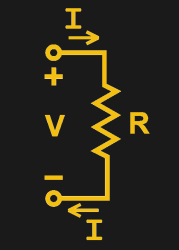
Ohm’s Law.
To understand current, it’s important to understand Ohm’s Law, which defines the relationship between current, voltage, and resistance. If we know two out of the three, we can calculate the unknown. This is the underlying principle behind the current shunt. A current flows through a resistor, and the voltage drop across the resistor is measured. If the resistance also is known, the current can be calculated with the equation I=V/R.
This simple fact can be used to great effect. As an example, consider a microcontroller used to control a DC motor with a transistor controlled by a PWM output. A known resistance is placed inline with the motor and, the voltage drop across it measured with the onboard analog-to-digital converter. With a few lines of code, it’s simple for the microcontroller to calculate the current flowing to the motor. Armed with this knowledge, code can be crafted to limit the motor current draw for such purposes as avoiding overheating the motor, or to protect the drive transistors from failure.
In fact, such strategies can be used in a wide variety of applications. In microcontroller projects you can measure as many currents as you have spare ADC channels and time. Whether you’re driving high power LEDs or trying to build protection into a power supply, current shunts are key to doing this.
If you’ve made it through the last two posts on quantum computing (QC), then you’ve seen the Quirk simulator, a little of IBM’s web-based offering, and how entanglement and superposition can do strange and possibly wonderful things. However, the superdense encoding I showed you didn’t really feel like a real computer algorithm. This time we will look at Grover’s algorithm which is often incorrectly billed as an “unstructured database search.” In reality, it is an algorithm for making a state — that is a set of qubits — match some desired state without simply setting the state.
By analogy, consider a web service where you guess a number. Most discussions of Grover’s algorithm will tell you that the service will only tell you if the number is correct or not. If the number was from 1 to 16, using traditional computing, you’d have to query the values one at a time to see which is correct. You might get lucky and hit the first time. Or it might take 16 times. With qubits you can get the same result in only four attempts. In fact, if you try more times, you might get the wrong answer. Of course, what you really get is an answer that is probably correct, because that how QC works.