Hackaday Berlin: The Badge, Workshops, And Lightning Talks

Hackaday Berlin is just under two weeks away, and we’ve got news times three! If you don’t already have tickets, there are still a few left, so grab them while they’re hot. We’ll be rolling out the final full schedule soon, but definitely plan on attending a pre-party Friday night the 24th, followed by a solid 14-hour day of hacking, talks, and music on Saturday the 25th, and then a mellow Bring-a-Hack brunch with impromptu demos, workshops, and whatever else on Sunday from 10:30 until 14:00.

The Badge Round Two

Many Europeans weren’t able to make the flight to Supercon, so here’s your chance to get hands on Voja Antonic’s superb down-to-the-metal computer trainer-slash-retrocomputer on this side of the Atlantic. It’s been re-skinned for Berlin, with a couple hardware tweaks because nobody can leave a board revision alone, but it’s 100% compatible with the badge that took Supercon 2022 by storm.

If you want to read more about it, you should. We loved it, and so did the crowd. One of the coolest badge hardware hacks was a “punchcard” reader, but there was also a lot of work on the software side as well, and we got pull requests for most of the cool demos. If you’re coming, and if you’d like to start your badge hacking a bit early, you could start your research now.

We’ll have a Badge Hacking Ceremony Saturday night, so you can show off whatever you made. It’s lots of fun. Continue reading “Hackaday Berlin: The Badge, Workshops, And Lightning Talks”
PCIe For Hackers: The Diffpair Prelude

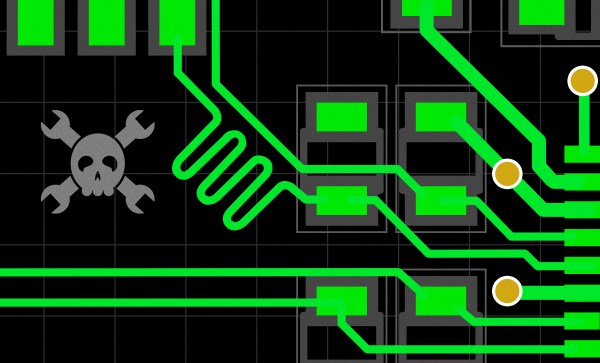
PCIe, also known as PCI-Express, is a highly powerful interface. So let’s see what it takes to hack on something that powerful. PCIe is be a bit intimidating at first, however it is reasonably simple to start building PCIe stuff, and the interface is quite resilient for hobbyist-level technology. There will come a time when we want to use a PCIe chip in our designs, or perhaps, make use of the PCIe connection available on a certain Compute Module, and it’s good to make sure that we’re ready for that.

PCIe is everywhere now. Every modern computer has a bunch of PCIe devices performing crucial functions, and even iPhones use PCIe internally to connect the CPU with the flash and WiFi chips. You can get all kinds of PCIe devices: Ethernet controllers, high-throughput WiFi cards, graphics, and all the cheap NVMe drives that gladly provide you with heaps of storage when connected over PCIe. If you’re hacking on a laptop or a single-board computer and you’d like to add a PCIe device, you can get some PCIe from one of the PCIe-carrying sockets, or just tap into an existing PCIe link if there’s no socket to connect to. It’s been two decades since we’ve started getting PCIe devices – now, PCIe is on its 5.0 revision, and it’s clear that it’s here to stay.

Continue reading “PCIe For Hackers: The Diffpair Prelude”

Supercon 2022: Irak Mayer Builds Self-Sustainable Outdoor IoT Devices

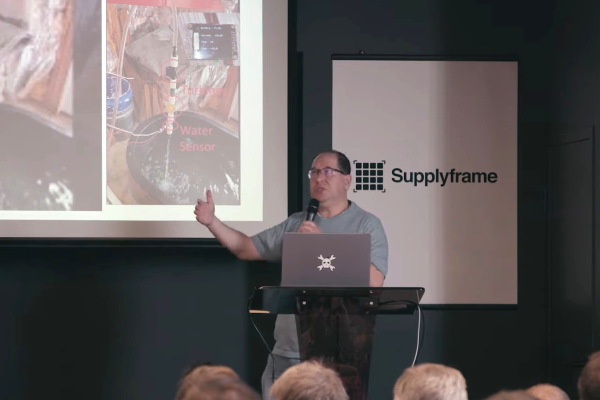
[Irak Mayer] has been exploring IoT applications for use with remote monitoring of irrigation control systems. As you would expect, the biggest challenges for moving data from the middle of a field to the home or office are with connectivity and power. Obviously, the further away from urbanization you get, the sparser both these aspects become, and the greater the challenge.

[Irak] solves his connectivity problem by assuming there is some WiFi network within range, building a system around the Blues Wireless WiFi note card. Substituting their cellular card would be an option for applications out of WiFi range, but presumably without changing too much on the system and software side of things. Leveraging the Adafruit FeatherWing INA219, which is a bidirectional current sensor with an I2C interface, for both the power generation and system consumption measurements. For control, [Irak] is using an Adafruit ESP32 board, but says little more about the hardware. On the software side, [Irak] is using the Blues Wireless NoteHub for the initial connection, which then routes the collected data onto the Adafruit IoT platform for collation purposes. The final part of the hardware is a LiPo battery which is on standby to soak up any excess power available from the energy harvesting. This is monitored by an LC709203f battery fuel gauge.

Continue reading “Supercon 2022: Irak Mayer Builds Self-Sustainable Outdoor IoT Devices”

A Hacker’s Introduction To DIY Light Guide Plates

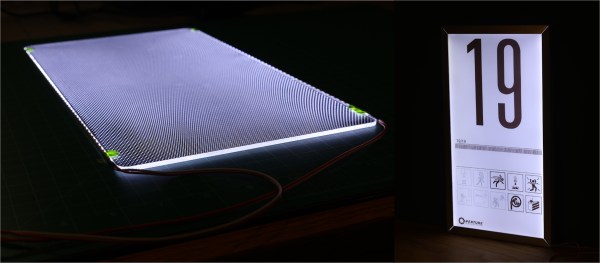
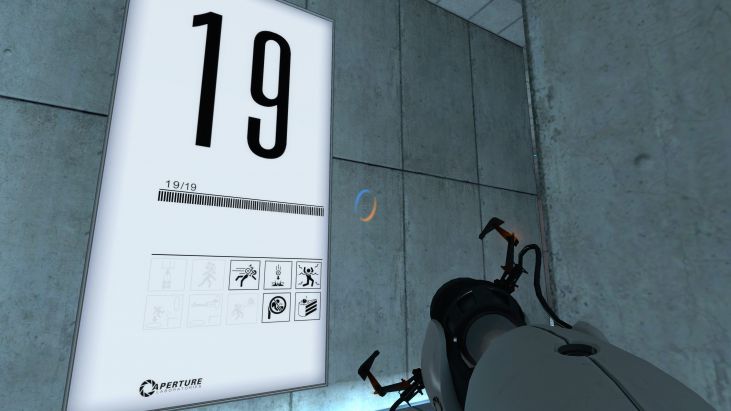
Last year, I found myself compelled to make a scaled-down replica of the iconic test chamber signs from the video game Portal. If you’ve played the game, you’ll remember these signs as the illuminated monoliths that postmarked the start of every test chamber. In hyperstylized video game fashion, they were also extremely thin.

Stay tuned for cake at the end of this article.

True to the original, my replica would need to be both slimmed down and backlit with a uniform, natural white glow. As fate would have it, the crux of this project was finding a way to do just that: to diffuse light coming in from the edges so that it would emit evenly from the front.

What I thought would be quick project ended up being a dive down the rabbit hole that yielded some satisfying results. Today, I’d like to share my findings and introduce you to light guide plates, one of the key building blocks inside of much of today’s backlit screen technology. I’ll dig into the some of the working principles, introduce you to my homebrew approach, and leave you with some inspirational source code to go forth and build your own. Continue reading “A Hacker’s Introduction To DIY Light Guide Plates”

Hackaday Links Column Banner

Hackaday Links: March 12, 2023

With a long history of nearly universal hate for their products, you’d think printer manufacturers would by now have found ways to back off from the policies that only seem to keep aggravating customers. But rather than make it a financially wiser decision to throw out a printer and buy a new one than to buy new ink cartridges or toners, manufacturers keep coming up with new and devious ways to piss customers off. Case in point: Hewlett-Packard now seems to be bricking printers with third-party ink cartridges. Reports from users say that a new error message has popped up on screens of printers with non-HP cartridges installed warning that further use of the printer has been blocked. Previously, printers just warned about potential quality issues from non-HP consumables, but now they’re essentially bricked until you cough up the money for legit HP cartridges. Users who have contacted HP support say that they were told the change occurred because of a recent firmware update sent to the printer, so that’s comforting.

Continue reading “Hackaday Links: March 12, 2023”

Computers For Fun

The last couple years have seen an incredible flourishing of the cyberdeck scene, and probably for about as many reasons as there are individual ’deck designs. Some people get really into the prop-making, some into scrapping old tech or reusing a particularly appealing case, and others simply into the customization possibilities. That’s awesome, and they’re all different motivations for making a computer that’s truly your own.

But I really like the motivation and sentiment behind [Andreas Eriksen]’s PotatoP. (Assuming that his real motivation isn’t all the bad potato puns.) This is a small microcomputer that’s built on a commonly available microcontroller, so it’s not a particularly powerful beast – hence the “potato”. But what makes up for that in my mind is that it’s running a rudimentary bare-metal OS of his own writing. It’s like he’s taken the cyberdeck’s DIY aesthetic into the software as well.

What I like most about the spirit of the project is the idea of a long-term project that’s also a constant companion. Once you get past a terminal and an interpreter – [Andreas] is using LISP for both – everything else consists of small projects that you can check off one by one, that maybe don’t take forever, and that are limited in complexity by the hardware you’re working on. A simple text editor, some graphics primitives, maybe a sound subsystem. A way to read and write files in flash. I don’t love LISP personally, but I love that it brings interactivity and independence from an external compiler, making the it possible to develop the system on the system, pulling itself up by its own bootstraps.

Pretty soon, you could have something capable, and completely DIY. But it doesn’t need to be done all at once either. With a light enough computer, and a good basic foundation, you could keep it in your backpack and play “OS development” whenever you’ve got the free time. A DIY play OS for a sandbox computing platform: what more could a nerd want?

Retrotechtacular: The Revolutionary Visual Effects Of King Kong

Today, it’s easy to take realistic visual effects in film and TV for granted. Computer-generated imagery (CGI) has all but done away with the traditional camera tricks and miniatures used in decades past, and has become so commonplace in modern productions that there’s a good chance you’ve watched scenes without even realizing they were created partially, or sometimes even entirely, using digital tools.

But things were quite different when King Kong was released in 1933. In her recently released short documentary King Kong: The Practical Effects Wonder, Katie Keenan explains some the groundbreaking techniques used in the legendary film. At a time when audiences were only just becoming accustomed to experiencing sound in theaters, King Kong employed stop-motion animation, matte painting, rear projection, and even primitive robotics to bring the titular character to life in a realistic way.

Continue reading “Retrotechtacular: The Revolutionary Visual Effects Of King Kong