Floppy Disk Sales Are Higher-Density Than You Might Think

Floppies may be big in Japan, but nostalgic and/or needful Stateside floppy enthusiasts needn’t fret — just use AOL keyword point that browser toward floppydisk.com. There, you can buy new floppies of all sizes, both new and old, recycle your disks, or send them in to get all that precious vintage stuff transferred off of them.

That delightfully Web 1.0 site is owned by Tom Persky, who fancies himself the ‘last man standing in the floppy disk business’. Who are we to argue? By the way, Tom has owned that address since approximately 1990 — evidently that’s when a cyber-squatter offered up the domain for $1,000, and although Tom scoffed at paying so much as $1 for any URL, his wife got the checkbook out, and he has had her to thank for it ever since.

My business, which used to be 90% CD and DVD duplication, is now 90% selling blank floppy disks. It’s shocking to me. — Tom Persky

In the course of writing a book all about yours-truly’s favorite less-than-rigid medium, authors Niek Hilkmann and Thomas Walskaar sat down to talk with Tom about what it’s like to basically sell buggy whips in the age of the electric car.

Tom also owns diskduper.com, which is where he got his start with floppies — by duplicating them. In the 80s and 90s, being in this business was a bit like cranking out legal tender in the basement. As time wore on and more companies stopped selling floppies or simply went under, the focus of Tom’s company shifted away from duplication and toward sales. Whereas the business was once 90% duplication and 10% floppy sales, in 2022, those percentages have flopped places, if you will.

Continue reading “Floppy Disk Sales Are Higher-Density Than You Might Think”

IGY: The Year We All Got Along

If you are a Steely Dan fan, you might know the Donald Fagen song, “IGY.” In it, Fagen sings about a rosy future with high-speed undersea rail, solar power, giant computers making life better, and spandex jackets. Since that song was on the 1982 album Nightfly, it is already too old for some people to remember, but the title goes back even further: the International Geophysical Year which was actually a little longer than a year in 1957 and 1958. The year was a concerted effort by 67 countries to further mankind’s knowledge of the Earth. It was successful,  and was big news in its day, although not much remembered now.

The real origin dates back to even earlier. In 1882 and 1932 there were International Polar Years dedicated to researching the polar regions of the Earth. In a way, it makes sense to do this. Why should 60 or more countries each mount difficult, dangerous, and expensive expeditions to such a hostile environment? However, instead of a third polar year, James Van Allen (who has a famous belt) and some other scientists felt that advances in many fields made it the right time to study geophysics. From the scientific point of view, the IGY coincided with the solar activity cycle maximum. But there were other forces at play, too.

Continue reading “IGY: The Year We All Got Along”

Retrotechtacular: The Original Robot Arm

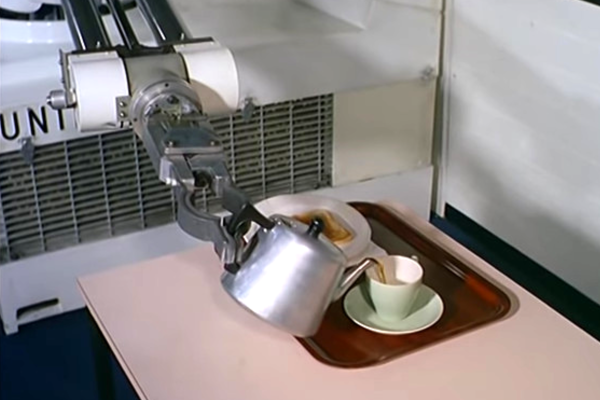
Do you know the name [George Devol]? Probably not. In 1961 he received a patent for “Programmed Article Transfer.” We’d call his invention the first robot arm, and its name was the Unimate. Unlike some inventors, this wasn’t some unrealized dream. [Devol’s] arm went to work in New Jersey at a GM plant. The 4,000 pound arm cost $25,000 and stacked hot metal parts. With tubes and hydraulics, we imagine it was a lot of work to keep it working. On the other hand, about 450 of the arms eventually went to work somewhere.

The Unimate became a celebrity with an appearance in at least one newsreel — see below — and the Johnny Carson show. Predictably, the robot in the newsreel was pouring drinks.

Continue reading “Retrotechtacular: The Original Robot Arm”

Sappers clearing the last mines from the beach front of a former French luxury hotel, now in use as a rest club for troops of 3rd Division, 15 July 1944.

The Long Tail Of War: Finding Unexploded Ordnance Before It Finds Us

Long after the enemy forces have laid down their arms, peace accords have been signed and victories celebrated, there is still a heavy toll to be paid. Most of this comes in the form of unexploded ordnance, including landmines and the severe pollution from heavy metals and other contaminants that can make large areas risky to lethal to enter. Perhaps the most extreme example of this lasting effect is the Zone Rouge (Red Zone) in France, which immediately after the First World War came to a close comprised 1,200 square kilometers.

Within this zone, contamination with heavy metals is so heavy that some areas do not support life, while unexploded shells – some containing lethal gases – and other unexploded ordnance is found throughout the soil. To this day much of the original area remains off-limits, though injuries from old, but still very potent ordnance are common around its borders. Clean-up of the Zone Rouge is expected to take hundreds of years. Sadly, this a pattern that is repeated throughout much of the world. While European nations stumble over ordnance from its two world wars, nations in Africa, Asia and elsewhere struggle with the legacy from much more recent conflicts.

Currently, in Europe’s most recent battlefield, more mines are being laid, booby traps set and unexploded shells and other ordnance scattered where people used to live. Clearing these areas, to make them safe for a return of their inhabitants has already begun in Ukraine, but just like elsewhere in the world, it is an arduous and highly dangerous process with all too often lethal outcomes.

Continue reading “The Long Tail Of War: Finding Unexploded Ordnance Before It Finds Us”

Hackaday Links Column Banner

Hackaday Links: September 18, 2022

We always love when people take the trouble to show information in new, creative ways — after all, there’s a reason that r/dataisbeautiful exists. But we were particularly taken by this version of the periodic table of the elements, distorted to represent the relative abundance on Earth of the 90 elements that make up almost everything. The table is also color-coded to indicate basically how fast we’re using each element relative to its abundance. The chart also indicates which elements are “conflict resources,” basically stuff people fight over, and which elements go into making smartphones. That last bit we thought was incomplete; we’d have sworn at least some boron would be somewhere in a phone. Still, it’s an interesting way to look at the elements, and reminds us of another way to enumerate the elements.

It’s wildfire season in the western part of North America again, and while this year hasn’t been anywhere near as bad as last year — so far — there’s still a lot of activity in our neck of the woods. And wouldn’t you know it, some people seem to feel like a wildfire is a perfect time to put up a drone. It hardly seems necessary to say that this is A Really Bad Idea™, but for some reason, people still keep doing it. Don’t misunderstand — we absolutely get how cool it is to see firefighting aircraft do their thing. The skill these pilots show as they maneuver their planes, which are sometimes as large as passenger jets, within a hundred meters of the treetops is breathtaking. But operating a drone in the same airspace is just stupid. Not only is it likely to get you in trouble with the law, but there’s a fair chance that the people whose property and lives are being saved by these heroic pilots won’t look kindly on your antics.

Continue reading “Hackaday Links: September 18, 2022”

Why Can’t We Have Pretty Things?

I was reading [Al Williams]’ great rant on why sometimes the public adoption of tech moves so slowly, as exemplified by the Japanese Minister of Tech requesting the end of submissions to the government on floppy diskettes. In 2022!

Along the way, [Al] points out that we still trust ballpoint-pen-on-paper signatures more than digital ones. Imagine going to a bank and being able to open an account with your authentication token! It would be tons more secure, verifiable, and easier to store. It makes sense in every way. Except, unless you’ve needed one for work, you probably don’t have a Fido2 (or whatever) token, do you?

Same goes for signed, or encrypted, e-mail. If you’re a big cryptography geek, you probably have a GPG key. You might even have a mail reader that supports it. But try requesting an encrypted message from a normal person. Or ask them to verify a signature.

Honestly, signing and encrypting are essentially both solved problems, from a technical standpoint, and for a long time. But somehow, from a societal point of view, we’re not even close yet. Public key encryption dates back to the late 1970’s, and 3.5” diskettes are at least a decade younger. Diskettes are now obsolete, but I still can’t sign a legal document with my GPG key. What gives?

This Week In Security: 11,000 Gas Stations, TrustZone Hacks Kernel, And Unexpected Fuzzing Finds

Automated Tank Gauges (ATGs) are nifty bits of tech, sitting unseen in just about every gas station. They keep track of fuel levels, temperature, and other bits of information, and sometimes get tied into the automated systems at the station. The problem, is that a bunch of these devices are listening to port 10001 on the Internet, and some of them appear to be misconfigured. How many? Let’s start with the easier question, how many IPs have port 10001 open? Masscan is one of the best tools for this, and [RoseSecurity] found over 85,000 listening devices. An open port is just the start. How many of those respond to connections with the string In-Tank Inventory Reports? Shodan reports 11,113 IPs as of August of this year. [RoseSecurity] wrote a simple Python script that checked each of those listening IPs came up with a matching number of devices. The scary bit is that this check was done by sending a Get In-Tank Inventory Report command, and checking for a good response. It seems like that’s 11K systems, connected to the internet, with no authentication. What could possibly go wrong? Continue reading “This Week In Security: 11,000 Gas Stations, TrustZone Hacks Kernel, And Unexpected Fuzzing Finds”