Taking A Crack At The Traveling Salesman Problem

The human mind is a path-planning wizard. Think back to pre-lockdown days when we all ran multiple errands back to back across town. There was always a mental dance in the back of your head to make sense of how you planned the day. It might go something like “first to the bank, then to drop off the dry-cleaning. Since the post office is on the way to the grocery store, I’ll pop by and send that box that’s been sitting in the trunk for a week.”

This sort of mental gymnastics doesn’t come naturally to machines — it’s actually a famous problem in computer science known as the traveling salesman problem. While it is classified in the industry as an NP-hard problem in combinatorial optimization, a more succinct and understandable definition would be: given a list of destinations, what’s the best round-trip route that visits every location?

This summer brought news that the 44-year old record for solving the problem has been broken. Let’s take a look at why this is a hard problem, and how the research team from the University of Washington took a different approach to achieve the speed up.

Continue reading “Taking A Crack At The Traveling Salesman Problem”
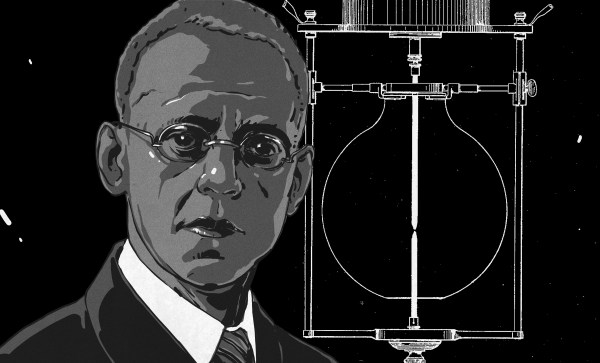
Lewis Latimer Drafted The Future Of Electric Light

These days, we have LED light bulbs that will last a decade. But it wasn’t so long ago that incandescent lamps were all we had, and they burned out after several months. Thomas Edison’s early light bulbs used bamboo filaments that burned out very quickly. An inventor and draftsman named Lewis Latimer improved Edison’s filament by encasing it in cardboard, earning himself a patent the process.

Lewis had a hard early life, but he succeeded in spite of the odds and his lack of formal education. He was a respected draftsman who earned several patents and worked directly with Alexander Graham Bell and Thomas Edison. Although Lewis didn’t invent the light bulb, he definitely made it better and longer-lasting. Continue reading “Lewis Latimer Drafted The Future Of Electric Light”

Mazda Investing Big In Advanced Gasoline Tech With Skyactiv-X

Electric cars, as a concept, were once not dissimilar from the flying car. Promised to be a big thing in the future, but hopelessly impractical in the here and now. However, in the last ten years, they’ve become a very real thing, with market share growing year on year as new models bring greater range and faster charging times.

With their lower emissions output and ever-improving performance, one could be forgiven for thinking that traditional combustion engines are all but dead. Mazda would beg to differ – investing heavily in new technology to take the gasoline engine into the next decade and beyond. Continue reading “Mazda Investing Big In Advanced Gasoline Tech With Skyactiv-X”

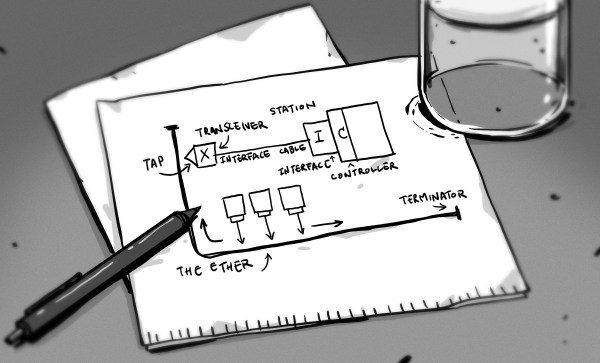
Ethernet At 40: From A Napkin Sketch To Multi-Gigabit Links

September 30th, 1980 is the day when Ethernet was first commercially introduced, making it exactly forty years ago this year. It was first defined in a patent filed by Xerox as a 10 Mb/s networking protocol in 1975, introduced to the market in 1980 and subsequently standardized in 1983 by the IEEE as IEEE 802.3. Over the next thirty-seven years, this standard would see numerous updates and revisions.

Included in the present Ethernet standard are not just the different speed grades from the original 10 Mbit/s to today’s maximum 400 Gb/s speeds, but also the countless changes to the core protocol to enable these ever higher data rates, not to mention new applications of Ethernet such as power delivery and backplane routing. The reliability and cost-effectiveness of Ethernet would result in the 1990 10BASE-T Ethernet standard (802.3i-1990) that gradually found itself implemented on desktop PCs.

With Ethernet these days being as present as the presumed luminiferous aether that it was named after, this seems like a good point to look at what made Ethernet so different from other solutions, and what changes it had to undergo to keep up with the demands of an ever-more interconnected world. Continue reading “Ethernet At 40: From A Napkin Sketch To Multi-Gigabit Links”

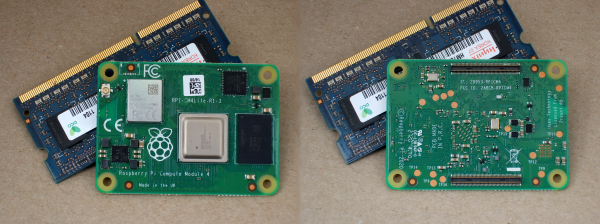
New Raspberry Pi 4 Compute Module: So Long SO-DIMM, Hello PCIe!

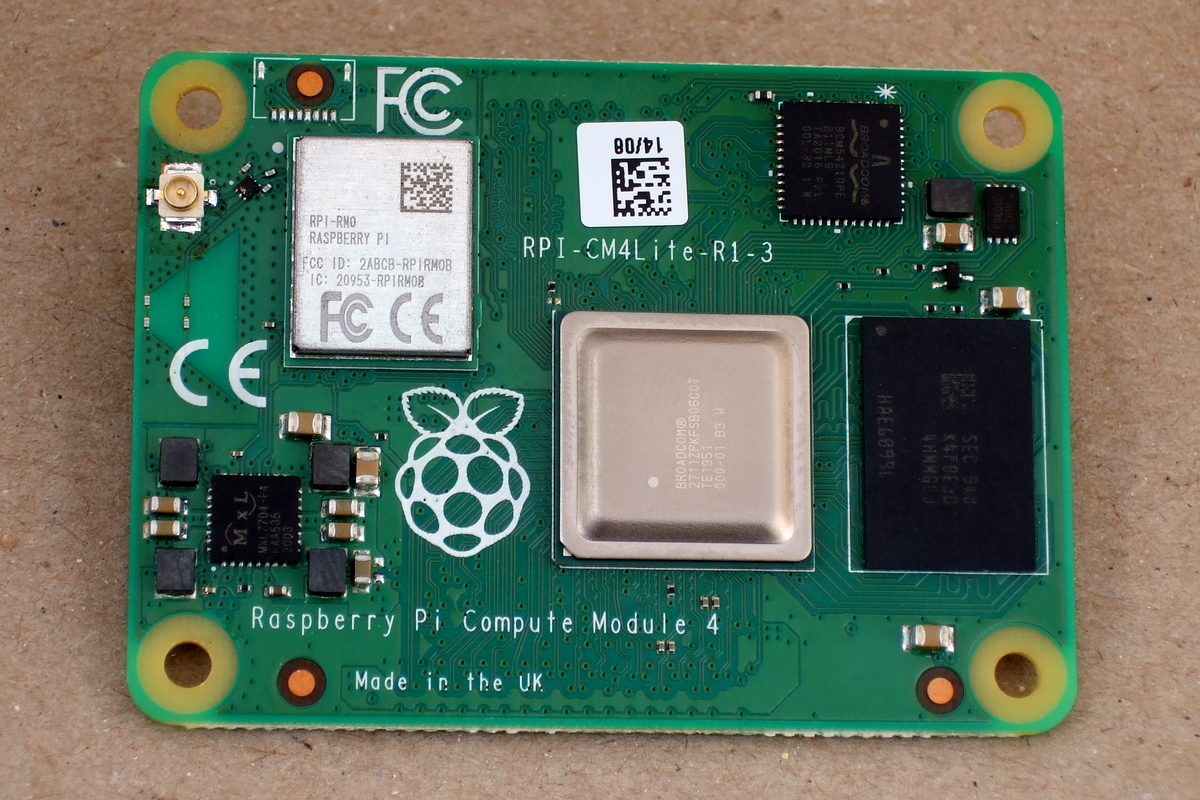
The brand new Raspberry Pi Compute Module 4 (CM4) was just released! Surprised? Nope, and we’re not either — the Raspberry Pi Foundation had hinted that it was going to release a compute module for the 4-series for a long while.

The form factor got a total overhaul, but there’s bigger changes in this little beastie than are visible at first glance, and we’re going to walk you through most of them. The foremost bonuses are the easy implementation of PCIe and NVMe, making it possible to get data in and out of SSDs ridiculously fast. Combined with optional WiFi/Bluetooth and easily designed Gigabit Ethernet, the CM4 is a connectivity monster.

One of the classic want-to-build-it-with-a-Pi projects is the ultra-fast home NAS. The CM4 makes this finally possible.

If you don’t know the compute modules, they are stripped-down versions of what you probably think of as a Raspberry Pi, which is officially known as the “Model B” form-factor. Aimed at commercial applications, the compute modules lack many of the creature comforts of their bigger siblings, but they trade those for flexibility in design and allow for some extra functionality.

The compute modules aren’t exactly beginner friendly, but we’re positively impressed by how far Team Raspberry has been able to make this module accessible to the intermediate hacker. Most of this is down to the open design of the IO Breakout board that also got released today. With completely open KiCAD design files, if you can edit and order a PCB, and then reflow-solder what arrives in the mail, you can design for the CM4. The benefit is a lighter, cheaper, and yet significantly more customizable platform that packs the power of the Raspberry Pi 4 into a low-profile 40 mm x 55 mm package.

So let’s see what’s new, and then look a little bit into what is necessary to incorporate a compute module into your own design.

Continue reading “New Raspberry Pi 4 Compute Module: So Long SO-DIMM, Hello PCIe!”

Hackaday Podcast 089: 770 Potato Battery, Printing Resin Resist, And No-Internet Video Chat

Hackaday editors Mike Szczys and Elliot Williams weigh the hacking gold found across the internet this week. We can’t get over the epic adventure that went into making a battery from 100 pounds of potatoes. It turns out you don’t need Internet for video conferencing as long as you’re within a coupe of kilometers of everyone else. And move over toner transfer method, resin printers want a shot at at-home PCB etching. We’ll take a look at what the Tesla selfie cam is doing under the hood, and lose our marbles over a ball-bearing segment clock that’s defying gravity.

Take a look at the links below if you want to follow along, and as always, tell us what you think about this episode in the comments!

Take a look at the links below if you want to follow along, and as always, tell us what you think about this episode in the comments!

Direct download (60 MB or so.)

Continue reading “Hackaday Podcast 089: 770 Potato Battery, Printing Resin Resist, And No-Internet Video Chat”

Axe Hacks: Spinning Knobs And Flipping Switches

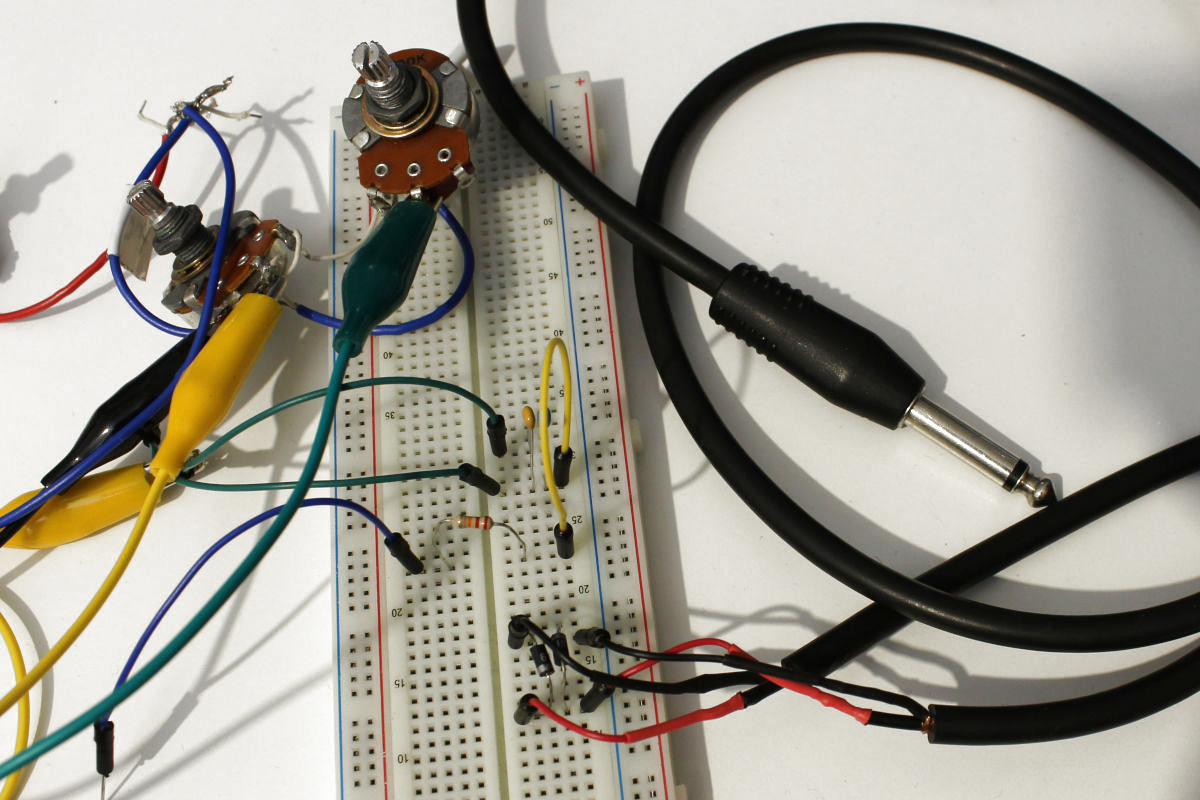
From a guitar hacking point of view, the two major parts that are interesting to us are the pickups and the volume/tone control circuit that lets you adjust the sound while playing. Today, I’ll get into the latter part and take a close look at the components involved — potentiometers, switches, and a few other passive components — and show how they function, what alternative options we have, and how we can re-purpose them altogether.

In that sense, it’s time to heat up the soldering iron, get out the screwdriver, and take off that pick guard / open up that back cover and continue our quest for new electric guitar sounds. And if the thought of that sounds uncomfortable, skip the soldering iron and grab some alligator clips and a breadboard. It may not be the ideal environment, but it’ll work.

Continue reading “Axe Hacks: Spinning Knobs And Flipping Switches”