EV History: The Lightning Precedes The Thunder

In 1988, a bunch of engineers from Hotzenwald, Germany, came together and decided that it is time for the future of mobility: A new, more modern and environmentally friendly car should put an end to fossils and emissions while still being fun to drive. “It should become a new kind of car. Smaller, lighter, cleaner – and more beautiful” is how future CEO Thomas Albiez described his mission. For the first time in automotive history, this series car would be designed as an all-electric vehicle from the start and set a new standard for mobility. The project was given the codename “Hotzenblitz” (“Hotzen Bolt”) to indicate how the idea came to them: Like a lightning bolt. The snarky regional term also came with a double meaning: Imaginary lightning bolts, used for insurance fraud.
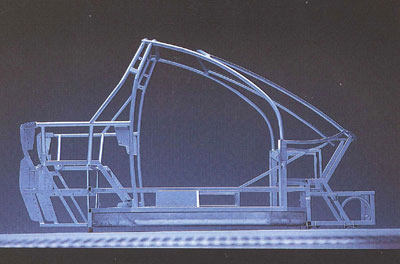
hotzenblitz_chassis
Hotzenblitz frame construction (origin unknown, image source)

Unnoticed by the rest of the world, they founded Hotzenblitz Mobile. Industrial Designer Harold Schurz was contracted to design the chassis for the Hotzenblitz, which was then modeled into a prototype chassis. The self-funded team moved fast. An external motorsports company helped to develop the tubular steel frame, and soon their vision took on shape. After the team had fitted a motor and transmission into the frame, CEO Thomas Albiez himself installed the traction battery and drive train. The team felt confident with the result, and in July 1990, during an open house day in the office, they somewhat spontaneously decided to call Green Tech entrepreneur and chocolate mogul Alfred Ritter.

Alfred Ritter had experienced financial losses after the Chernobyl Disaster. Many agricultural regions, including several hazelnut plantations that were vital to Alfred’s chocolate business, were irreversibly lost to the fallout contamination. It was then when he turned to the green energy business, founding the Paradigma group to manufacture solar collector systems and pellet heaters. When Thomas and the team called, Alfred jumped on the idea of an electric car. In the same year, Alfred Ritter and his sister Marli Hoppe-Ritter became shareholders in the company and helped to finance the future of the Hotzenblitz.

Continue reading “EV History: The Lightning Precedes The Thunder”
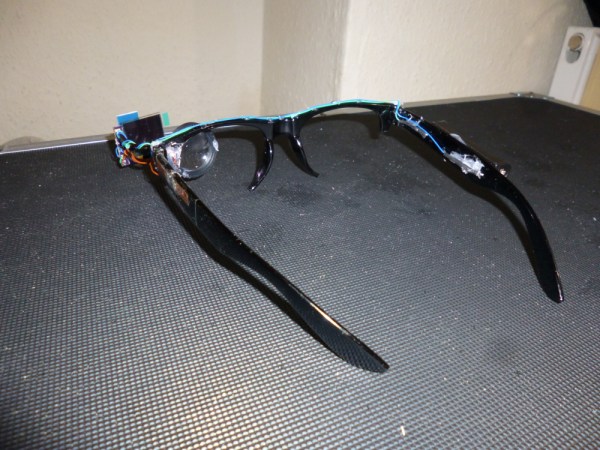
Homemade Smart Glasses Shows Why Smart Glasses Are Hard

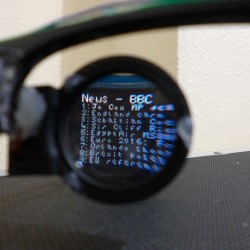
[Harris Shallcross] decided to build a pair of smart glasses and recently completed a first prototype of his project ‘Ochi’ – an STM32 based, BLE-connected, OLED eyeglass display. There are of course several homebrew smart glasses projects out there; many are more polished-looking and nearly all of them also display information from a smartphone over Bluetooth. This one is interesting partly because it highlights many of the design challenges that smart glasses and other near-eye displays face. It also demonstrates the iterative development process: begin by getting something working to learn what does and doesn’t cut it at a basic level, and don’t optimize prematurely; let the process bring problems to the surface.

Ochi-1 Smart Glasses BBC feed SquareFor his project, [Harris Shallcross] used a small 0.95″ diagonal 96×64 color OLED as the display. The lens is from a knockoff Google Cardboard headset, and is held in a 3D printed piece that slides along a wire rail to adjust focus. The display uses a custom font and is driven by an STM32 microcontroller on a small custom PCB, with an HM11 BLE module to receive data wirelessly. Power is provided by a rechargeable lithium-ion battery with a boost converter. An Android app handles sending small packets of data over Bluetooth for display. The prototype software handles display of time and date, calendar, BBC news feed, or weather information.

Devices like these have a lot to deal with. Weight and distribution of that weight is a concern, the size and comfort of the optics is important, and displaying data on a small OLED is only part of the battle – choosing what information to display and when are vital to the device being actually useful in any way, otherwise it’s just a tech demo.

This project set out to show whether it was possible to use the parts listed to make a glasses mounted smart display that was at least somewhat functional, and the software to support it. Clearly, [Harris Shallcross] succeeded at that, but what really showcases the development process is his list of improvements – what he decided needs to go into a second version, and why. One of those goals is to improve the optics; perhaps there’s something to learn from The $60 Bluetooth Head Mounted Display project, which used a similar OLED and a prism to locate the display off to the side instead of in front.

Effortlessly Send Antenna Wires Skywards With A Spud Gun

The heroes of action films always make it look so easy. Need to climb a tall building? Simply fire a grapnel hook from a handy harpoon gun, it’ll always land exactly where you want it and gain a perfect purchase so you can shin up the rope and arrive at the top barely having raised a sweat. If Hackaday ran Q Branch, we can tell you, we’d make ’em work a bit harder. If only because nobody likes a smartass.

If you’ve ever had to get a real line over something tall, you’ll know it’s a lot more difficult than that. You can only make it work with the lightest of lines that you can then use to pull up something more substantial, and you would be amazed how poor a thrower you are when you’re trying to throw upwards. Try attaching fishing line to a weight, try a bow and arrow, and nine times out of ten you won’t make it. There’s a serious amount of skill and luck involved in this line-throwing game.

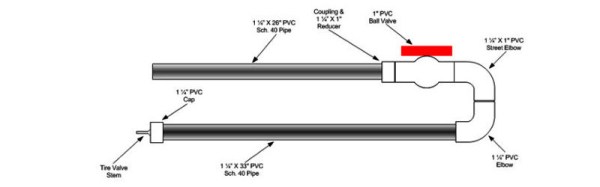
[WB5CXC] has an interesting solution to this problem, at least as far as the application of throwing antenna wires over tall obstacles. He’s made a spud gun from PVC pipe, powered by compressed air. It takes the form of a U-shaped tube with one side of the U being a pressure vessel separated from the other by a ball valve.. Place a close-fitting puck with your wire attached in the open side with the valve closed, pump the pressure vessel full of air with a bicycle pump, and open the valve to send both puck and wire skywards. He says it will clear 100′ trees, counsels the user not to go higher than 100psi, and warns that the speeding puck can be dangerous. We like it already.

We’ve covered many spud guns here at Hackaday in the past, but it seems this is the first wire launching one. We’ve had a steam one for example, or this bolt-action spud gun, but pride of place has to go to the spud gun to end all spud guns.

Via DXZone.

Crowdfunding: A Wireless Oscilloscope

One of the most ingenious developments in test and measuring tools over the last few years is the Mooshimeter. That’s a wireless, two-channel multimeter that can measure voltage and current simultaneously. If you’ve ever wanted to look at the voltage drop and power output on a souped up electrified go-kart, the Mooshimeter is the tool for you.

A cheap, wireless multimeter was only the fevered dream of a madman a decade ago. We didn’t have smartphones with Bluetooth back then, so any remote display would cost much more than the multimeter itself. Now this test and measurement over Bluetooth is bleeding over into the rest of the electronics workbench with the Aeroscope,  a wireless Bluetooth oscilloscope.

[Alexander] and [Jonathan], the devs for the Aeroscope got the idea for this device while debugging a mobile robot. The robot would work on the bench, but in the field the problem would reappear. The idea for a wireless troubleshooting tool was born out of necessity.

The specs for the Aeroscope are about equal to the quite capable ‘My First Oscilloscope’ Rigol DS1052E. Analog bandwidth is 100MHz, sample rate is 500 Msamples/second, and the memory depth is 10k points. Resolution per division is 20mV to 10V, and the Aeroscope “Deluxe Package” that includes a few leads, tip, clip, USB cable, and case is about the same price as the Rigol 1052E. The difference, of course, is that the Aeroscope is a single channel, and wireless. That’s fairly impressive for two guys who aren’t a team of Rigol engineers.

As is the case with all Bluetooth test and measurement devices, the proof is in the app. Right now, the Aeroscope only supports iOS 9 devices, but according to the crowdfunding campaign, Android support is coming. Since the device is Open Source, you can always bang something out in Python if you really need to.

While this is a crowdfunding campaign, it’s hosted on Crowd Supply. Crowd Supply isn’t Indiegogo or Kickstarter; there are people at Crowd Supply vetting projects. The campaign still has a month to go, but the first few pledges are putting the Aeroscope right on track to a successful campaign.

Reverse Engineering The McDonald’s French Fry

McDonald’s is serious about their fries. When they were forced by shifting public opinion (drunkenly swaggering around as it always does) to switch from their beef tallow and cottonseed oil mixture to a vegetable oil mixture; they spent millions to find a solution that retained the taste. How they make the fries is not the worlds most closely guarded secret, but they do have a unique flavor, texture, and appearance which is a product of lots of large scale industrial processes. [J. Kenji López-Alt] decided to reverse engineer the process.

His first problem was of procurement. He could easily buy cooked fries, but he needed the frozen fries from McDonald’s to begin his reverse engineering. McDonald’s refused to sell him uncooked fries, “They just don’t do that,” one employee informed him. He reached out to his audience, and one of them had access to a charlatan. The mountebank made quick work of the McDonald’s employees and soon [J. Kenji] had a few bags of the frozen potato slivers to work with.

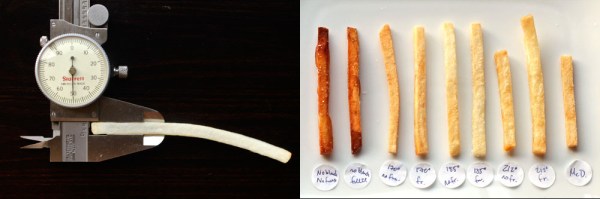
What follows next was both entertaining and informative. At one point he actually brought out a Starrett dial caliper to measure the fries; they were 0.25in squares in cross section. Lots of research and experimentation was done to get that texture. For example, McDonald’s fries aren’t just frozen raw potatoes. They are, in fact; blanched, flash fried, frozen and then fried again. Getting this process right was a challenge, but he arrived at similar fries by employing his sous vide cooker.

He then wanted to see if he could come up with a french fry recipe that not only allowed the home chef to make their own McDonald’s fries, but improve on them as well. It gets into some food chemistry here. For example he found that the same effect as blanching could be produced by boiling the fries; if you added vinegar to keep the cell walls from disintegrating.

The article certainly shows how knowledge of the chemistry behind cooking can improve the results.

Driving BB-8 - More than one way to move this bot

Driving BB-8: More Than One Way To Move This Bot

BB-8 is the much loved new droid introduced in the 2016 movie Star Wars: The Force Awakens, though in my case from the very first trailer released in 2014 I liked it for the interesting engineering problems it posed. How would you make a robot that’s a ball that rolls along, but with a head that stays on top while the ball rolls under it?

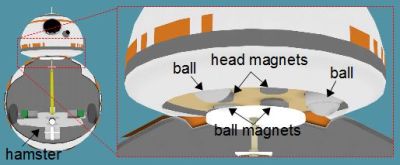
To make the ball roll, the answer most people found obvious at first was to use the analogy of a hamster wheel. The hamster running inside makes the wheel turn. In the BB-8 building world, which is quite large, the drive mechanism has come to be called a hamster drive, or just a hamster.

Magnets holding the head on

For the head, it seemed obvious that there would be magnets inside the ball, perhaps held in place near the top of the ball by a post extending up from the hamster. Corresponding magnets in attraction would then be attached to the underside of the head, and balls (also mounted under the head) would keep the head moving smoothly over the ball.

The magnet approach for the head has turned out to be the method used by all BB-8 builders that I’ve seen. However, the hamster has turned out to be only one of multiple solutions. Since the original debut many different methods have been used in builds and we’re going to have a lot of fun looking at each separate approach. It’s almost like revealing a magic trick; but really it’s all just clever engineering.

Note that for the actual movie, a combination of 7 or 8 props and CGI were used. The official working BB-8s that are shown at various promotional events were built after the movie was made and as of this writing, few details of their construction have been released. One notable detail, however, is that they aren’t using hamster drives.

Below are details of all the different BB-8 drive systems I’ve seen so far that have been built along with how they work.

Continue reading “Driving BB-8: More Than One Way To Move This Bot”

Fail Of The Week: Arachno∙fail∙ia

Going down the list (FCC, CE, UL, etc.) we can’t think of a regulating body that will test for this failure mode. Reportedly, a $1M irrigation system was taken down by a spider. And an itsy-bitsy spider at that.

This fail turned up as a quick image post over on /r/mildlyinteresting but I wasn’t the only electronics person attracted like a moth to a flame. Our friend [Sprite_TM] popped in to answer a question about conformal coating. Seems this board was sealed in a waterproof enclosure but was obviously not conformally coated.

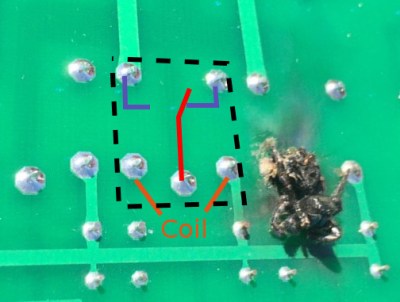
fotw-spider-short-relay-diagram[Sprite_TM] also helped out with some armchair-engineering to guess at what happened. It’s not hard to tell that the footprint on the board looks like a set of mechanical relays all in a line. He looked up the most likely pinout for the relay.

We’ve superimposed that pinout on the board to help illustrate the failure. High voltage comes in on the pin shown with the red trace leading away from it. On either side of that pin are the connections for the low voltage coil which switches from normally closed (the pin in the upper right that is not connected to anything) to the normally open pin (which has the wide trace leading away from it).

So there sat the high voltage pin in between the coil pins when, along came a spider. It shorted the pins and presumably all the way back to the power supply for the low voltage rail. [Fugly_Turnip] (the OP) share some additional detail about the system and this failure; in addition to this card it fried the control module as well.

Another comment on the same thread shares a different story of two boards mounted next to each other with a bug shorting a 1/4″ air gap between two boards and causing similar carnage. Have you encountered Arachno-fail-ia of your own? Let us know below.


2013-09-05-Hackaday-Fail-tips-tileFail of the Week is a Hackaday column which celebrates failure as a learning tool. Help keep the fun rolling by writing about your own failures and sending us a link to the story — or sending in links to fail write ups you find in your Internet travels.