Vampire Charger Is A Rugged Anything-to-5VDC Converter

USB sockets providing 5 VDC are so ubiquitous as a power source that just about any piece of modern portable technology can use them to run or charge. USB power is so common, in fact, that it’s easy to take for granted. But in an emergency or in the wake of a disaster, a working cell phone or GPS can be a life saver and it would be wise not to count on the availability of a clean, reliable USB power supply.

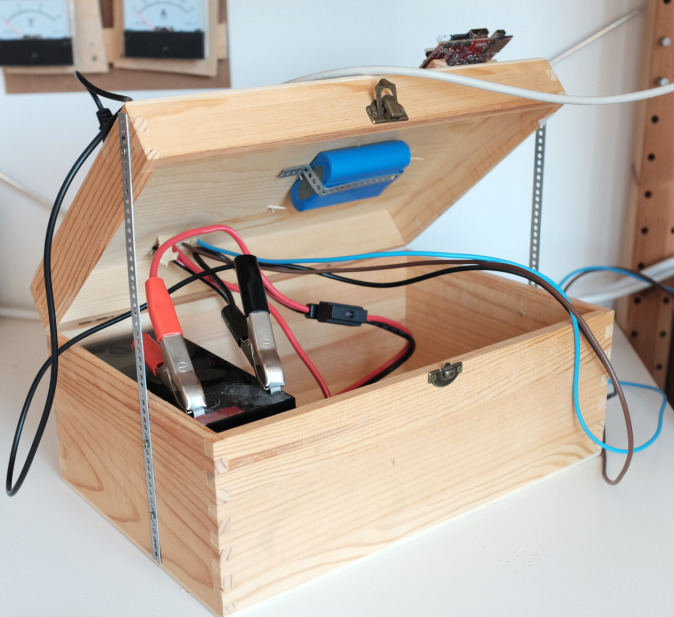
That’s where the Vampire Charger by [Matteo Borri] and [Lisa Rein] comes in. It is a piece of hardware focused on turning just about any source or power one might possibly have access to into a reliable source of 5 VDC for anything that can plug in by USB. This is much more than a DC-DC converter with a wide input range; when they say it is made to accept just about anything as an input, they mean it. Found a working power source but don’t know what voltage it is? Don’t know which wire is positive and which is negative? Don’t even know whether it’s AC or DC? Just hook up the alligator clips and let the Vampire Charger figure it out; when the light is green, the power’s clean.

The Vampire Charger was recently selected to move on to the final round of The Hackaday Prize, netting $1000 cash in the process. The next challenge (which will have another twenty finalists receiving $1000 each) is the Human-Computer Interface challenge. All you need to enter is an idea and some documentation, so dust off that project that’s been waiting for an opportunity, because here it is.

Micro-Organisms Give Up The Volts In This Biological Battery

Battery cells work by chemical reactions, and the fascinating Hybrid Microbial Fuel Cell design by [Josh Starnes] is no different. True, batteries don’t normally contain life, but the process coughs up useful electrons all the same; 1.7 V per cell in [Josh]’s design, to be precise. His proof of concept consists of eight cells in parallel, enough to give his cell phone a charge via a DC-DC boost converter. He says it’s not known how long this can be expected to last before the voltage drops to an unusable level, but it works!

Eight-cell, 3D printed proof of concept.

There are two complementary sides to each cell in [Josh]’s design. On the cathode side are phytoplankton; green micro algae that absorb carbon dioxide and sunlight. On the anode side are bacteria that break organic material (like food waste) into nitrates, and expel carbon dioxide. Version 2 of the design will incorporate a semi-permeable membrane between the cells that would allow oxygen and carbon dioxide to be exchanged while keeping the populations of micro-organisms separate; this would make the biological processes more complementary.

A battery consisting of 24 cells and a plumbing system to cycle and care for the algae and bacteria is the ultimate goal, and we hope [Josh] can get closer to that now that his project won a $1000 cash prize as one of the twenty finalists in the Power Harvesting Challenge portion of the Hackaday Prize. (Next up is the Human Computer Interface Challenge, just so you know.)

Hackaday Belgrade: Luka Mustafa On Exploiting IoT Niches

Ecology is a strange discipline. At its most basic, it’s the study of how living things interact with their environment. It doesn’t so much seek to explain how life works, but rather how lives work together. A guiding principle of ecology is that life finds a way to exploit niches, subregions within the larger world with a particular mix of resources and challenges. It’s actually all quite fascinating.

But what does ecology have to do with Luka Mustafa’s talk at the 2018 Hackaday Belgrade Conference? Everything, as it turns out, and not just because Luka and his colleagues put IoT tools on animals and in their environments to measure and monitor them. It’s also that Luka has found a fascinating niche of his own to exploit, one on the edge of technology and ecology. As CEO of Institute IRNAS, a non-profit technology development group in Slovenia, Luka has leveraged his MEng degree, background in ham radio, and interest in LoRaWAN and other wide-area radio networks to explore ecological niches in ways that would have been unthinkable even 10 years ago, let alone in the days when animal tracking was limited by bulky radio collars.

Continue reading “Hackaday Belgrade: Luka Mustafa On Exploiting IoT Niches”

Getting The Lead Out Of Lithium Battery Recycling

When that fateful morning comes that your car no longer roars to life with a quick twist of the key, but rather groans its displeasure at the sad state of your ride’s electrical system, your course is clear: you need a new battery. Whether you do it yourself or – perish the thought – farm out the job to someone else, the end result is the same. You get a spanking new lead-acid battery, and the old one is whisked away to be ground up and turned into a new battery in a nearly perfect closed loop system.

Contrast this to what happens to the battery in your laptop when it finally gives up the ghost. Some of us will pop the pack open, find the likely one bad cell, and either fix the pack or repurpose the good cells. But most dead lithium-based battery packs are dropped in the regular trash, or placed in blue recycling bins with the best of intentions but generally end up in the landfill anyway.

Why the difference between lead and lithium batteries? What about these two seemingly similar technologies dictates why one battery can have 98% of its material recycled, while the other is cheaper to just toss? And what are the implications down the road, when battery packs from electric vehicles start to enter the waste stream in bulk?

Continue reading “Getting The Lead Out Of Lithium Battery Recycling”

Solar Pi Cluster Scours Internet For Nudes

There seems to be a universal truth on the Internet: if you open up a service to the world, eventually somebody will come in and try to mess it up. If you have a comment section, trolls will come in and fill it with pedantic complaints (so we’ve heard anyway, naturally we have no experience with such matters). If you have a service where people can upload files, then it’s a guarantee that something unsavory is eventually going to take up residence on your server.

Unfortunately, that’s exactly what [Christian Haschek] found while developing his open source image hosting platform, PictShare. He was alerted to some unsavory pictures on PictShare, and after he dealt with them he realized these could be the proverbial tip of the iceberg. But there were far too many pictures on the system to check manually. He decided to build a system that could search for NSFW images using a trained neural network.

The nude-sniffing cluster is made up of a trio of Raspberry Pi computers, each with its own Movidius neural compute stick to perform the heavy lifting. [Christian] explains how he installed the compute stick SDK and Yahoo’s open source learning module for identifying questionable images, the aptly named open_nsfw. The system can be scaled up by adding more Pis to the system, and since it’s all ARM processors and compute sticks, it’s energy efficient enough the whole system can run off a 10 watt solar panel.

After opening up the system with a public web interface where users can scan their own images, he offered his system’s services to a large image hosting provider to see what it would find. Shockingly, the system was able to find over 3,000 images that contained suspected child pornography. The appropriate authorities were notified, and [Christian] encourages anyone else looking to search their servers for this kind of content to drop him a line. Truly hacking for good.

This isn’t the first time we’ve seen Intel’s Movidius compute stick in the wild., and of course we’ve seen our fair share of Raspberry Pi clusters. From 750 node monsters down to builds which are far more show than go.

TerraDome Gives Plants And Dinosaurs A New Home

Housing exotic plants or animals offer a great opportunity to get into the world of electronic automation. When temperature, light, and humidity ranges are crucial, sensors are your best friend. And if woodworking and other types of crafts are your thing on top, why not build it all from scratch. [MagicManu] did so with his Jurassic Park themed octagonal dome built from MDF and transparent polystyrene.

With the intention to house some exotic plants of his own, [MagicManu] equipped the dome with an Arduino powered control system that regulates the temperature and light, and displays the current sensor states on a LCD, including the humidity. For reasons of simplicity regarding wiring and isolation, the humidity itself is not automated for the time being. A fan salvaged from an old PC power supply provides proper ventilation, and in case the temperature inside the dome ever gets too high, a servo controlled set of doors that match the Jurassic Park theme, will automatically open up.

[MagicManu] documented the whole build process in a video, which you can watch after the break — in French only though. We’ve seen a similar DIY indoor gardening project earlier this year, and considering its simple yet practical application to learn about sensors, plus a growing interest in indoor gardening itself (pun fully intended), this certainly won’t be the last one.
Continue reading “TerraDome Gives Plants And Dinosaurs A New Home”

Smart Citizen Opens Eyes And Ears In Barcelona

More often than not, our coverage of projects here at Hackaday tends to be one-off sort of thing. We find something interesting, write it up for our beloved readers, and keep it moving. There’s an unending world of hacks and creations out there, and not a lot of time to cover them all. Still, it’s nice when we occasionally see a project we’ve previously covered “out in the wild” so to speak. A reminder that, while a project’s time on the Hackaday front page might be fleeting, their journey is far from finished.

A perfect example can be found in a recent article posted by the BBC about the battle with noise in Barcelona’s Plaza del Sol. The Plaza is a popular meeting place for tourists and residents alike, with loud parties continuing into the middle of the night, those with homes overlooking the Plaza were struggling to sleep. But to get any changes made, they needed a way to prove to the city council that the noise was beyond reasonable levels.

Enter the Smart Citizen, an open source Arduino-compatible sensor platform developed by Fab Lab Barcelona. We originally covered the Smart Citizen board back in 2013, right after it ran a successful funding campaign on Kickstarter. Armed with the data collected by Smart Citizen sensors deployed around the Plaza, the council has enacted measures to try to quiet things down before midnight.

Today people tend to approach crowdfunded projects with a healthy dose of apprehension, so it’s nice to see validation that they aren’t all flash in the pan ideas. Some of them really do end up making a positive impact, years after the campaign ends.

Of course, we can’t talk about distributed environmental monitoring without mentioning the fantastic work of [Radu Motisan], who’s made it his mission to put advanced sensors in the hands of citizen scientists.

[Thanks to muA for the tip.]