Those Voices In Your Head Might Be Lasers

What if I told you that you can get rid of your headphones and still listen to music privately, just by shooting lasers at your ears?

The trick here is something called the photoacoustic effect. When certain materials absorb light — or any electromagnetic radiation — that is either pulsed or modulated in intensity, the material will give off a sound. Sometimes not much of a sound, but a sound. This effect is useful for spectroscopy, biomedical imaging, and the study of photosynthesis. MIT researchers are using this effect to beam sound directly into people’s ears. It could lead to devices that deliver an audio message to specific people with no hardware on the receiving end. But for now, ditching those AirPods for LaserPods remains science fiction.

There are a few mechanisms that explain the photoacoustic effect, but the simple explanation is the energy causes localized heating and cooling, the material microscopically expands and contracts, and that causes pressure changes in the sample and the surrounding air. Saying pressure waves in air is just a fancy way of explaining sound.

Continue reading “Those Voices In Your Head Might Be Lasers”

Hackaday Podcast 004: Taking The Blue Pill, Abusing Resistors, And Not Finding Drones

Catch up on your Hackaday with this week’s podcast. Mike and Elliot riff on the Bluepill (ST32F103 boards), blackest of black paints, hand-crafted sorting machines, a 3D printer bed leveling system that abuses some 2512 resistors, how cyborgs are going mainstream, and the need for more evidence around airport drone sightings.

Stream or download Episode 4 here, and subscribe to Hackaday on your favorite podcasting platform! You’ll find show notes after the break.

Take a look at the links below if you want to follow along, and as always, tell us what you think about this episode in the comments!

Direct download (60 MB or so.)

Continue reading “Hackaday Podcast 004: Taking The Blue Pill, Abusing Resistors, And Not Finding Drones”

AI Patent Trolls Now On The Job For Drug Companies

Love it or loathe it, the pharmaceutical industry is really good at protecting its intellectual property. Drug companies pour billions into discovering new drugs and bringing them to market, and they do whatever it takes to make sure they have exclusive positions to profit from their innovations for as long a possible. Patent applications are meticulously crafted to keep the competition at bay for as long as possible, which is why it often takes ages for cheaper generic versions of blockbuster medications to hit the market, to the chagrin of patients, insurers, and policymakers alike.

Drug companies now appear poised to benefit from the artificial intelligence revolution to solidify their patent positions even further. New computational methods are being employed to not only plan the synthesis of new drugs, but to also find alternative pathways to the same end product that might present a patent loophole. AI just might change the face of drug development in the near future, and not necessarily for the better.

Continue reading “AI Patent Trolls Now On The Job For Drug Companies”

How To Make Your Own Springs For Extruded Rail T-Nuts

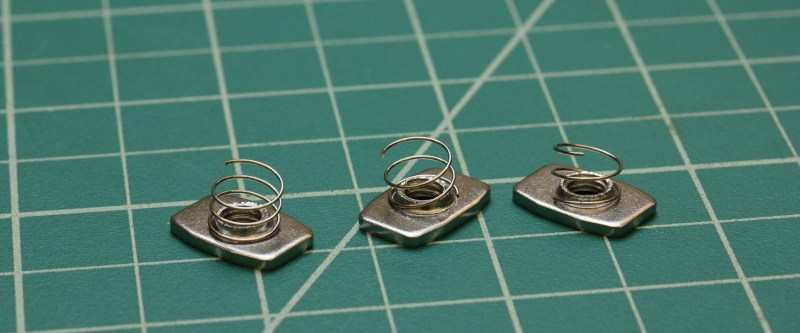
Open-Source Extruded Profile systems are a mature breed these days. With Openbuilds, Makerslide, and Openbeam, we’ve got plenty of systems to choose from; and Amazon and Alibaba are coming in strong with lots of generic interchangeable parts. These open-source framing systems have borrowed tricks from some decades-old industry players like Rexroth and 80/20. But from all they’ve gleaned, there’s still one trick they haven’t snagged yet: affordable springloaded T-nuts.

I’ve discussed a few tricks when working with these systems before, and Roger Cheng came up with a 3D printed technique for working with T-nuts. But today I’ll take another step and show you how to make our own springs for VSlot rail nuts.

Continue reading “How To Make Your Own Springs For Extruded Rail T-Nuts”

Plastics: PETG

You’d be hard-pressed to walk down nearly any aisle of a modern food store without coming across something made of plastic. From jars of peanut butter to bottles of soda, along with the trays that hold cookies firmly in place to prevent breakage or let a meal go directly from freezer to microwave, food is often in very close contact with a plastic that is specifically engineered for the job: polyethylene terephthalate, or PET.

For makers of non-food objects, PET and more importantly its derivative, PETG, also happen to have excellent properties that make them the superior choice for 3D-printing filament for some applications. Here’s a look at the chemistry of polyester resins, and how just one slight change can turn a synthetic fiber into a rather useful 3D-printing filament.

Continue reading “Plastics: PETG”

Ben Krasnow At Supercon: Making Alien Technology In Your Own Shop

Ben Krasnow has a vision of future electronics: instead of the present PCB-screwed-into-a-plastic-box construction, flexible circuits will be deposited straight onto the plastic body of the device itself, merging the physical object and its electronics. There is existing copper-on-plastic technology, but Ben’s got something novel that he presents in this talk that you could implement yourself. You might also want a display, or at least something to blink, so he’s also working on some electroluminescent technology to complement it. If you were wondering why Ben is so interested in silkscreening photopolymers right now, watching this talk will pull a lot of interesting threads together. Continue reading “Ben Krasnow At Supercon: Making Alien Technology In Your Own Shop”

The Cyborgs Among Us: Exoskeletons Go Mainstream

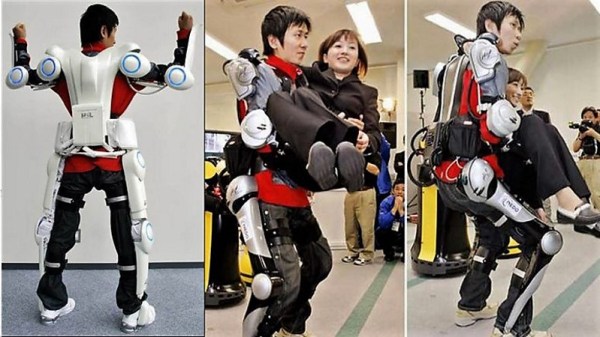
Every technological advancement seems to have a sharp inflection point, a time before which it seems like any early adopters are considered kooks, but beyond which the device or service quickly becomes so mainstream that non-adopters become the kooky ones. Take cell phones, for example – I clearly remember a news report back in the 1990s about some manufacturers crazy idea to put a digital camera in a phone. Seemingly minutes later, you couldn’t buy a phone without a camera.

It seems like we may be nearing a similar inflection point with a technology far more complex and potentially far more life-altering than cameras in cell phones: powered exoskeletons. With increasing numbers of news stories covering advancements in exoskeletal assistants for the elderly, therapeutic applications for those suffering from spinal cord injuries and neurodegenerative diseases, and penetration into the workplace – including the battlefield – as amplifiers of human effort, it’s worth taking a look at where we are with exoskeletons before seeing someone using one in public becomes so commonplace as to go unnoticed.

Continue reading “The Cyborgs Among Us: Exoskeletons Go Mainstream”