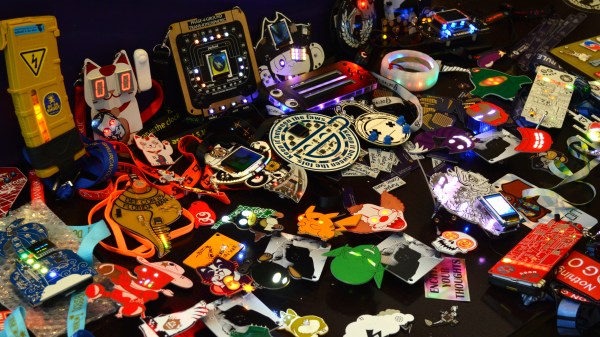
Two or three years back you would see a handful of really interesting unofficial badges at DEF CON. Now, there’s a deluge of clever, beautiful, and well executed badges. Last weekend I tried to see every badge and meet every badge maker. Normally, I would publish one megapost to show off everything I had seen, but this year I’m splitting it into volumes. Join me after the break for the first upload of the incredible badges of DC26!
Hackaday Columns4698 Articles
This excellent content from the Hackaday writing crew highlights recurring topics and popular series like Linux-Fu, 3D-Printering, Hackaday Links, This Week in Security, Inputs of Interest, Profiles in Science, Retrotechtacular, Ask Hackaday, Teardowns, Reviews, and many more.
Behind The Pin: Logic Level Outputs
There is one thing that unites almost every computer and logic circuit commonly used in the hardware hacking and experimentation arena. No matter what its age, speed, or internal configuration, electronics speak to the world through logic level I/O. A single conductor which is switched between voltage levels to denote a logic 1 or logic zero. This is an interface standard that has survived the decades from the earliest integrated circuit logic output of the 1960s to the latest microcontroller GPIO in 2018.
The effect of this tried and true arrangement is that we can take a 7400 series I/O port on an 8-bit microcomputer from the 1970s and know with absolute confidence that it will interface without too much drama to a modern single-board computer GPIO. When you think about it, this is rather amazing.
It’s tempting to think then that all logic level outputs are the same, right? And of course they are from a certain viewpoint. Sure, you may need to account for level shifting between for example 5V and 3.3V families but otherwise just plug, and go, right? Of course, the real answer isn’t quite that simple. There are subtle electrical differences between the properties of I/O lines of different logic and microcontroller families. In most cases these will never be a problem at all, but can rear their heads as edge cases which the would-be experimenter needs to know something about.
Dawn Of The First Digital Camera
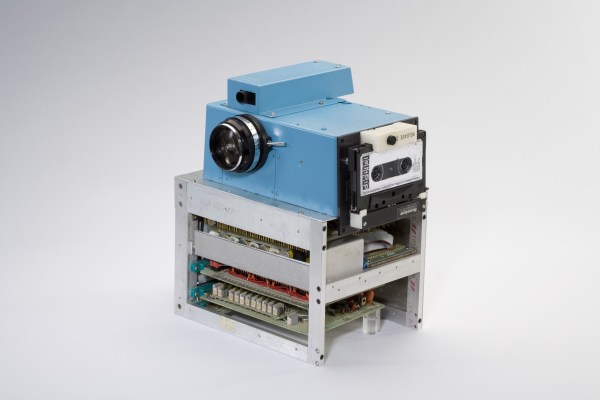
Technology vanishes. It either succeeds and becomes ubiquitous or fails. For example, there was a time when networking and multimedia were computer buzzwords. Now they are just how computers work. On the other hand, when was the last time you thought about using a CueCat barcode reader to scan an advertisement? Then there are the things that have their time and vanish, like pagers. It is hard to decide which category digital cameras fall into. They are being absorbed into our phones and disappearing as a separate category for most consumers. But have you ever wondered about the first digital camera? The story isn’t what you would probably guess.
The first digital camera I ever had was a Sony that took a floppy disk. Surely that was the first, right? Turns out, no. There were some very early attempts that didn’t really have the technology to make them work. The Jet Propulsion Laboratory was using analog electronic imaging as early as 1961 (they had been developing film on the moon but certainly need a better way). A TI engineer even patented the basic outline of an electronic camera in 1972, but it wasn’t strictly digital. None of these bore any practical fruit, especially relative to digital technology. It would take Eastman Kodak to create a portable digital camera, even though they were not the first to commercialize the technology.
Hackaday Links: August 12, 2018
Falling into the marvelous space between, ‘I really want to do that’ and ‘but that’s a lot of work and I’m lazy’ comes this reproduction of the motherboard from the original IBM 5150. This is a complete reproduction of the first PC, being sold as a kit. Yes, chips are included, although I highly doubt they’ve gone through the trouble of finding chips with contemporaneous date codes. We’re dying for a writeup on this one.
Someone has found the source code for the first Furby. [Mark Boldyrev] was talking with a few fellows on the MAME forum to see if anyone had the source for the Furby. He was looking into contacting the USPTO for the original source but the red tape involed was a bit too intense. Luckily, that research turned up some info from [Sean Riddle] who somehow already found the original source listing. After [Mark] got in contact, [Sean] posted it as a PDF. Yes, it’s 6502 source, although the microcontroller is technically a SPC81A, with the rest of the hardware consisting of TI50C04 speech chip. (you would not believe how many toys are still shipping with a 6502-ish core somewhere inside). The files are up in the archive, and we’re probably going to have a Furby MAME sometime soon.
The Bitfi hardware wallet is a cryptocurrency storage device being bandied about by [John McAffee], and there’s a quarter million dollar bug bounty on it. It’s ‘unhackable’, and ‘it has no memory’. I’m serious, those are direct quotes from [McAffee]. Both of those claims are nonsense and now it can play Doom.
Oh noes, a new hardware backdoor in x86 CPUs! [xoreaxeaxeax] has published a demo that allows userland code to read and write kernel data (that’s very bad). The exploit comes in the form of the ‘rosenbridge backdoor’, a small embedded processor tightly coupled to the CPU that is similar to, but entirely different from, Intel’s ME. This processor has access to all the CPU’s memory, registers, and pipeline. The good news, and why this isn’t big news, is that this exploit only affects Via C3 CPUs. Yes, the other company besides Intel and AMD that makes x86 CPUs. These are commonly found in industrial equipment and ATMs.

Car Hacking At DEF CON 26
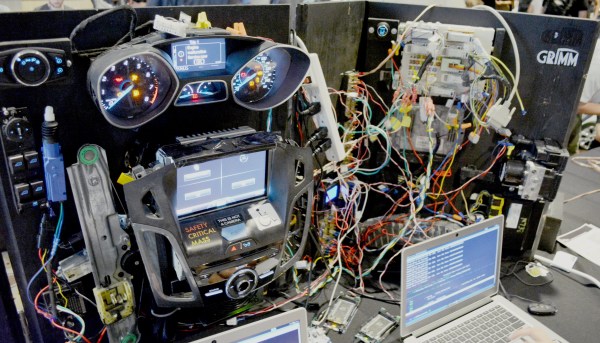
A great place to get your feet wet with the data-network-wonderland that is modern-day automobiles is the Car Hacking Village at DEF CON. I stopped by on Saturday afternoon to see what it was all about and the place was packed. From Ducati motorcycles to junkyard instrument clusters, and from mobility scooters to autonomous RC test tracks, this feels like one of the most interactive villages in the whole con.
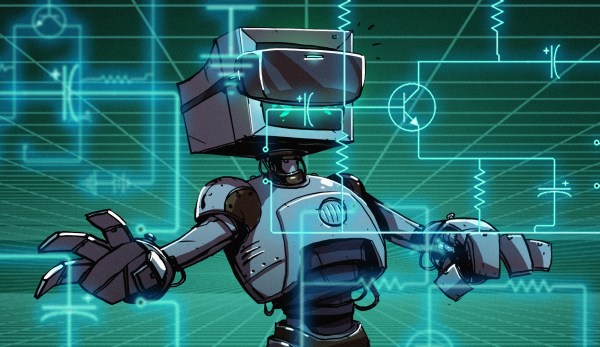
Circuit VR: Starting An Amplifier Design
Sometimes I wish FETs had become practical before bipolar transistors. A FET is a lot more like a tube and amplifies voltages. Bipolar transistors amplify current and that makes them a bit harder to use. Recently, [Jenny List] did a series on transistor amplifiers including the topic of this Circuit VR, the common emitter amplifier. [Jenny] talked about biasing. I’ll start with biasing too, but in the next installment, I want to talk about how to use capacitors in this design and how to blend two amplifiers together and why you’d want to do that.
But before you can dive into capacitors and cascades, we need a good feel for how to get the transistor biased to start with. As always, there’s good news and bad news. The bad news it that transistors vary quite a bit from device to device. The good news is that we’ll use some design tricks to keep that from being a problem and that will also give us a pretty wide tolerance on component values. The resulting amplifier won’t necessarily be precise, but it will be fine for most uses. As usual, you can find all the design files on GitHub, and we’ll be using the LT Spice simulator.
Big Power, Little Power, Tiny Power, Zap!
Our Hackaday Prize Challenges are evaluated by a panel of judges who examine every entry to see how they fare against judging criteria. With prize money at stake, it makes sense we want to make sure it is done right. But we also have our Hackaday Prize achievements, with less at stake leading to a more free-wheeling way to recognize projects that catch our eye. Most of the achievements center around fun topics that aren’t related to any particular challenge, but it’s a little different for the Infinite Improbability achievement. This achievement was unlocked by any project that impressed with their quest for power, leading to some overlap with the just-concluded Power Harvesting Challenge. In fact, when the twenty Power Harvesting winners were announced, we saw that fourteen of them had already unlocked the achievement.
Each of the Power Harvesting winners will get their own spotlight story. And since many of them have unlocked this achievement, now is the perfect time to take a quick tour through a few of the other entries that have also unlocked the Infinite Improbability achievement.
Continue reading “Big Power, Little Power, Tiny Power, Zap!”