Hackaday Links Column Banner

Hackaday Links: Some Sort Of Fool’s Day, 2018

A few years ago, writing for a blog called Motherboard of all things, [Emanuel Maiberg] wrote PC Gaming Is Still Way Too Hard. The premise is that custom building a gaming PC is too hard, because you have to source components and comparison shop. Again, this was written for Motherboard. Personally, I would have shopped that story around a bit more. Now, the same author is back again, telling us PC Building Simulator is way more fun than building a real computer. It’s my early nomination for worst tech article of the year.

Speaking of motherboards, This is a GoFundMe project to re-create the Amiga 4000 mainboard, with schematics. Building PCs is too hard, but the Amiga architecture is elegant. Some of these boards are dying due to electrolytic capacitor and battery leakage. This project is aiming to deconstruct an original A4000 board and turn it into Gerbers and schematics, allowing new boards to be manufactured. Building a PC is way too hard, but with this GoFundMe, you won’t have to design an entire system from scratch. Don’t worry, I already tipped off the Motherboard editors to this one.

Alright, story time. In 6th grade science class, the teacher was awesome. On the days when there was really no chance of any learning happening (the day before Christmas break, the last day of school), the teacher broke out the Electric Chicken. What’s an Electric Chicken? It’s a test tube rack, two wires, and a Wimshurst generator. “Here, grab ahold of this for as long as you can.” It got even cooler when you get a bunch of kids to hold hands and tell them pride is better than pain. Here’s a Kickstarter for a mini Wimshurst generator. It’s made out of PCBs! Hat tip to [WestfW] for finding this one.

It’s no secret that I get a lot of dumb press releases. Most of these are relegated to the circular file folder. It’s also no secret I get a lot of ICO announcements hitting my email. These, also, are trashed. I recently received a press release for an ICO that goes beyond anything else. ONSTELLAR is a blockchain-powered social media network for paranormal and metaphysical enthusiasts.  It’s the crypto for Coast to Coast AM listeners, UFO enthusiasts, and people who think PKE meters are real. This is it, we’ve reached peak crypto.

If you want to decapsulate an IC — and why wouldn’t you? — the usual way of doing things involves dropping acid, ego death, toxic chemicals, and a fume hood. There is another way. Here’s [A Menadue] decapping a quartz watch IC with just fire. The process is about as ‘hold my beer’ as you would expect. Just take a small butane torch, heat up a chip, and recover the die. A bit of ultrasonic cleaning later and you get a pretty clean chip. Microscope not included.

Fail Of The Week: How Not To Build Your Own DGPS Base Station

GPS is the modern answer to the ancient question about one’s place in the world yet it has its limitations. It depends on the time of flight of radio signals emitted by satellites twenty thousand kilometers above you. Like any system involving large distances and high velocities, this is bound to offer some challenges to precise measurements which result in a limit to achievable accuracy. In other words: The fact that GPS locations tend to be off by a few meters is rooted in the underlying principle of operation.

Today’s level of precision was virtually unattainable just decades ago, and we’re getting that precision with a handheld device in mere seconds. Incredible! Yet the goal posts continue to move and people are working to get rid of the remaining error. The solution is called Differential GPS or ‘DGPS’ and its concept looks surprisingly simple.

What’s fascinating is that you can use one GPS to precisely measure the error of another GPS. This is because the inherent error of a GPS fix is known to be locally constant. Two receivers next to each other pick up signals that have been affected in the same way and thus can be expected to calculate identical wrong positions. This holds true for distances up to several kilometers between individual receivers. So in order to remove the error, all you need is a GPS receiver in a known location to measure the current deviation and a way to transmit correction information to other units. DGPS does just that, using either terrestrial radio in some regions and satellites in others. Mobile solutions exist as well.

So a raspi with a USB GPS dongle in a known location should be able to act as a DGPS over IP base station, right? In theory, yes. In practice… fail.

Continue reading “Fail Of The Week: How Not To Build Your Own DGPS Base Station”

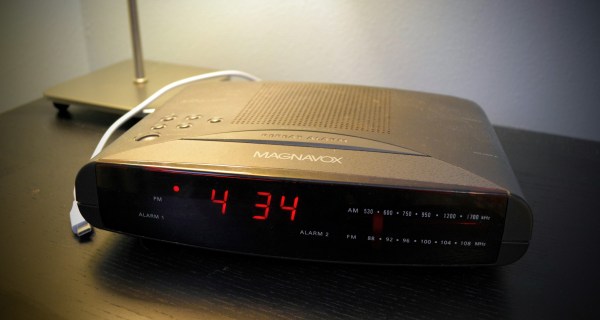
Ask Hackaday: Is Your Clock Tied To Mains Frequency?

Earlier in March we heard about a quirk of the interconnected continental European electricity grid which caused clocks to lose about six minutes so far this year. This was due to a slight dip in the mains frequency. That dip didn’t put anything out of commission, but clocks that are designed to accumulate the total zero-crossings of the power grid frequency of 50 Hz don’t keep accurate time when that frequency is, say 49.985 Hz for an extended period of time.

An interesting set of conversations popped up from that topic. There were several claims that modern alarm clocks, and most devices connected to mains, no longer get their clock timing from mains frequency. I’ve looked into this a bit which I’ll go into below. But what we really want to know is: are your alarm clocks and other devices keeping time with the grid or with something else?

Continue reading “Ask Hackaday: Is Your Clock Tied To Mains Frequency?”

Friday Hack Chat: Simulating Analog

Simulation is a valuable tool for any hardware developer. Instead of building hardware for a long debugging session, you can emulate a microcontroller and blink your lights with some Javascript. Instead of working on a Bluetooth protocol for your fitness wearable, you can just whip up some Javascript and get it working that way. Once all your Javascript is in order, then you can finally move over to hardware. It saves development time, and it saves money.

But this is all digital. What do you do if you’re working on an analog system? Lucky for you, there’s a system built for analog and mixed-signal analysis, and it’s been around for decades. This week we’re talking all about PSpice, a simulator for analog analysis that will give you voltages and currents across every node in a schematic.

For this week’s Hack Chat, we’re going to be talking about PSpice with [Abha Jain] and [Alok Tripathi]. [Abha] has worked at Cadence for 19 years and has been part of the PSpice R&D team for the last decade. She’s an MTech in VLSI Design Tools and Technology and holds multiple EDA patents. [Alok] graduated in 1993 with a B. Tech in Electrical Engineering. He started working at the Department of Atomic Energy in 1993 as a power supply and control system designer for particle accelerators. Currently, he’s working with Cadence and is the Product Engineering Architect for PSpice and OrCAD.

For this Hack Chat, we’re going to be discussing the challenges of system-level simulation, improving reliability, yield, and productivity of circuit design, the issues of Spice simulation, and answer the question, ‘on an infinite grid of one Ohm resistors, what is the resistance between two nodes a knight’s move apart?’ You are, of course, encouraged to add your own questions to the Hack Chat. You can do that by leaving the questions as a comment on this Hack Chat’s event page.

join-hack-chat

Our Hack Chats are live community events on the Hackaday.io Hack Chat group messaging. This week it’s going down at an unusual time: 8 AM Pacific, Friday, March 30th  Want to know what time this is happening in your neck of the woods? Have a countdown timer!

Click that speech bubble to the right, and you’ll be taken directly to the Hack Chat group on Hackaday.io.

You don’t have to wait until Friday; join whenever you want and you can see what the community is talking about.

The Essential List Of 3D Printer Accessories

You’ve acquired your first 3D printer and are giddy with excitement. But like all new additive manufacturing adventurers, the more you do with your printer the more questions arise. Don’t worry, we’ve got your back.

Getting the most out of your time with a new 3D printer has a lot to do with the tools and accessories on hand and what you do with them. Let’s take a look at a few of the accessories that should accompany every 3D printer, be it in your home, school, or hackerspace. There’s already enough potential aggravation when it comes to 3D printing, the goal here is to ensure you won’t be without a tool or supply when you need it the most.

Continue reading “The Essential List Of 3D Printer Accessories”

Scotty Allen Visits Strange Parts, Builds An IPhone

Scotty Allen has a YouTube blog called Strange Parts; maybe you’ve seen his super-popular video about building his own iPhone “from scratch”. It’s a great story, and it’s also a pretext for a slightly deeper dive into the electronics hardware manufacturing, assembly, and repair capital of the world: Shenzhen, China. After his talk at the 2017 Superconference, we got a chance to sit down with Scotty and ask about cellphones and his other travels. Check it out:

The Story of the Phone

Scotty was sitting around with friends, drinking in one of Shenzhen’s night markets, and talking about how bizarre some things seem to outsiders. There are people sitting on street corners, shucking cellphones like you’d shuck oysters, and harvesting the good parts inside. Electronics parts, new and used, don’t come from somewhere far away and there’s no mail-ordering. A ten-minute walk over to the markets will get you everything you need. The desire to explain some small part of this alternate reality to outsiders was what drove Scotty to dig into China’s cellphone ecosystem.

Continue reading “Scotty Allen Visits Strange Parts, Builds An IPhone”

Retrotechtacular: A 180 GB Drive From 1994

Hard drive storage has gone through the roof in recent years. Rotating hard drives that can hold 16 terabytes of data are essentially available today, although pricey, and 12 terabyte drives are commonplace. For those who remember when a single terabyte was a lot of storage, the idea that you can now pick up a drive of that size for under $40 is amazing. Bear in mind, we are talking terabytes.

In 1994, that was an unimaginable amount of storage. Just a scant 24 years ago, though, you could get 90 gigabytes — 0.09 terabytes — if you didn’t mind buying an IBM mainframe and a RAMAC disk storage unit. You can see a promotional video digitized by Archive.org, below. Just keep in mind that IBM has a long history of calling disk drives DASD — an acronym for Direct Access Storage Device. You pronounce that “dazz-dee”, as you’ll hear in the video.

Continue reading “Retrotechtacular: A 180 GB Drive From 1994”