Friday Hack Chat: Becoming Cyborg

What is it like to be a cyborg? What does it mean to have augmented hearing, improved vision, and coprocessors for your brain that enhance your memory? We could ask people with hearing aids, glasses, and a smartphone strapped to their wrist, but that’s boring. We’re looking to the future and the cool type of cyborgation, and that’s what this week’s Hack Chat is all about.

Our guest for this week’s Hack Chat will be Lindy Wilkins, and they’re here to discuss what it takes to be a cyborg. Right now, they’re sporting a magnetic implant, an NFC implant and will soon have a North Sense, an exo-sensory device that tells your brain where North is.

Lindy is currently based in Toronto as a PhD student at the University of Toronto, and director at the Site 3 coLaboratory. They spend free time making robots, playing with lasers, and thinking about how body modification and where the intersection of bio-hacking and wearable technology will meet in the near future.

During this Hack Chat, we’re going to be talking about what it means to be a cyborg. Is it simply a matter of wearing contacts, getting a replacement hip or heart valve, or is it something even cooler? Do RFID tags count? Do insulin pumps? We’re going to be digging deep into what it means to be a cyborg, and what future technologies will enable the human body to do. You are, of course, encouraged to ask your own questions; leave those on the Hack Chat event page.

join-hack-chat

Our Hack Chats are live community events on the Hackaday.io Hack Chat group messaging. This Hack Chat is going down Friday, January 26th at noon, Pacific time. Time Zones got you down? Here’s a handy countdown timer!

Click that speech bubble to the left, and you’ll be taken directly to the Hack Chat group on Hackaday.io.

You don’t have to wait until Friday; join whenever you want and you can see what the community is talking about.
Printed It: Rubber Band PCB Vise

If you’ve ever worked on a small PCB, you know how much of a hassle it can be to hold on to the thing. It’s almost as if they weren’t designed to be held in the grubby mitts of a human. As designs have become miniaturized over time, PCBs are often so fragile and festooned with components that tossing them into the alligator clips of the classic soldering “third hand” can damage them. The proper tool for this job is a dedicated PCB vise, which is like a normal bench vise except it doesn’t crank down very hard and usually has plastic pads on the jaws to protect the board.

Only problem with a PCB vise is, like many cool tools and gadgets out there, not everybody owns one. Unless you’re doing regular PCB fabrication, you might not take the plunge and buy one either. So what’s a hacker on a budget to do when they’ve got fiddly little PCBs that need attention?

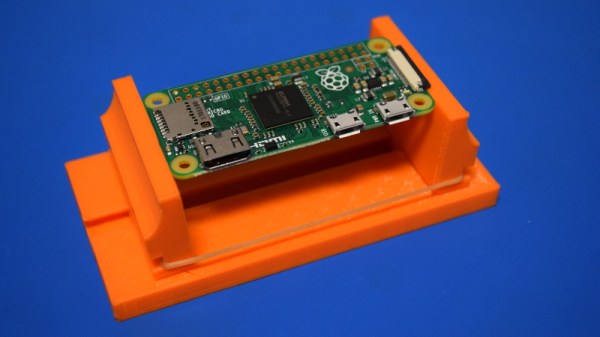
Luckily for us, we live in a world where you can press a button and have a magical robot on your desktop build things for you. Online model repositories like Thingiverse and YouMagine are full of designs for printable PCB vises, all you have to do is pick one. After looking through a number of them I eventually decided on a model designed by [Delph27] on Thingiverse, which I think has a couple of compelling features and more than deserves the few meters of filament it will take to add to your bench.

Of course the best part of all of this is that you can customize and improve the designs you download, which is what I’m about to do with this PCB vise!

Continue reading “Printed It: Rubber Band PCB Vise”

The Precision Upon Which Civilizations Are Built

If you’re interested in making things (particularly metal things), you’re on a road that eventually leads to machine tools. Machine tools have a special place in history, because they are basically the difference between subsistence farming and modern civilization. A bold statement, I realize — but the ability to make very precise things is what gave us the industrial revolution, and everything that snowballed afterward. If you want to build a modern life filled with jet airplanes and inexpensive chocolate, start here.

Precision is more than just a desirable property. It’s a product. It has value, there is competition to create it, and our ability to create it as a species has improved over time. When your “precision product” is in the centimeter range, congratulations — you can make catapults and portcullises. Once you get into the millimeter range, guess what? You can make fine millwork in fancy houses, and indoor plumbing. Once you get sub-millimeter, now things get really interesting. It’s time for steam engines and automobiles. Once you get into the micrometer range, well, now we’re talking artificial heart valves and spaceships. Much like materials science, the ability to create precision is the unsung foundation and driving force of our standard of living.

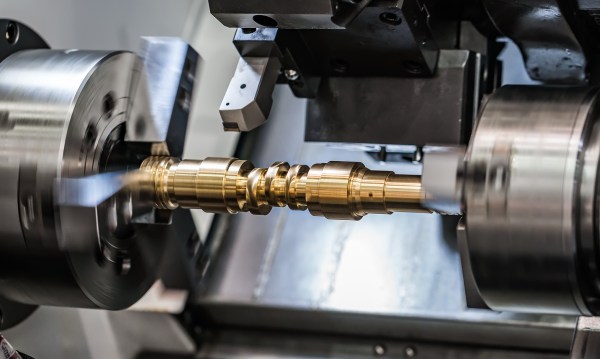
Okay, so assuming I’ve sold you on the value of this product called “precision”, how do we make it? Machine tools are how humans currently get there, despite the dreams of the 3D printer crowd. Yes, drizzled plastic is great and the future is bright, but for right now, subtractive manufacturing is where it’s at when something has to be perfect.

Continue reading “The Precision Upon Which Civilizations Are Built”

Shah Selbe: Science In The World’s Wildest Places

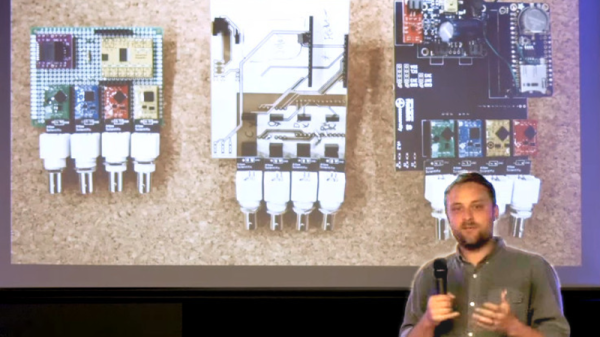
When we think of building research hardware, lab coats and pristine workbenches come to mind. Shah Selbe used to do something kind of like that when he was engineering satellite propulsion systems. But after putting twelve of them into space, he ditched the office gig and took his gear to some of the wildest places on earth. He’s an explorer and fellow with the National Geographic Society, and at the Hackaday Superconference he shared his experiences building research hardware that gathers data in incredibly remote places.

Shah makes a really good point about two very different trends in our world over the past several decades. While we’ve had unparalleled technological growth, we’ve also seen horrifying wildlife trends to the point that some scientists believe we’re currently in a sixth mass extinction event. But to know that for sure, and look for ways to prevent and reverse it, we need reliable data. This is a fascinating problem because the world is huge, and we simply can’t monitor everything.

Continue reading “Shah Selbe: Science In The World’s Wildest Places”

Hackaday Links Column Banner

Hackaday Links: January 21, 2018

You know what next week is? Sparklecon! What is it? Everybody hangs out at the 23b Hackerspace in Fullerton, California. Last year, people were transmuting the elements, playing Hammer Jenga, roasting marshmallows over hot resistors, and generally having a really great time. It’s the party for our sort of people, and there are talks on 3D projection mapping and a hebocon. I can’t recommend this one enough.

The STM32F7 is a very, very powerful ARM Cortex-M7 microcontroller with piles of RAM, oodles of Flash, DSP, and tons of I/O. It’s a relatively new part, so are there any breakout or dev boards for it? Sure thing. [satsha] used a desktop CNC mill to create what is probably the simplest possible breakout board for the STM32F7. There’s not much here — just some parts for power and a few LEDs — but this is all you need to get one of these powerful chips up and running.

It’s cold and dark and you can’t fly RC airplanes in January. It’s not because planes and quadcopters don’t work in the cold (they should work better, but I’d love to see a graph of battery temperature and density altitude), it’s that your hands don’t work in the cold. What’s the solution? Just strap some motorcycle handwarmer thingies onto your transmitter. With a 2200 battery strapped to the back, you’ll get about an hour of runtime for these handwarmers.

The BBC is reporting the latest advancement in Hyperloop technology. Is it a fundamentally different way of digging tunnels that isn’t simply scaling down the size of tunnel boring machines? No. Is it improvements in material science that would allow the seals on a 500-mile-long steel pressure chamber to exist? No. Does this latest advancement mitigate the ‘hillbillies with guns’ problem that would turn every Hyperloop car into a literal bullet screaming towards one of the most spectacular deaths possible? No. The chief executive of the Virgin Hyperloop project has something better in mind. A smartphone app, “that would connect future Hyperloop passengers with other modes of transport on arrival.”

Linux Fu: Custom Bash Command Completion

If you aren’t a Linux user and you watch someone who knows what they are doing use Bash — the popular command line interpreter — you might get the impression they type much faster than they actually do. That’s because experienced Linux users know that pressing the tab key will tend to complete what they are typing, so you can type just a few characters and get a much longer line of text. The feature is very smart so you may not have realized it, but it knows a good bit about what you could type. For example, if you try to unzip a file, it knows the expected file name probably has a .zip extension.

How does that happen? At first, you might think, “who cares how it happens?” The problem is when you write a shell script or a program that runs on Linux, the completion gets dumb. Someone has to make Bash smart about each command line program and if you are the author then that someone is you.

Continue reading “Linux Fu: Custom Bash Command Completion”

Neural Networking: Robots Learning From Video

Humans are very good at watching others and imitating what they do. Show someone a video of flipping a switch to turn on a CNC machine and after a single viewing they’ll be able to do it themselves. But can a robot do the same?

Bear in mind that we want the demonstration video to be of a human arm and hand flipping the switch. When the robot does it, the camera that is its eye will be seeing its robot arm and gripper. So somehow it’ll have to know that its robot parts are equivalent to the human parts in the demonstration video. Oh, and the switch in the demonstration video may be a different model and make, and the CNC machine may be a different one, though we’ll at least put the robot within reach of its switch.

Sound difficult?

Researchers from Google Brain and the University of Southern California have done it. In their paper describing how, they talk about a few different experiments but we’ll focus on just one, getting a robot to imitate pouring a liquid from a container into a cup.

Continue reading “Neural Networking: Robots Learning From Video”