Friday Hack Chat: Designing RF Products

This Friday, we’re talking RF. Join us for a discussion on designing RF products with Hackaday’s very own Jenny List. It’s all happening in the Hack Chat on hackaday.io.

jennylisthackchattake1-01When Jenny isn’t busy writing for Hackaday, she sits on the board of the Oxford Hackspace. She’s the brains behind Language Spy, and sells electronic kits that include receivers, filters, and RF breakout boards. She’s extremely active on hackaday.io, and has used a Pi Zero to transmit across the Atlantic.

As usual, we’re starting this Hack Chat at Noon, Pacific time on Friday (or Friday 20:00 GMT). Here’s a handy countdown for the event.

Here’s How To Take Part:

join-hack-chatOur Hack Chats are live community events on the Hackaday.io Hack Chat group messaging.

Log into hackaday.io, visit that page, and look for the ‘Join this Project’ Button. Once you’re part of the project, the button will change to ‘Team Messaging’, which takes you directly to the Hack Chat.

You don’t have to wait until Friday; join whenever you want and you can see what the community is talking about.

Upcoming Hack Chats

The Hack Chats on hackaday.io are quickly becoming a thing. Already, we’ve had a pantheon of embedded systems gods including Lady Ada of Adafruit, Sprite_tm, and bunnie.

In March, we’re going to have a Hack Chat with Raspberry Pi engineer Roger Thornton, and a mechanical manufacturing Hack Chat with Fictiv. You can check out all the upcoming Hack Chats right here.

Retrotechtacular: ERNIE

Wherever you may live in the world, who do you wish to smile upon you and deliver good fortune? You may be surprised to discover that for a significant number of Brits this role is taken by someone called [Ernie].

What, [Jim Henson]’s Ernie from Sesame Street‘s famous duo Bert and Ernie? Sadly not, because the owner of a [Rubber Duckie] can’t offer you the chance of a million quid every month. Instead, [Ernie] is a computer that has been anthropomorphised in the national imagination. More properly referred to as E.R.N.I.E, for Electronic Random Number Indicator Equipment, he is the machine that picks the winning bond numbers for the Premium Bonds, a lottery investment scheme  run by the British Government.

Brits have been able to buy £1 bonds, up to 50,000 of them today, since the 1950s, and every month they are entered into a drawing from which ERNIE picks the winners. The top two prizes are a million pounds, but for most bond holders the best they can hope for is the occasional £25 cheque. Premium Bonds are often bought for young children so a lot of Brits will have a few, often completely forgotten. Prizes never expire, so if you are the holder of old bonds you should consider asking National Savings and Investments whether anything is owed to you.

The Great Grandfather of Premium Bond Drawings

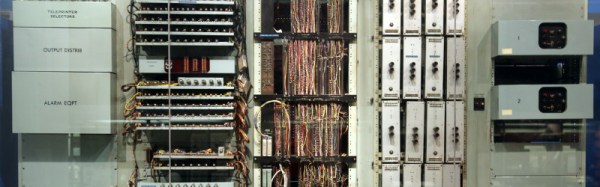
The original 1957 ERNIE, now in the collection of the Science Museum, London. Geni [CC BY-SA 4.0-3.0-2.5-2.0-1.0, via Wikimedia Commons.
The current ERNIE is the fourth-generation model, but our attention today is on its 1950s ancestor. In a way it’s the most interesting of the machines because it has an unusual pedigree, being a creation of the Post Office Research Station, at Dollis Hill, London. As such it came from the lab of the Colossus engineer [Tommy Flowers], and is described as being a descendant of the now-famous but then still top-secret first digital computer used by the World War Two codebreakers. It’s thus a fascinating study for the student of computer history as well as for its role in British postwar social history, because it represents the only glimpse (had they known it at the time) that the British public had of the technology that had helped them so much a decade earlier.

A significant effort was made to ensure that the draw was truly random, and the solution employed by [Flowers] and his team was thoroughly tested before each draw. The thermionic noise generated across a neon tube was sampled, and this random voltage delivered the truly random numbers used to generate the winning bond numbers. The machine’s construction is extremely reminiscent of its wartime predecessor, however it is as well to bear in mind that it owes this to the standard racking and paint used in British telephone exchanges of the day. Gone though are the octal tubes, and in their place are their more familiar miniature successors.

We have two films for you showing this incarnation of ERNIE in action. The first is a National Savings promotional film which explains ERNIE’s purpose, while the second shows us the Minister of the time starting the first draw. Believe it or not, this was a cause of major national excitement at the time.

Continue reading “Retrotechtacular: ERNIE”

Hackaday.io Passes 200,000 Registered Users

Hackaday.io just welcomed the 200,000th registered user! We are the world’s largest repository of open hardware projects and Hackaday.io is proving its worth as the world’s most vibrant technology community. This is where you go to get inspiration for your next project, to get help fleshing out your product ideas, to build your engineering dream team, and to tell the tales of the workbench whether that be success, failure, or anything in between.

Over the past six months, as we’ve grown from the 150k member milestone to this one, our movement has enjoyed ever-increasing interaction among this amazing group of people. Thank you for spending so much time here and making Hackaday.io a great place for everyone!

Hack Chat Bring Experts from Many Fields

bunnie03-01It’s always great when you can watch a conference talk or interview online. But if you weren’t there in person the opportunity for meaningful interaction has already passed. With this in mind, we’ve been inviting experts from numerous fields to host discussions live in the Hackaday.io Hack Chat room.

This is a great way to further our goal of forming a global virtual hackerspace. It’s common to have talks and workshops at a hackerspace, where you can not only learn from and ask questions of the person leading the event, but meet others who share your interests. This has happened time and again with recent guests including Bunnie Huang who talked about making and breaking hardware, a group of Adafruit engineers who discussed their work extending the MicroPython libraries, Sprite_tm who covered the continuing development of ESP32 support, and many more.

This Friday at Noon PST Hackaday’s own Jenny List will be leading the Hack Chat on RF Product design. See you there!

Amazing Projects

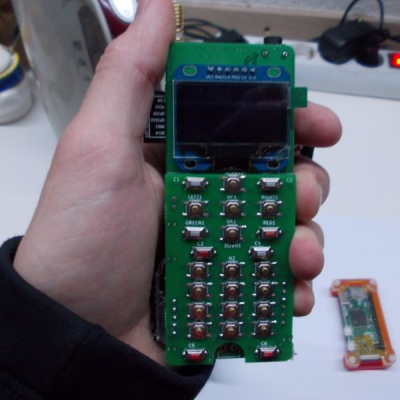
It’s pretty amazing to see a guide on building a smartphone for $50 in parts. If that exists anywhere, it’s probably on Hackaday.io — and it’s actually pushing about 80,000 views so far! Arsenijs is a regular around these parts and his ZeroPhone — a 2G communications device based on the Raspberry Pi Zero — is a project that he’s been updating as his prototype-to-production journey progresses. It has a big team behind it and we can’t wait to see where this one goes.
zerophone-thumbWorking on your own is still a great way to learn and we see all kinds of examples of that. Just4Fun is learning the dark arts that went into early personal computing with a $4 project to build a Z80 system on a breadboard.

We revel in the joy of seeing great hardware art come to life. FlipFrame is a great example; it’s a digital picture frame project that goes far beyond that simple description. It rotates the entire screen to fit the layout of the image while showing off all of the hardware that makes this possible rather than hiding it away inside a case.

In addition to our registered users milestone, we’re just about to pass our 20,000th published project. There are so many projects to celebrate and draw inspiration from, and that collection grows every day!

The Rise of Build Contests

This winter we’ve seen a ton of interest in the build contests hosted on Hackaday.io. Of course, nothing can compare to the reach of the Hackaday Prize, our worldwide engineering initiative that challenges people to Build Something That Matters. The 2016 winners were announced in November; even so, people have been tripping over themselves to get a project built for the numerous contests we’ve hosted since then.

enlightenpiOf note is the 1 kB Challenge — a contest dreamed up by our own Adam Fabio which challenged entrants to build an embedded project whose compiled code was 1 kB or less. It was a joy to dive into the entries for this and it will certainly return again.

Running right now is the revival of my favorite build contest: the Hackaday Sci-Fi Contest. Bring your favorite Sci-Fi tech to life — it just needs to be recognizable from a book, movie, or TV show and include some type of electronics.

Meet Your Friends in Real Life

Some of my closest friends in life were first met online. But eventually, you just want to hang out in the same room. This is becoming more and more common with Hackaday.io. In November we celebrated our second Hackaday SuperConferece where hundreds of people who love hardware creation gathered in Los Angeles for two days of amazing talks, workshops, and hands-on hacking challenges. This is a good one to add to your calendar but tickets do sell out so consider some other options.

We have regular meetups in LA and New York. If you are ever traveling there, make sure to look up the schedule and see if it can be part of your trip. Perhaps the most interesting was World Create Day. In 2016, we had 80 groups across the world plan meetups on the same day so that the Hackaday community could hang out in real life. We’re not ready to share the details quite yet, but you should plan for that to happen again this year. Something to look forward to!


Hacking On The Weirdest ESP Module

Sometimes I see a component that’s bizarre enough that I buy it just to see if I can actually do something with it. That’s the case with today’s example, the ESP-14. At first glance, you’d ask yourself what AI Thinker, the maker of many of the more popular ESP8266 modules, was thinking.

The ESP-14 takes the phenomenally powerful ESP8266 chip and buries it underneath one of the cheapest microcontrollers around: the 8-bit STM8S003 “value line” chip. Almost all of the pins of the ESP chip are locked inside the RF cage’s metal tomb — only the power, bootloader, and serial TX/RX pins see the light of day, and the TX/RX pins are shared with the STM8S. The rest of the module’s pins are dedicated to the STM8S. Slaving the ESP8266 to an STM8S is like taking a Ferrari and wrapping it inside a VW Beetle.

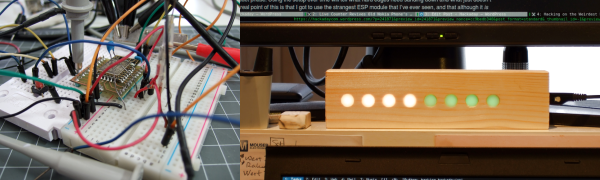
I had never touched an STM8 chip before, and just wanted to see what I could do with this strange beast. In the end, ironically, I ended up doing something that wouldn’t be too far out of place on Alibaba, but with a few very Hackaday twists: a monitor for our washer and dryer that reports power usage over MQTT, programmed in Forth with a transparent WiFi serial bridge into the chip for interactive debugging without schlepping down into the basement. Everything’s open, tweakable, and the Forth implementation for the STM8S was even developed here on Hackaday.io.

It’s a weird project for the weirdest of ESP modules. I thought I’d walk you through it and see if it sparks you to come up with any alternative uses for the ESP8266-and-STM8S odd couple that is the ESP-14.

Continue reading “Hacking On The Weirdest ESP Module”

Hackaday Links Column Banner

Hackaday Links: February 12, 2017

Taking small LCD screens, a tiny computer running Linux, and a 3D printed enclosure to build miniature versions of old computers is a thing now. Here’s [Cupcakus]’s tiny little Apple II, complete with Oregon Trail. This Apple II is running on a C.H.I.P., uses a 3s lithium battery from a drone, and works with a Bluetooth keyboard and joystick. Yes, the power button on the monitor works.

At Hackaday, we get a lot of emails from people asking the most important question ever: “how do you become a hardware hacker?” [Tex Projects] lays it all out on the line. All you need to do is to buy five of something every time you need one. Need some header pins? Buy five. A sensor? five. Come to the realization that anything you build could be bought for less money.

Are we still doing low-poly Pokemon? [davedarko] has an idea for the Sci-Fi contest we’re running. He’s going to give children seizures. He’s refreshing a project of mine by putting lights, blinkies, and noisy things in a 3D printed Porygon, the original 3D printed Pokemon. Porygon was the subject of that one episode of the Pokemon cartoon that sent 635 Japanese children to the hospital. The episode was banned in America, but it was actually Pikachu that caused the flashing lights.

‘Member Clickspring? He’s the guy who made a fantastic mechanical clock using nothing except a few bits of brass, a blowtorch, a tiny mill and lathe, and a lot of patience. Now he’s building the Antikythera mechanism. The Antikythera mechanism is a 2000-year-old device designed to calculate the phases of the moon, the motion of the planets, and other local astronomical phenomena. This is going to be a masterpiece, and will eventually end up in a museum, so be sure to subscribe to his YouTube channel.

Acoustic Mirrors: How To Find Planes Without RADAR

A lot of science museums and parks feature something called an acoustic mirror. The one at Houston’s Discovery Green park is called the listening vessels. [Doug Hollis] created two acoustic mirrors 70 feet apart, pointing at each other. If you stand or sit near one of the vessels, you can hear a whisper from someone near the other vessel. The limestone installations (see right) are concave and focus sound like a parabolic mirror will focus light.

mirrorJust a science curiosity, right? Maybe today, but not always. The story of these devices runs through World War II and is an object lesson in how new technology requires new ways of thinking about things.


Continue reading “Acoustic Mirrors: How To Find Planes Without RADAR”

Good In A Pinch: The Physics Of Crimped Connections

I had a friend who was an electronics assembly tech for a big defense contractor. He was a production floor guy who had a chip on his shoulder for the engineers with their fancy book-learnin’ who couldn’t figure out the simplest problems. He claimed that one assembly wasn’t passing QC and a bunch of the guys in ties couldn’t figure it out. He sidled up to assess the situation and delivered his two-word diagnosis: “Bad crimp.” The dodgy connector was re-worked and the assembly passed, much to the chagrin of the guys in the short-sleeved shirts.

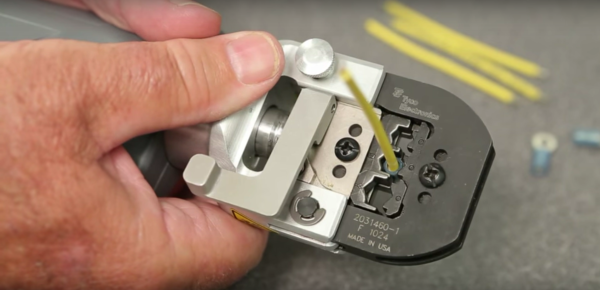
Aside from the object lesson in experience sometimes trumping education, I always wondered about that “bad crimp” proclamation. What could go wrong with a crimp to so subtly futz with a circuit that engineers were baffled? How is it that we can rely on such a simple technology to wire up so much of the modern world? What exactly is going on inside a crimped connection anyway?

Continue reading “Good In A Pinch: The Physics Of Crimped Connections”