Retrotechtacular: 6207, A Study In Steel

If you ever encounter railroad or railway enthusiasts, you may have heard the view that at some point in the past there was a golden age of rail transport that has somehow been lost. It’s something that’s up for debate as to when that age was or even whether with a selection of new super-high-speed trains snaking across our continents we’re in a golden age now, but it’s true to say that the rail business has had its fair share of decline in the last half-century.

It’s quite likely that when they talk of a golden age, they really mean a golden age of steam rail transport. At which point depending on where you live in the world it’s easier to put your finger on a decade. For UK residents a good candidate would be the 1930s; steam locomotive design had reached its peak, the rail network hadn’t been worn out by the demands of wartime, and private car ownership hadn’t eaten into their passenger numbers. The country was divided up into a set of regional rail monopolies, each of which had their own locomotive works and designers who were in fierce competition to show that their machines were the best and the fastest.

The LMS, the London Midland and Scottish railway company, served the northwestern segment of the country, North Wales, and the West of Scotland. Their high-speed express trains were in hot competition with those of the LNER, the London and North Eastern Railway, who served the eastern side of the country, to offer the fastest service from London to Scotland. It’s difficult to grasp through an 80-year lens, but this battle was one of national excitement, with the fastest locomotives becoming household names nationwide. The railway companies were justifiably proud of their engineering expertise, and so featured their locomotives as a key part of their marketing to the general public.

And so we come to the subject of today’s Retrotechtacular piece, a film below the break from 1935 following the construction of a high-speed express locomotive from start to finish in the LMS’s Crewe railway works. 6207 was one of a class of thirteen 4-6-2 Pacific locomotives designed by the company’s chief engineer [William Stanier], built between 1932 and 1935 and known as the Princess Royal class, all being named for princesses. In the film we see the various parts of the locomotive being cut, cast and forged from raw metal before being assembled in the Crewe plant. All the machinery is human controlled, and one of the surprises is sometimes the number of people involved in each task. The level of skill and experience in precision metalworking to be found in plants like Crewe was immense, and in some cases it is very difficult to find its equivalent in our own time.


Continue reading “Retrotechtacular: 6207, A Study In Steel”

These 20 Projects Just Won $1000 In The Hackaday Prize

For this year’s Hackaday Prize, we’re doing something spectacular. We’re funding the next great piece of Open Hardware by giving away thousands of dollars for the best hardware projects. Just a few days ago, we wrapped up the Anything Goes portion of The Hackaday Prize, an electronic free for all to build the coolest gizmos imaginable. Now, it’s time to announce the twenty winners of the Anything Goes portion of The Hackaday Prize.

The winners of the Anything Goes challenge, in no particular order, are:

These twenty project just won $1000 and will now move on to the last phase of The Hackaday Prize, to be judged by our fourteen celebrity judges. Congrats! There’s a lot of work for these project to do before the final judging in October. Better get to work!

citizenScienceIf your project didn’t make the cut, there’s still ample opportunity for you to build the next great hardware gizmo. For the next few weeks, we’re running the Citizen Scientist portion of The Hackaday Prize. We’re looking for projects that expand the frontiers of knowledge, and give the common man the tools to discover the world.

Citizen Scientist is this month’s Hackaday Prize challenge to create something new, study something undiscovered, or replicate scientific studies. We’re opening up the gates for everyone to build their own apparatus and do their own research.

Like the Design Your Concept and Anything Goes rounds of The Hackaday Prize, the top twenty projects will win $1000, and go on to the Hackaday Prize finals for a chance to win the Hackaday Prize – $150,000 and a residency at the Supplyframe Design Lab in Pasadena.

If you don’t have a project up on Hackaday.io, you can start one right now and submit it to The Hackaday Prize. If you already have a project up, add it to the Citizen Scientist challenge using the dropdown menu on the left sidebar of your project page.

The HackadayPrize2016 is Sponsored by:

Artificial Muscles To Bring Relief To Robotic Tenseness

Custom, robotic prosthesis are on the rise. In numerous projects, hackers and makers have taken on the challenge. From Enabling The Future, Open Hand Project, OpenBionics to the myriad prosthesis projects on Hackaday.io. Yet, the mechatronics that power most of them are still from the last century. At the end of the day, you can only fit so many miniature motors and gears into a plastic hand, and only so many hydraulics fit onto an arm or leg before it becomes a slow, heavy brick – more hindering than helpful. If only we had a few extra of these light, fast and powerful actuators that help us make it through the day. If only we had artificial muscles.

Continue reading “Artificial Muscles To Bring Relief To Robotic Tenseness”

Hackaday Links: June 5, 2016

CERN is having a hackathon. It’s in October, yes, but the registration is closing on the 15th of June. They’ve been doing this every year, and the projects that come out of this hackathon are as diverse as infrastructure-less navigation, cosmic ray detectors, and inflatable refrigerators.

Have one of those solder fume extractors? Here’s an obvious improvement. [polyglot] put a strip of LEDs around the frame of his solder fume extractor to put a little more light on the subject.

A few months ago, [Bunnie] started work on a book. It was the Essential Guide to Electronics in Shenzhen. It’s made for hardware hackers to figure out how to buy stuff in Shenzhen, using a neat point-and-understand interface. Those books are now being shipped to people around the globe. I got one, and here’s the mini-review: it’s awesome. Is it a complete travel guide? No, but if you dropped me off at Hong Kong International, I could probably 1) Make it to Shenzhen 2) Buy random LEDs 3) Find a hotel 4) Get a beer 5) Not die. Pics below.

You’re hackers, and that means you’re the people who build stuff for all those ‘makers’ out there. Don’t have an MBA? No problem, [Dave Jones] has your back. He re-did his Economics of Selling Hardware video from several years ago. It’s 25 minutes long, and gives you enough information so you’re not a complete idiot at the business end of design.

Like Raspberry Pis stuffed into things? Here’s a Pi Zero stuffed into a MegaDrive cartridge. Now someone grab a Sonic and Knuckles cart, build a ROM reader, and do a proper cart-reading emulator.

If you’re into R/C, you know about Flite Test. They’re the folks that make crazy, crazy model planes out of Dollar Tree foam board, and have gotten hundreds of people into the hobby. Flite Test is having their own con, Flight Fest, in a little over a month. It’s in Ohio, and from last year’s coverage of the event, it looks like a really cool time.

So, No Man’s Sky is coming out soon. It’s a space game set in a procedurally generated, infinite galaxy. Does anyone have any idea on how to form a Hackaday clan? Somebody should start a Hackaday clan/alliance/thing. I’ll meet you guys at the core.

Hacklet 110 – Optical Microscopy Projects

Humans have always wanted to make small things bigger. To see that which is unseen with the naked eye. The inventor of the original microscope happened sometime in the 1600’s, though the inventor is still contested. Some say it was Cornelis Drebbel, while others say Hans Lippershey. Galileo Galilei’s compound microscope is probably the most well-known ancient magnifier. Regardless of who created the device, hackers, makers, engineers, and scientists have used microscopes to study mysteries of biology, geology, electronics, and just about anything else you can imagine.

This is a fitting topic for this week’s Hacklet at is aligns well with the Citizen Scientist challenge round of the Hackaday Prize which began on Monday. Making quality microscopes more widely available is one of many great starting ideas for an entry. Let’s take a look at some of the best microscopy projects on Hackaday.io!

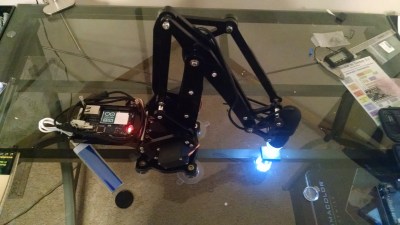
scope1We start with [J. Kha] and Armed Microscope. [J. Kha] was one of the backers of the original uArm over at Kickstarter. He also does quite a bit of work with electronics. After fighting with a cheap USB microscope, he realized he had the perfect platform to control it. Microscopes usually are stationary, with the object being viewed moved on a stage. [J. Kha] turned things upside down by mounting the microscope on his uArm. An Arduino Yun controls the system. The Yun also allows him to stream the microscope’s video over the internet using the mjpg-streamer library. [J. Kha] did have some power issues at first, but he’s got his regulators all sorted out now.

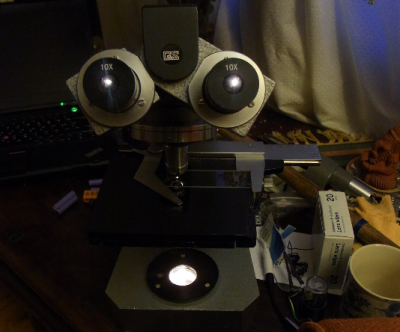
scope2Next we have [andyhull] with Adding a light touch to a “classic” microscope. A lucky dumpster find netted [Andy] a pile of old broken microscopes. From this he was able to build a working classic stereo scope. This was a Gillet & Sibert stereo compound scope. Like most microscopes of its time, the old GS used standard incandescent or halogen lights for illumination. The old bulbs were long gone, and would have been a pain to replace. [Andy] switched his scope over to LED illumination. He ended up using a commercially available LED “bulb” designed to replace type 1157 automotive tail light bulbs. This type of LED is designed to run on 12 volt power which simplifies the wiring. The small LED flashlight in a custom mount also provides a bit of help for opaque subjects.

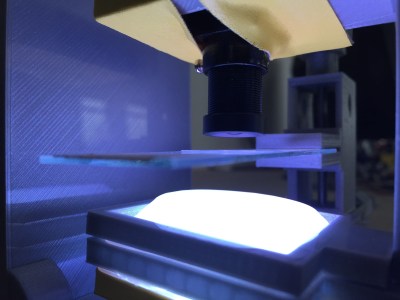
scope3Next up is [Andre Maia Chagas] with Flypi – cheap microscope/experimental setup. Flypi is [Andre’s] entry in the 2106 Hackaday Prize. Flypi is more than just a microscope, it’s a 3D printed data collection and image analysis device for hackers and scientists alike. A Raspberry Pi 2 or 3 controls the show. Images come in through Pi Camera with an M12 lens. The Pi runs some open source Python code allowing it to acquire and analyze images. It also has an Arduino as a co-processor to handle anything a particular experiment may need – like RGB LEDs, heaters, manipulators, you name it. Andre sees Flypi as having uses in everything from fluorescence imaging to optogenetics and thermogenetics.

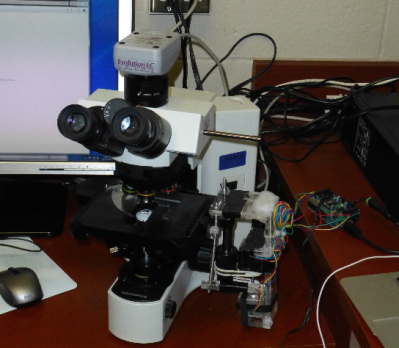
scope5Finally we have [Jarred Heinrich] with Stagmo: Microscope Stage Automator. Positioning samples under high magnification requires a steady hand. Trying to image them makes things even harder. To help with this, microscopes have stages. Fine lead screws manually controlled by knobs allow the user to precisely position any subject. Automated stages are available as well, but they can get quite expensive. [Jarred] recognized that the microscope stage is an X-Y platform like any CNC, laser, or 3D printer. He used an Arduino and a motor shield to control a couple of stepper motors. The motors are coupled to the stage knobs with rubber belts. While the mounting system looks a little wobbly, but it got the job done, and didn’t require any modifications to the microscope itself.

Optical microscopes are just one type of scope you’ll find on Hackaday.io. There are also atomic force microscopes, scanning electron microscopes, and more! I’ll cover those on a future Hacklet. If you want to see more awesome optical microscopy projects, check out our new optical microscope projects list! If I missed your project, don’t be shy, just drop me a message on Hackaday.io. That’s it for this week’s Hacklet. As always, see you next week. Same hack time, same hack channel, bringing you the best of Hackaday.io!

Designing Circuits With Switching Algebra

We return once again to the work of Dr. Claude E. Shannon, this time to his Masters thesis on relay switching circuit design. This thesis introduced switching algebra that allows the systematic design and optimization of logical circuits. While Shannon’s work applied to switches and relays, it is equally applicable to all the modern forms of digital circuits. His thesis received widespread notice when published as “A Symbolic Analysis of Relay and Switching Circuits” in 1938. This work built on the Boolean algebra developed by George Boole and an analysis of logic by Augustus De Morgan which these mathematicians published nearly simultaneously in 1847. To some extent, it was the beginning of the age of modern digital logic. Continue reading “Designing Circuits With Switching Algebra”

Minimal MQTT: Power And Privacy

In this installment of Minimal MQTT, I’m going to cover two loose ends: one on the sensor node side, and one on the MQTT server side. Specifically, I’ll tackle the NodeMCU’s sleep mode to reduce power and step you through bridging MQTT servers to get your data securely out of your home server and into “the cloud”, which is really just other people’s servers.

If you’re just stepping into this series now, you should really check out the other three posts, where I set up a server, then build up some sensor nodes, and then flesh-out a few ways to control everything from your phone or the web. That’s the coolest material, anyway. This last installment just refines what we’ve built on. Let’s go!

Continue reading “Minimal MQTT: Power And Privacy”