Rotating Plasma Vortex Speaker

[Anthony Garofalo] has made a fancier plasma speaker. Not content with a simple spark, he uses a plasma vortex. To make the vortex, the spark gap is swapped out for an electrode placed in the centre of a ring magnet. The Lorentz force experienced by the arc causes it to rotate rapidly enough round the arc of the magnet’s centre to appear as a continuous sheet of plasma.

The speaker gets its power from an inverter using a flyback transformer driven through a MOSFET by a 555-based pulse width modulator. You can see the result in the video below the break, it’s very impressive to look at but probably not quite ready to sit in your hi-fi stack. The resulting sound isn’t quite as good as that from a stationary arc, but it looks a lot cooler.

Continue reading “Rotating Plasma Vortex Speaker”

Small And Inexpensive MEMS Gravimeter

A gravimeter, as the name suggests, measures gravity. These specialized accelerometers can find underground resources and measure volcanic activity. Unfortunately, traditional instruments are relatively large and expensive (nearly 20 pounds and $100,000). Of course, MEMS accelerometers are old hat, but none of them have been stable enough to be called gravimeters. Until now.

In a recent edition of Nature (pdf), researchers at the University of Glasgow have built a MEMS device that has the stability to work as a gravimeter. To demonstrate this, they used it to measure the tides over six days.

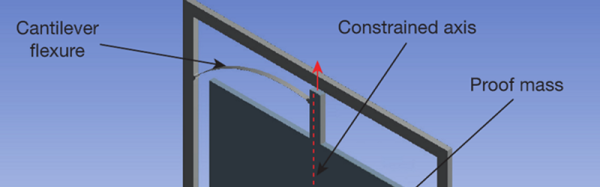
The device functions as a relative gravimeter. Essentially a tiny weight hangs from a tiny spring, and the device measures the pull of gravity on the spring. The design of the Glasgow device has a low resonate frequency (2.3 Hz).

Small and inexpensive devices could monitor volcanoes or fly on drones to find tunnels or buried oil and gas (a job currently done by low altitude aircraft). We’ve covered MEMS accelerometers before, although not at this stability level.  We’ve even seen an explanation from the Engineer Guy.

Make A BLDC Motor From Scraps You Can Find In The Garage

Think you’ve got what it takes to build a homebrew brushless motor? As [JaycubL] shows us, it turns out that a bldc motor may be living in pieces right under your nose, in scraps that so many of us would otherwise toss aside. To get our heads turning, [JaycubL] takes us into the theory of brushless DC motors operate. He then builds a homebrew brushless motor using screws, a plastic container, a few bearings, a metal rod, some magnets, and a dab of epoxy. Finally, he gives it a whirl with an off-the-shelf motor controller.

This isn’t [JaycubL’s] first dive into homebrew brushless motors. For the curious, he’s also assembled a fully-functional brushless outrunner motor with a paint can housing.

Sure, understanding the principles is one thing, but being able to take the leap into the real world and find the functional beginnings of a motor from your scrap bin is an entirely different story! [JaycubL’s], dare we say, finesse of understanding the principles behind motor design makes us wonder: how many other functional higher-level electrical and mechanical components can we bootstrap from bitter scrap? To get you started, we’ll point you in the direction of this CNC router that’s just a few steps away from one trip to the hardware store.

Thanks for the tip, [John]!

Continue reading “Make A BLDC Motor From Scraps You Can Find In The Garage”

Red Bricks: Alphabet To Turn Off Revolv’s Lights

Revolv, the bright red smart home hub famous for its abundance of radio modules, has finally been declared dead by its founders. After a series of acquisitions, Google’s parent company Alphabet has gained control over Revolv’s cloud service – and they are shutting it down.

Customers who bought into Revolv’s vision of a truly connected and automated smart home hub featuring 7 different physical radio modules to connect all their devices will soon become owners of significantly less useful, red bricks due to the complete shutdown of the service on May 15, 2016.
Continue reading “Red Bricks: Alphabet To Turn Off Revolv’s Lights”

Apple Introduces Their Answer To The Raspberry Pi

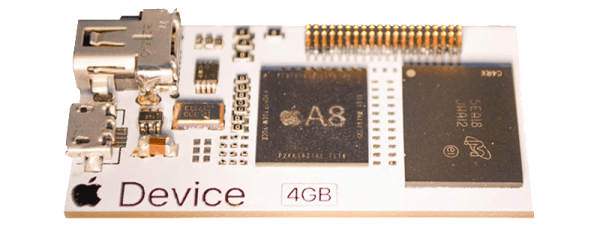
Today, Apple has announced their latest bit of hardware. Following in the tradition of the Raspberry Pi, BeagleBone, and the Intel Edison, Apple have released a single board computer meant for embedded and Internet of Things applications. It’s called the Apple Device, and is sure to be a game changer in the field of low-power, Internet-enabled computing.

First off, some specs. The Apple Device uses Apple’s own A8 chip, the same dual-core 64-bit CPU found in the iPhone 6. This CPU is clocked at 1.1 GHz, and comes equipped with 1GB of LPDDR3 RAM and 4GB of eMMC Flash. I/O includes a Mini DisplayPort capable of driving a 4k display, 802.11ac, Bluetooth, and USB. In a massive break from the Apple zeitgeist of the last decade or so, the Apple Device also includes a forty pin header for expansion, much like the Raspberry Pi, BeagleBone, and Edison.

Although Apple’s first foray into the embedded computing market is a shocker, in retrospect it should come as no surprise; the introduction of HomeKit in iOS 9 laid the groundwork for an Internet of Apple Devices, embedded into toasters, refrigerators, smart homes, and cars. The Apple Device lives up to all these expectations, but what is the hands-on experience like?

See our review of the Apple Device after the break.

Continue reading “Apple Introduces Their Answer To The Raspberry Pi”

3D-Printed Case Turns Servo Into Quality Linear Actuator

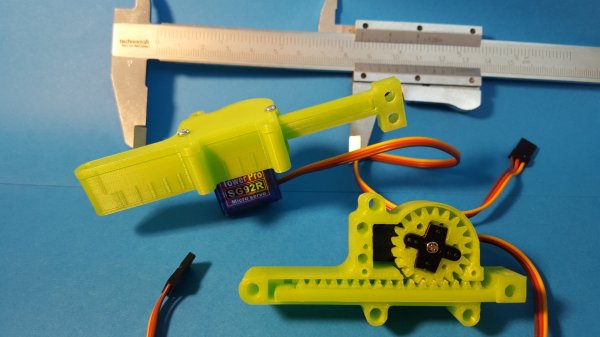
Micro servomotors are a hacker staple. You’ll find maybe four or five in an RC plane, while a hexbot build could soak up a dozen or more of the cheap and readily available devices. Unfortunately, long-throw linear actuators are a little harder to come by, so it’s nice to know you can 3D-print linear gearing for standard micro RC servos and roll your own.

Currently on revision 2, [Roger Rabbit]’s design is not just a quick and dirty solution. He’s really thought through the problems he observed with his first revision, and the result is a robust, powerful linear actuator. The pinion fits a trimmed servo crank arm, the mating rack is stout and stiff, and early backlash problems have been solved. The whole case is easy to assemble, and as the video below shows, the completed actuator can lift 300 grams.

We like [Roger]’s build process, especially the iterative approach to improving the design. We’ll stay tuned to see where it goes next – a continuous rotation servo for extra-long throws? While we wait, you might want to check out [Richard Baguley]’s recent primer on servos if you want a little background on the underlying mechanism.

Continue reading “3D-Printed Case Turns Servo Into Quality Linear Actuator”

When Difference Matters: Differential Signaling

We have talked about a whole slew of logic and interconnect technologies including TTL, CMOS and assorted low voltage versions. All of these technologies have in common the fact that they are single-ended, i.e. the signal is measured as a “high” or “low” level above ground.

This is great for simple uses. But when you start talking about speed, distance, or both, the single ended solutions don’t look so good. To step in and carry the torch we have Differential Signalling. This is the “DS” in LVDS, just one of the common standards throughout industry. Let’s take a look at how differential signaling is different from single ended, and what that means for engineers and for users.

Single Ended

Collectively, standards like TTL, CMOS, and LVTTL are known as Single Ended technologies and they have in common some undesirable attributes, namely that ground noise directly affects the noise margin (the budget for how much noise is tolerable) as well as any induced noise measured to ground directly adds to the overall noise as well.

By making the voltage swing to greater voltages we can make the noise look smaller in proportion but at the expense of speed as it takes more time to make larger voltage swings, especially with the kind of capacitance and inductance we sometimes see.

Differential

diff4

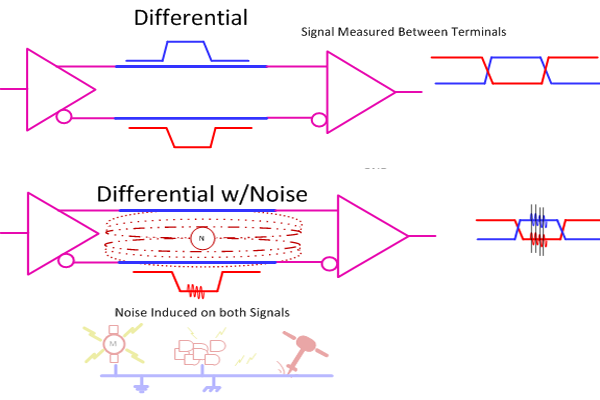
Enter Differential Signaling where we use two conductor instead of one. A differential transmitter produces an inverted version of the signal and a non-inverted version and we measure the desired signal strictly between the two instead of to ground. Now ground noise doesn’t count (mostly) and noise induced onto both signal lines gets canceled as we only amplify the difference between the two, we do not amplify anything that is in common such as the noise.

Continue reading “When Difference Matters: Differential Signaling”