USB to Dupont adapter by [PROSCH]

USB Power Has Never Been Easier

USB cables inevitably fail and sometimes one end is reincarnated to power our solderless breadboards. Of course, if the cable broke once, it is waiting to crap out again. Too many have flimsy conductors that cannot withstand any torque and buckle when you push them into a socket. [PROSCH] has a superior answer that only takes a couple of minutes to print and up-cycles a pair of wires with DuPont connectors. The metal tips become the leads and the plastic sheathing aligns with the rim.

The model prints with a clear plus sign on the positive terminal, so you don’t have to worry about sending the wrong polarity, and it shouldn’t be difficult to add your own features, like a hoop for pulling it out, or an indicator LED and resistor. We’d like to see one with a tiny fuse holder.

If you want your breadboard to have old-school features, like a base and embedded power supply, we can point you in the right direction. If you are looking to up your prototyping game to make presentation-worthy pieces, we have a host of ideas.

The Benefits Of Critiquing Your Own PCB Designs

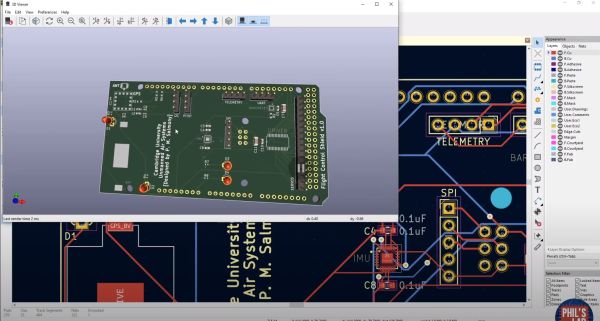
In a recent retrospective video, [Phil] from Phil’s Lab goes through a number of his early PCB designs, to critique and comment on what he likes and doesn’t like in these designs. Even though it’s only been a few a few years, he founds plenty that’s wrong. From poor and inconsistent formatting in the schematic, to sloppy and outright broken PCB layouts. It’s a fascinating look at years of lessons learned.

[Phil] comments on the importance of clear labeling and organization of sections and pages in the schematic to make it obvious what the function of a block is. Other lessons include the labeling of nets to make PCB routing a lot easier, making good use of PCB planes, getting all relevant information on components and layout in the schematic as a comment, and connecting decoupling capacitors to their relevant pins.

Although we tend to forget about older projects, it can be very interesting to take a look at them now and then, to see (hopefully) our progress over the years. In the case of [Phil] it’s fascinating to see the transition from a basic two-sided board with THT components to multi-layer boards with STM32 MCUs.

Continue reading “The Benefits Of Critiquing Your Own PCB Designs”

Teaching A DC Servo Motor To Act Like A Stepper

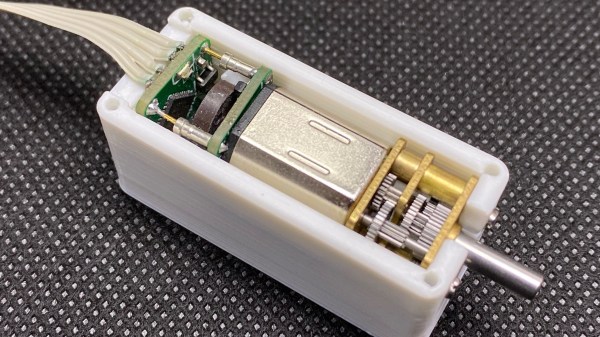
[Frank Herrmann] had an interesting idea to turn a geared DC motor into a servo motor assembly, but with a stepper motor-like interface. By stacking some small PCBs behind the motor body, it was possible to squeeze a DRV8837 DC motor driver and a pair of hall effect sensors on the first PCB layer, with the magnetic encoder nestled tightly behind it. Pin headers at the edge of the PCB connect to a second PCB bearing the microcontroller, which is based on the cheap STM32L432. The second PCB also holds an associated LDO and debug LED. Together, this handful of parts provide all that is needed to read the encoder, control the motor rotation and listen on the ‘stepper motor driver’ interface pins hooked up to the motion controller upstream. The Arduino source for this can be found on the project GitHub.

Whilst [Frank] mentions that this assembly has a weight and torque advantage over a NEMA 17 sized stepper motor, but we see no hard data on accuracy and repeatability which would be important for precise operations like 3D printing.

This project is part of a larger goal to make a complete 3D printer based around these ‘DC motor stepper motors’ which we will watch with interest.

While we’re on the subject of closed-loop control of DC motors, here’s another attempt to do the same, without the integration. If these are too small for you, then you always repurpose some windscreen washer motors.

Continue reading “Teaching A DC Servo Motor To Act Like A Stepper”

The No-MCU Fan Controller

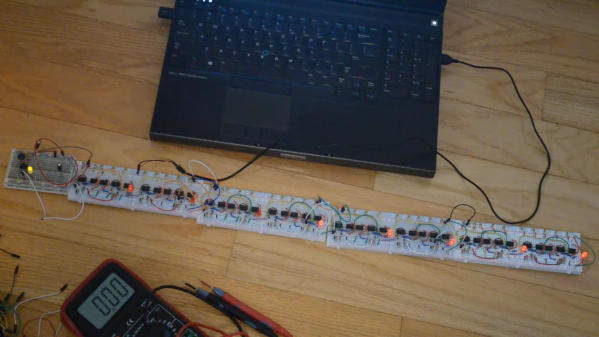
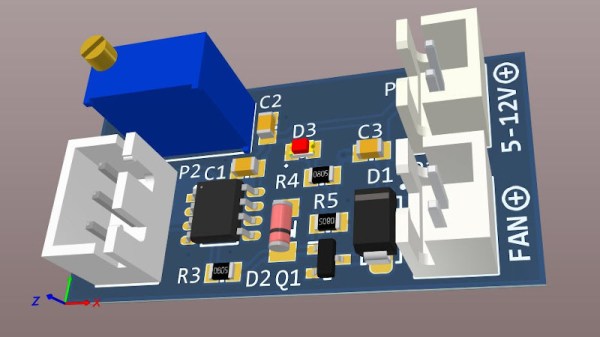
The default for any control project here in 2019 was to reach for a microcontroller. Such are their low cost and ubiquity that they can be used to replicate what might once have needed some extra circuitry, with the minimum of parts. But here we are at the end of 2021, and of course microcontrollers are hard to come by in a semiconductor shortage. [Hesam Moshiri] has a project that takes us back to a simpler time, a temperature controlled fan the way they used to be made, without a microcontroller in sight.

Old hands will no doubt guess where this design is heading, there is an LM35 temperature sensor producing a voltage proportional to its temperature, and half of an LM358 which forms a comparator against a static voltage from a divider. The LM358’s output drives a MOSFET which in turn switches on or off the fan motor. This type of circuit used to be the daily fare of simple control electronics in the days when a microcontroller represented a significant expense, and it’s still a handy circuit to be reminded of.

Have you forgotten sensors such as the LM35 in a world of on-board sensors? Time to refresh your sensing memory.

A man welds on a chassis

Electric Wheelchair Dump Truck Hack Really Hauls

Have you ever looked at a derelict electric wheelchair and thought “I bet I could make something great with that!” Of course you have- this is Hackaday, after all! And so did [Made in Poland], who managed to get a hold of a broken down electric wheelchair and put the full utility of his well equipped metalworking shop to work. The results? Lets just say it hauls.

What we really enjoyed about the build was that there wasn’t much that couldn’t be done by an average garage hacker with a drill press, angle grinder, and a stick welder. While it’s definitely nicer to have a lathe and a high quality welding table, plasma cutter, and everything in between, nothing that [Made in Poland] did in the video is such high precision that it would require those extensive tools. There may be some parts that would beĀ a lot more difficult, or lower precision, but still functional.

Another aspect of the build is of course the control circuitry and user interface. Keeping the skid steer and castor approach meant that each motor would need to be controllable independently. To achieve this, [Made in Poland] put together a purely electromechanical drive controlled with momentary rocker switches and automotive relays to form a simple H-Bridge for each motor.

Of course you just have to watch until the end, because it really proves that a man will do anything to get out of hauling wood around! Old electric wheelchairs can also make a great base for big robots, as it turns out.

Continue reading “Electric Wheelchair Dump Truck Hack Really Hauls”

The Pinouts Book Is Here, And It’s Just What You Need

Updates from the enigmatic [NODE] are unfortunately few and far between these days. In fact his latest post is only the second time we’ve heard from the hacker in 2021. But as we’ve come to expect from his white-on-sorta-black releases, it certainly doesn’t disappoint.

Just in time to ring in whatever holiday you may celebrate, [NODE] has unveiled The Pinouts Book. A project he’s been working on for some time now with colleague [Baptiste], the free PDF download contains over 300 pages of high-contrast hardware diagrams and their respective pinouts. It’s about as straightforward as you can get, beyond the dedication page in the beginning, there’s not a word of fluff in the entire document. This is a work of hacker minimalism at its best, and we’re all about it.

From audio/video connectors all the way to development boards and single-board computers, The Pinouts Book sticks to the same format of a diagram and accompanying chart, making it exceptionally easy to find what you’re looking for. If you need more information than this streamlined layout can provide, each entry includes a link to a dedicated page on the book’s companion website. This will redirect you to supplemental data such as the manufacturer’s website, the part’s full datasheet, etc.

According to [NODE], the original plan for the Creative Commons BY-SA licensed work was to release it as a physical book, but the project ballooned up to such a scale that they realized it would be much easier to navigate and use as a digital document. While we don’t disagree, a physical release would certainly look lovely on our bookshelf. In the meantime, those who want to support the effort financially can purchase shirts emblazoned with diagrams pulled straight from the book’s pages.

We’ve long believed that a large-format electronic paper device would be an ideal gadget for the hacker’s workbench, as it allows for browsing through schematics and datasheets with a minimum of eye strain. Now we can also add a copy of The Pinouts Book to the list of things we’d install on our hacker-friendly e-ink compendium.

Continue reading The Pinouts Book Is Here, And It’s Just What You Need”

Ordering prototypes like they were fast food

Made To Spec: The Coming Age Of Prototyping As A Service

In the last decade, the price for making a single PCB plummeted. And we’ve featured tons of hacks with boards hailing from places like OSH Park or Seeed Studio. But this phenomenon isn’t isolated, and all sorts of one-off prototyping services are becoming cheaper and looking to satiate both hobbyist and engineer alike.

Today, I want to blow the lid off a few places offering one-off mechanical prototyping services. I’ll take us through some history of how we got here, introduce a few new players, and finally highlight some important tradeoffs before you start ordering bespoke aluminum parts straight to your doorstep.

Now go get your ANSI Z87+ safety glasses, and let’s get started.

Continue reading “Made To Spec: The Coming Age Of Prototyping As A Service”