New Part Day: Sonoff USB Smart Adaptor Taps A New WiFi Chip

For decades, we dreamt of a future where all of our electronics used a standardized power connector. Most of us probably didn’t expect that USB would ultimately fill that role, but we’ll take what we can get if it means a future without getting a new wall wart for every piece of tech we buy. From soldering irons to laptops, the number of things you can power with a lowly USB cable these days is pretty incredible.

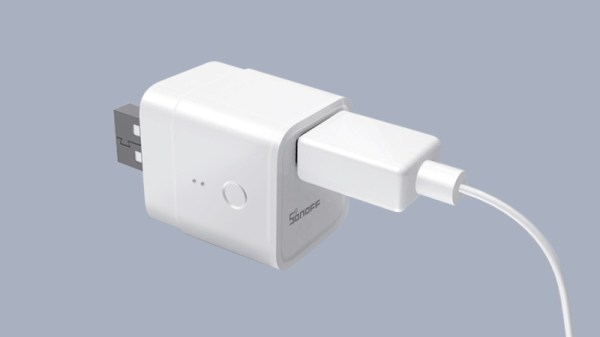
Which makes it all the more surprising it took so long for somebody to come up with a way to toggle USB devices off and on over the network. The Sonoff “USB Smart Adaptor”, which the company says will start shipping before the end of the year, is the logical evolution of their exceptionally popular mains voltage smart switches. The Smart Adapter is designed to go between the device and its existing power supply, allowing the user to drag any USB powered device kicking and screaming into their existing smart home setup. All for the princely sum of $6.50 USD.
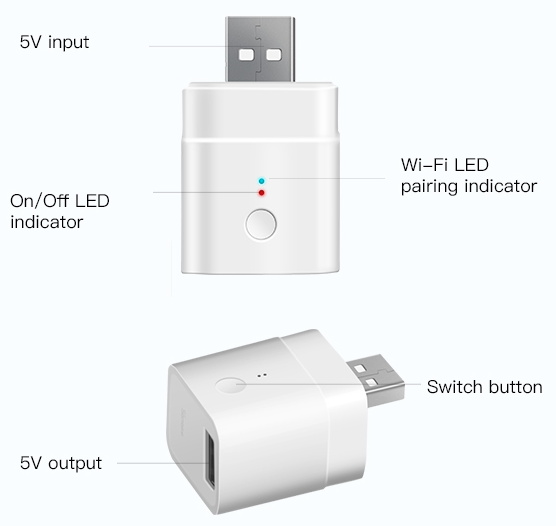
In the video after the break, Sonoff gives a few potential uses of the Smart Adapter: from controlling a string of LEDs to limiting how long a smartphone is allowed to charge for. But really, there’s a nearly limitless number of devices which could be easily and cheaply integrated into your home automation routines thanks to this gadget.

On the other end of the spectrum, those who are looking to keep a tighter control on the ears and eyes that are active in their home could use the Smart Adapter to make sure their Google and Amazon listening devices assistants are only powered up during certain hours of the day.

Unfortunately, there’s a catch. Sonoff smart switches are best known, at least among the type of folks who read Hackaday, for the fact that they’re based on the eminently hackable ESP8266 microcontroller. Given the size of this product and its intended use, it would seem logical enough to assume this device also utilizes the insanely popular chip. But according to a Sonoff representative, the USB Smart Adapter won’t be using an ESP at all; leaving its hackability an open question until people can actually get their hands on them and start poking around.

Continue reading “New Part Day: Sonoff USB Smart Adaptor Taps A New WiFi Chip”
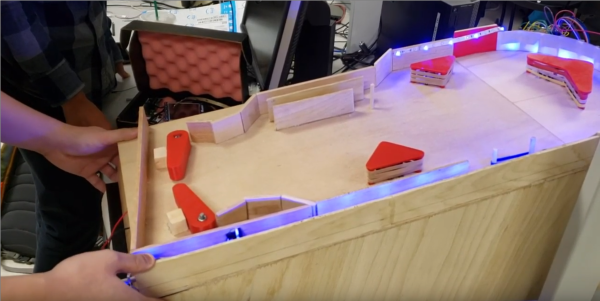
Team Scores Big Points With Pinball Final Project

For their final project in [Bruce Land]’s class on designing with PIC32 microcontrollers, [Sujith], [Julia] and [Andrew] wanted to do something fun. And what could be more fun than bending to the electromechanical siren song of the pinball machine?

This machine looks great, and as you can see in the demo video after the break, it plays and sounds great, too. We particularly like the boomerang obstacle and the game state-driven LED strip. The more points you score, the brighter they go. We also like that this machine combines traditional scoring methods with a few really clever ones, like the boomerang target near the top and the scoring triggers made from copper tape.

The team started by designing the heart of any pinball machine, the flippers. Though we have seen car door lock actuators used in homebrew machines, the team went with traditional solenoids to drive them. Unfortunately the solenoids caused a lot of interference, but the team got around it with filter capacitors and aluminium foil Faraday cages around the wires.

If all this pinball talk has your circuits lit up, why not try making your own machine? Continue reading “Team Scores Big Points With Pinball Final Project”

Addressable LED Strings In Your USB

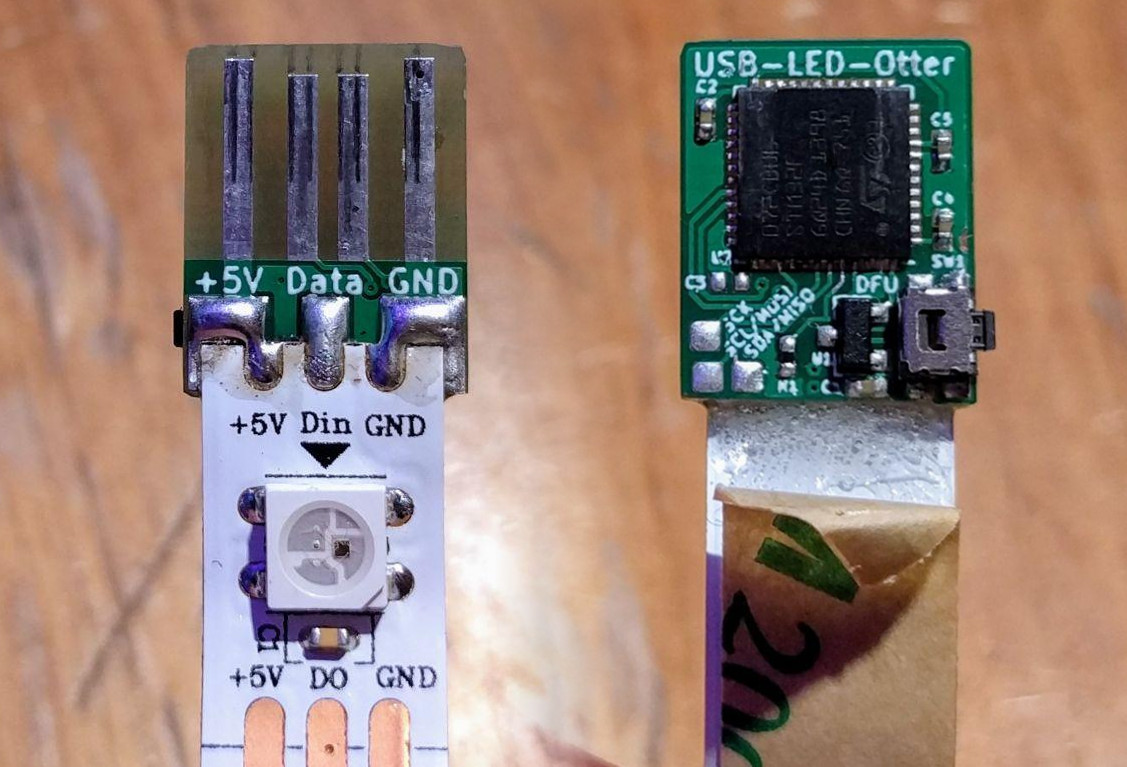
WS2812Bs, or NeoPixels, or whatever else you call them brought full-color LEDs to maker projects a meter at a time in recent years. Hooked up to a microcontroller, they make creating vibrant, full-color glowables a cinch. They won’t work on their own though, and a some point you want to ditch the dev board and let the blinking stand on its own two feet. Enter the USB LED Otter.

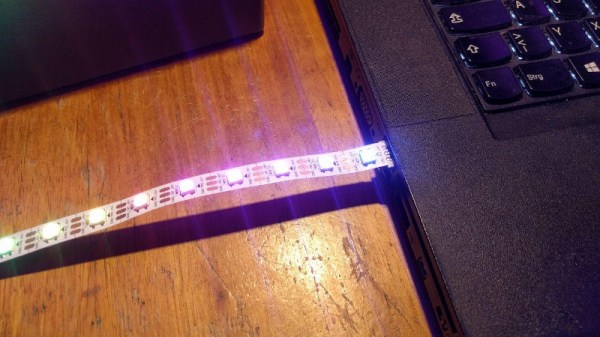
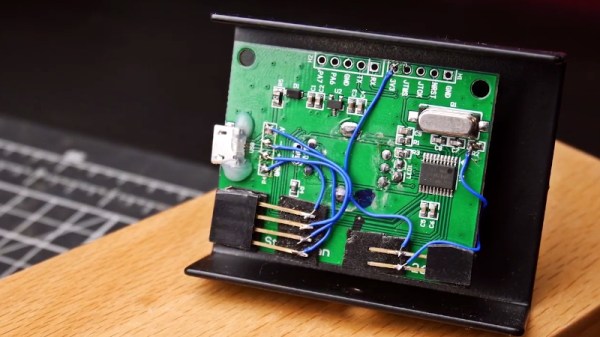
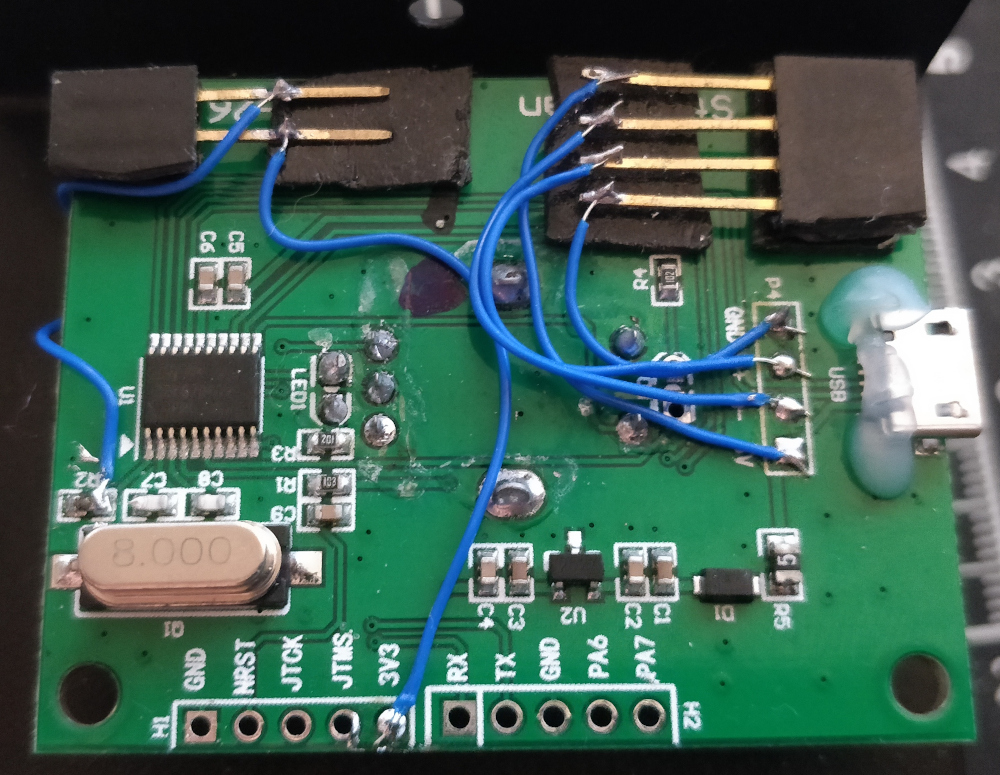
This small square of PCB lets you plug an LED strip directly into a USB port. The PCB itself has four traces on the back that mate with any USB port, and three pads for soldering the strip’s ground, 5 V line, and data. An STM32F072 microcontroller serves as the brains of the operation, packing plenty of horsepower and full compatibility with USB 2.0.

Code is flashed to the chip over USB using Device Firmware Upgrade (DFU) and once written the strip can then be driven by jamming the string into a suitably powerful USB wall charger. The woman behind the build, [Jana Marie], has mentioned that Open Pixel Control could be implemented but that may be an exercise left to the reader.

It’s a useful little tool, and one that promises to do even more with a little more development. Whipping up a few boards should be an easy task for anyone with a reflow oven and a free weekend. Oh, and if you’re tired of the WS2812? There’s other addressable LEDs out there, too!

DIY CircuitPython Brain Snakes Into Small Spaces

Whether you’re new to electronics and programming, or you were bit-banging bare metal long before hair metal, CircuitPython is a great tool for getting a project up and working without all the fuss. The boards show up as mass storage devices, and programming consists of editing the Python file and saving it back to the board.

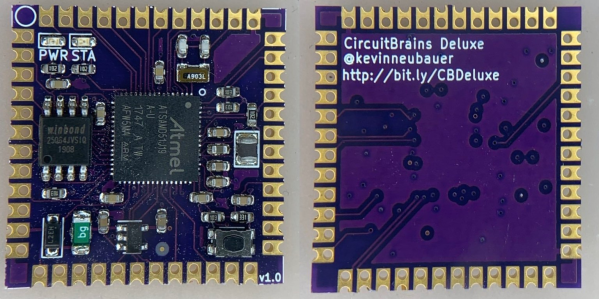
The only hard part about CircuitPython is trying to cram those official boards into small projects. [Kevin Neubauer] got tired of making his own board every time and came up with a slim system-on-module that has all the core functionality of CircuitPython. CircuitBrains Deluxe has regular holes for using headers, but also has castellated pads so he can solder these modules directly to a larger project PCB. [Kevin] says these are still in the testing and cost-optimization phase, but we would totally buy a few of them.

[Kevin] probably has a programming method for this module in mind already. But if you find yourself mystified by castellated pads, take a look at this pogo pin programmer built for ESP8266s. If your problem is pitch-related, maybe you can save the day with a breakout board.

Thanks to [Drew Fustini] for the tip!

Kerry Scharfglass Secures Your IoT Things

We’ve all seen the IoT device security trainwrecks: those gadgets that fail so spectacularly that the comment section lights up with calls of “were they even thinking about the most basic security?” No, they probably weren’t. Are you?

Hackaday Contributor and all around good guy Kerry Scharfglass thinks about basic security for a living, and his talk is pitched at the newcomer to device security. (Embedded below.) Of course “security” isn’t a one-size-fits-all proposition; you need to think about what threats you’re worried about, which you can ignore, and defend against what matters. But if you’ve never worked through such an exercise, you’re in for a treat here. You need to think like a maker, think like a breaker, and surprisingly, think like an accountant in defining what constitutes acceptable risks. Continue reading “Kerry Scharfglass Secures Your IoT Things”

A Stunning Ray Gun Built From Junk

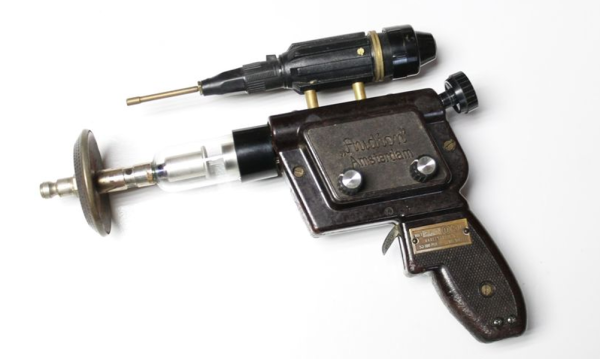
If ever there was a quintessential weapon of science fiction, it would have to be the ray gun. [lonesoulsurfer] built this one-of-a-kind stunner from his impressive collection of junk. It’s centered around a vintage Bakelite soldering gun, a vacuum tube, and a portable stove burner, all of which contribute to the fantastic mid-century look.

Inside is a slightly modified version of a ray gun sound effects circuit from MAKE: that squeezes square waves from a lo-fi synth builder’s favorite IC, the 40106 hex inverting Schmitt trigger. [lonesoulsurfer] was able to reuse the soldering gun’s trigger to start the pew-pew-pew, and he can adjust the death ray’s output with potentiometers. The gun is powered by an old cell phone battery and a combo Li-ion charger/step-up module from the world’s largest virtual auction house. Blast past the break to watch the build video.

If one little green LED isn’t enough for you, maybe you’d prefer this light painting gun.

Continue reading “A Stunning Ray Gun Built From Junk”

Software Defined Radio Gets Physical Control

Software Defined Radio (SDR) is a great technology, but there’s something so satisfying about spinning a physical knob to cruise the airwaves. Wanting to restore that tactile experience, [Tysonpower] purchased a cheap USB volume knob and set out to get it working with his software. Unfortunately, getting it up and running took a lot more work than you’re probably expecting.

Programming the knob’s STM32

After verifying that the knob worked for volume control on his computer, [Tysonpower] decided to try and pull the firmware from the device’s STM32 microcontroller. Unfortunately, this is where things got tricky. It turned out the chip had Code Protection enabled, so when it was wired up to a programmer and put into DFU mode, the firmware got wiped. Oops.

That left [Tysonpower] with no choice but to write a new firmware from scratch, which naturally required reverse engineering the device’s hardware. Step one was reading up on STM32 development and getting the toolchain working, which paved the way to getting the knob’s LED to blink. A couple more hours worth of work and some multimeter poking later, and he was able to read the knob’s movement. He describes getting USB HID working as a nightmare due to lack of documentation, but eventually he got that sorted out as well.

The end result is a firmware allows the volume knob to mimic a mouse scroll wheel, which can be used for tuning in many SDR packages. But we think the real success story is the experience [Tysonpower] gained with reverse engineering and working with the STM32 platform. After all, sometimes the journey is just as important as the end result. Continue reading “Software Defined Radio Gets Physical Control”