No Need For Speed With This Arduino-Based Inkjet Printer

When it comes to computers, it seems like the only thing that matters is speed. The more the better, in general, and the same applies to peripherals. We want the fastest network adapters, the fastest video card, and the fastest printer. So why in the world would anyone intentionally build a really slow inkjet printer? For art, of course.

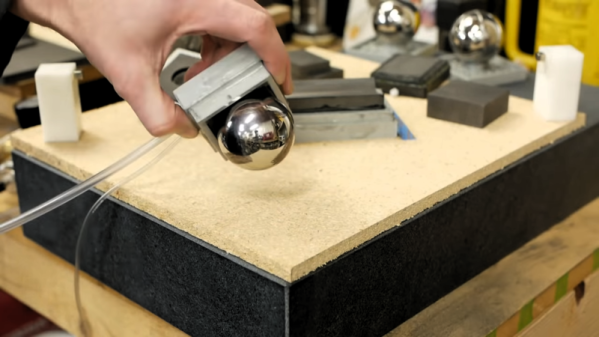
At least that’s the story [HomoFaciens] tells us in the video below. His efforts are in support of a friend’s art project, which seeks to print slowly but continuously on a roll of paper. [HomoFaciens]’s printer is based on an H-P C6602 inkjet cartridge, one of those high-priced consumables that make buying a new printer more attractive than replacing them once depleted. After figuring out how to drive the printhead — 5 to 6 μs pulses of 18 volts through a ULN2803 Darlington array driver chip seemed to do the trick — he mounted everything to the gantry of an old 3D printer. It’s interesting to watch the images slowly being built up — something that printers usually hide from prying eyes — and to see how the DPI count of the printer can be increased by interlacing each printed line.

Near the end of the video, we get a glimpse of his “tattoo gun printer”, which reminded us of all the other cool things he’s done over the years. From a CNC machine made from paperclips and cardboard to an encoder made from a wheel of resistors, [HomoFaciens] has some interesting designs that you really should check out.

Continue reading “No Need For Speed With This Arduino-Based Inkjet Printer”

Cheap Lab Balance Needs Upgrades, Gets Gutted Instead

What is this world coming to when you spend seven bucks on a digital scale and you have to completely rebuild it to get the functionality you need? Is nothing sacred anymore?

Such were the straits [Jana Marie] found herself in with his AliExpress special, a portable digital scale that certainly looks like it’s capable of its basic task. Sadly, though, [Jana] was looking for a few more digits of resolution and a lot more in the way of hackability. And so literally almost every original component was ripped out of the scale, replaced by a custom PCB carrying an STM32 microcontroller and OLED display. The PCB has a complicated shape that allows the original lid to attach to it, as well as the stainless steel pan and load cell. [Jana] developed new firmware that fixes some annoying traits, for example powering down after 30 seconds, and adds new functionality, such as piece-counting by weight. The video below shows some of the new features in action.

Alas, [Jana] reports that even the original load cell must go, as it lacks the accuracy her application requires. So she’ll essentially end up building the scale from scratch, which we respect, of course. At this rate, she might even try to build her own load cell from SMD resistors too.

Continue reading “Cheap Lab Balance Needs Upgrades, Gets Gutted Instead”

Now This Is A Maker’s PCB Shaker

Anyone who has ever etched their own PCB knows that the waiting is the hardest part. Dissolving copper in ferric chloride takes time, much like developing a Polaroid picture. And although you really should not shake a fresh Polaroid to speed up development, the PCB etching process thrives on agitation. Why wait an hour when you can build a simple PCB shaker and move on to drilling and/or filling in 10 minutes?

We love that [ASCAS] was probably able to build this without reaching past the the spare parts box and the recycling bin. There’s no Arduino or even a 555 — just a 12 VDC geared motor, a DC-DC buck converter, and an externalized pot to control the speed of the sloshing.

It’s hard to choose a favorite hack here between the hinge used to rock this electric seesaw and the crankshaft/armature [ASCAS] made from a sandwich spread lid and a Popsicle stick. Everything about this build is beautiful, including the build video after the break.

Did you know that unlike ferric chloride, copper chloride can be recharged and reused? Here’s a one-stop etching station that does just that.

Continue reading “Now This Is A Maker’s PCB Shaker”

Contactless Doorbell Built To Avoid Coronavirus

It’s often said that necessity breeds creativity, and during a global pandemic such words have proved truer than ever. Realising the common doorbell could be a potential surface transmission point for coronavirus, [CasperHuang] whipped up a quick build.

The build eschews the typical pushbutton we’re all familiar with. Instead, it relies on an ultrasonic distance sensor to detect a hand (or foot) waved in front of the door. An Arduino Leonardo runs the show, sounding a buzzer when the ultrasonic sensor is triggered. In order to avoid modifying the apartment door, the build is housed in a pair of cardboard boxes, taped to the base of the door, with wires passing underneath.

It’s a tidy way to handle contactless deliveries. We imagine little touches like this may become far more common in future design, as the world learns lessons from the COVID-19 pandemic. Every little bit helps, after all. Video after the break.

Continue reading “Contactless Doorbell Built To Avoid Coronavirus”

Scientific Calculator Whipped Up In Python

Scientific calculators were invaluable to most of us through high school and college, freeing us from the yoke of using tables to calculate logarithms and trigonometric functions. Once out in the real world, it’s no longer necessary to use an education board approved device to do your maths – you can do it all on your PC instead. For those keen to do so, [AstusRush]’s latest Python work may be just the ticket!

Far exceeding the capabilities of the usual calculator apps, there’s plenty of useful features under the hood. Particularly exciting is the LaTeX display, which shows equations in textbook-quality human-readable format. There’s also a graphing suite, and capability to handle matricies and vectors. LAN chat is implemented too, useful for working in teams.

It’s a useful tool that may suit better than a full-fat MATLAB install, particularly at the low, low price of free. This is one calculator that CASIO will have to keep their nose out of!

A Tasty Output Device

We have headphones for your ears, and monitors for your eyes. Some computers even have tactile feedback. Now researchers have an output device for taste. The decidedly odd device uses five gels, one for each of the tastes humans can sense. If we understand the paper, the trick is that ionizing the gels inhibits the taste of that gel. By controlling the ionization level of each gel, you can synthesize any taste, just like you can make colors with three LEDs.

The five gels are made from agar and glycine (sweet), magnesium chloride (bitter), citric acid (acidic), salt (salty), and glutamic sodium (umami). If you didn’t learn about umami in school, that’s a savory taste likened to the taste of a broth or meat and often associated with monosodium glutamate.

The shape of the device is made like a sushi roll so that while the gels contact the tongue, a copper foil cathode can connect also. Using this will make you look even stranger than someone wearing Google Glass, but that’s the price of being on the cutting edge of technology, we suppose. There doesn’t seem to be any reason you couldn’t duplicate something like this, although we wonder about the hygiene of passing it around at parties. Maybe your next home movie could show a meal and let the viewer taste it too.

If you are wondering about smell, that’s another set of researchers. You would think this is the first taste output device we have seen, but no… surprisingly, it isn’t.

Continue reading “A Tasty Output Device”