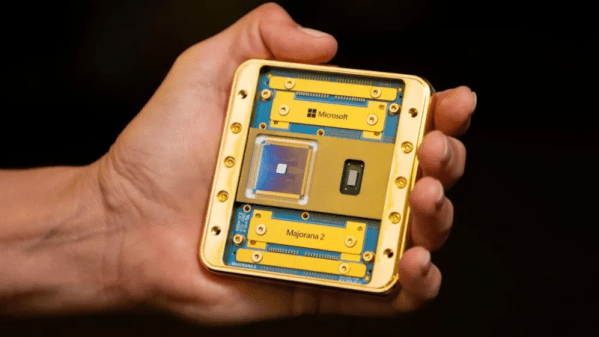
While it might seem that your computer malfunctions every few minutes, the reality is that modern computers are usually quite robust. Not so much for quantum computers, where qubit life is often measured in milliseconds. Now, the company claims to have qubits that last for about 20 seconds.
For example, Microsoft’s Majorana 1 quantum chip, which, incidentally, was mired in controversy, provided 8 qubits that were stable very briefly. This second-generation chip provides 12 qubits that average 20-second lifespans.
First introduced in 1979 by Signetics, the NE5532 was a pretty spiffy dual op-amp for the time with low noise and low distortion. Over the years it has become a standard part that showed up in countless audio products, and has become a so-called jellybean generic component with Texas Instruments (TI) being one of countless manufacturers.
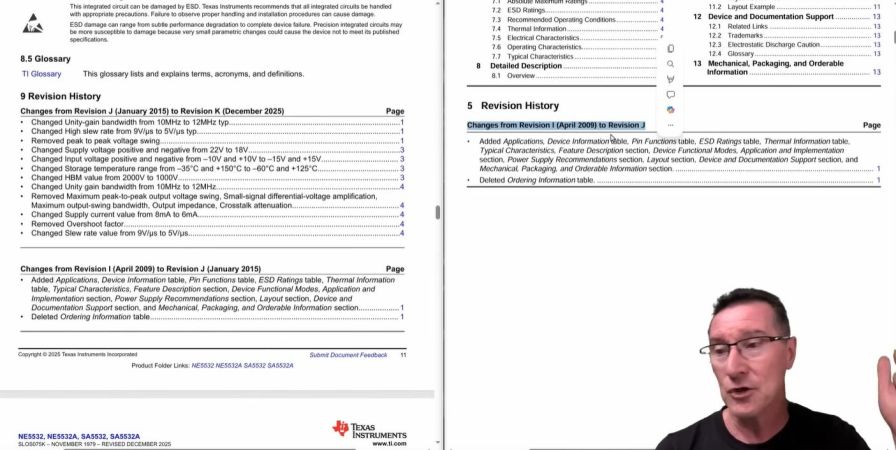
It being such a standard, multi-sourced part makes it thus even more puzzling that TI has now decided to completely overhaul this IC in a way that makes it incompatible with even the original Signetics NE5532. These changes are covered in detail by [Dave] of EEVblog as his mind is pretty much blown at such an incomprehensible change.
The changes entail an entirely different manufacturing process and a big change in specifications, while making no change to the part number. In revision K of the TI datasheet these changes are first seen, with some specifications changed for the better, like a higher unity gain bandwidth by 2 MHz, but a much slower slew rate.
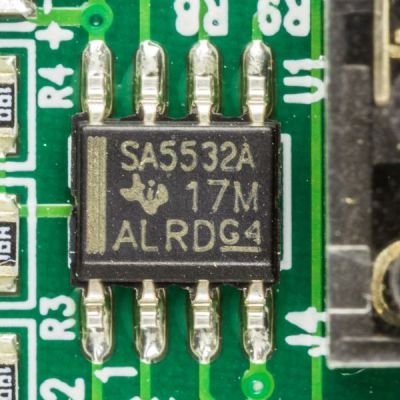
Texas Instruments SA5532A variant of the 5532 op-amp. (Credit: Raimond Spekking, Wikimedia)
Although the 5532 op-amps are multi-sourced, there are good reasons to just stick with manufacturers like TI, as that means receiving a product change notification (PCN) when anything changes. In the PCN related to this op-amp a change to process node is noted, along with other changes, but no reasoning.
Among the other big changes are a reduction in the supply voltage from 22 V to 18 V, and a halving of the ESD protection from 2 kV to 1 kV. Although it might be slightly more efficient on the new process node this way, it clearly comes with a lot of trade-offs that make it an overall worse op-amp, while also being incompatible with the same op-amp from other manufacturers.
In the video [Dave] goes through the datasheets of this jellybean part of other manufacturers, showing that they still have the original 1980s specifications. Only one exception here was the NE5532DR from Shenzhen HuaXuanYang Electronics, whose supply rail voltage is also 18 V for some reason, along with a similar internal transistor configuration that reduces the ESD resistance.
In addition to the NE5532 op-amp, it seems that TI also took an axe to the OPA134 op-amp, by removing its offset trim feature and listing the pins as ‘NC’, with a warning to not connect these pins and also worsening other specifications. This makes these similar jellybean parts incompatible, with no change to the part number. Worse is that it continues with the LMH6518, whose changes [Dave] argues might even kill oscilloscopes as they are commonly found in those.
Meanwhile the LM317M also got an overhaul, but here TI opted to give it a new part name, calling it the LM317MQ with at first glance no major degradations in the specifications, but instead some actual improvements. This makes it even more puzzling why TI didn’t give the other ICs a new part number to differentiate them from the jellybean part.
Until there’s some clarification from the side of TI, it might be a good idea to source these parts from a manufacturer that is not TI, especially when replacing these ICs in older devices.
Some of you may know there’s a version of UNIX for the Commodore Amiga, aptly called Amiga Unix or AMIX. There is an almost complete record of versions from 1.0 to 2.03, but 2.02 was lost media–until [Forgotten Computer] found it on an old Amiga.
It starts with an auction held for the 40 year anniversary of the Free Software Foundation where, by just one second, the highest bidder was too late. What do you do first with an artifact as valuable as an old FSF computer? You image the hard drive. Then you make several copies, including on different computers–after all, you wouldn’t want to lose the data on it. Preservation secured, the natural next thing is to boot it–and that’s when we see the magic 2.02c version number.
According to thorough digging by [Forgotten Computer], this version was–until now–lost.
In the video after the break, [Forgotten Computer] goes over what Amiga Unix is, the discovery process, and explores what’s on the disk–including FSF staples like GCC, G++ and core utilities like GNU less. Continue reading “Lost Version Of Amiga Unix Suddenly Reappears”→
Storage is expensive these days, whether you’re looking at the prices of spinning rust or magic little sticks of silicon. But what if there was some benevolent overlord that you could trick into giving you unlimited storage? That’s where Noisecloud comes in.
Created by [Lucas], Noisecloud is a tool that lets you use YouTube as a form of effectively-unlimited file storage. It works by taking whatever file data you have on hand, and turns it into frames of digital noise that can be stored and transported as an MP4 file and uploaded to YouTube. The encoding process involves first compressing the data with gzip, then packaging it into a high-constrast series of video frames that are then encoded with FFmpeg. Video containers can be produced in various resolutions, all the way down to 640×360 @ 30 fps. There’s also a special “TikTok mode” which is optimised to best preserve data on short form sites that use vertical orientation as default. More commentary from the creator is available via the supporting article on Github.
It’s probably not a practical way to store your files, given the fussy encoding and decoding required to actually use the data. However, it’s an interesting proof of concept that explores how data can be stashed in unexpected places via publicly-accessible services. We’ve explored similar work before, too.
Solar power has gotten cheap enough that putting up panels is among the cheapest ways of providing energy. This isn’t just the case for bulk electricity on a power grid, either; even small devices are easier and cheaper to power with solar than ever before. For example, landscape lighting which once relied on 12V or 24V DC wires all over one’s yard with a transformer and power supply hidden somewhere have partially been converted to simpler individual solar-powered lights now. These small devices can also be given additional capabilities as [Mauro] demonstrates.
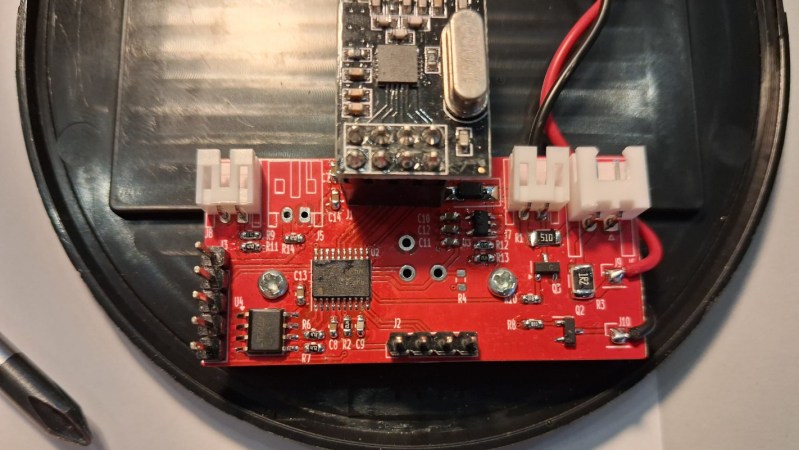
In this case, [Mauro]’s goal was to add on-demand lighting to a solar-powered light which was otherwise motion-activated only. To do this, they added a NRF24L01+ radio inside the light’s housing paired with an STM32 microcontroller. This secondary system is largely separated from the existing control circuitry with the exception of being able to switch the lights and receiving its power from the same solar panel. [Mauro] also created a small library to help with communicating with these new modules, whether that’s using a home automation system like Home Assistant or some other method.
Although adding in a few capabilities to inexpensive solar lighting might seem simple on the surface, a project like this is a gateway to adding in all kinds of interesting features to things with built-in solar panels and lots of free space in their cases. The best example here is the addition of a Meshtastic node to one of these lights, making it convenient and stealthy, but we could also see adding in other remote hardware to a landscape lighting module like a gate sensor or a plant health monitoring system.
With Hackaday Europe no more than two days away, we want to help you wrap up all of the last loose ends. And that means last-minute changes in the workshop schedule, details on the Friday night pre-party, and more! Some tickets for the event itself, the workshops, and the pre-party (reservations required) are still available right here.
Pre-Party, Friday May 15th
Kick off the weekend with us at the official Hackaday Europe pre-party at Soqquadro Restaurant, Piazza Era 7, 23900 Lecco, Italy. Enjoy the Italian aperitivi on the gorgeous Lago di Lecco waterfront. Your ticket includes two drinks and an array of delicious snacks. It’s the Italian way to pregame the weekend ahead. Bring a hack, or just relax and hang out. Your choice. Either way, make sure you pre-register. (On the preregistration page, scroll all the way down past the workshops.)
Workshops
Unfortunately, the Let’s Mesh workshop has been canceled, but the good news, thanks to our incredible sponsors, we’ve added two great new workshops to the lineup. On Saturday, May 16th, we’ll have Tiny Tapeout, When Code Needs a Body, and Fault Injection 101. Sunday features EchoGlow: Arduino UNO Q Workshop with the brand-new Arduino Q devices, from 11:00 AM – 2:00 PM.
Tickets and full descriptions are available at registration.
Lightning Talks
On Sunday afternoon, we’ll dedicate some time to Lightning Talks. These are short, seven-minute talks, with or without slides, on whatever interests you at the moment. If you’ve got hacks or deep thoughts to share with us, you’ll never find a more receptive audience. Register now! Talk slots are FIFO.
Thanks, and See You Soon!
If you’ve never attended a Hackaday event before, we’re excited to see you. Half the fun is the crowd that convenes. If you want to bring along a hack to informally show-and-tell, it’s a great icebreaker. You won’t have to bring food or drinks – we’ve got that covered all weekend.
If you’re an old Hackaday hand, we’re stoked to see you again! A first at Hackaday Europe is going to be whatever large fraction of our SAO collection fits into carry-on luggage, and a sweet-looking SAO wall made by Hackaday Superfriend [Thomas Flummer]. If you have an SAO that you’d like to add to our pile, bring it along! It’s about time for us to do a photo gallery and write-up of everything we’ve got.
And we can’t leave without thanking our broad array of sponsors who make Hackaday Europe possible:
You normally think of fiber optic as something used in network cables. However, scientists employ dedicated fibers to detect earthquakes. In simple terms, they fire a laser down the fiber and watch reflections caused by imperfections. When vibrations hit the cable, it changes the defects, which show up in the return pattern. However, with the right techniques, those vibrations could just as easily be from people speaking near the cable.
If you are alarmed, there’s good news and bad news. The good news is that the technique seems to be limited to coils of fiber that are not buried, and you have to be within about 5 meters of the fiber. The bad news is that there is plenty of dark cable all over the place. Besides, if researchers can do this successfully, you would imagine three-letter agencies around the world could do it even better.