Psst – Wanna Buy A Control Panel From A Nuclear Power Station?

Doing the rounds today is an interesting lot in an otherwise unexciting industrial dispersal auction in Lincolnshire, UK. On sale is an “Ex nuclear plant reactor control/monitoring system“, at the time of writing attracting the low low bid of £220 ($270), but we guess it will rise. Everyone who has watched Chernobyl (or maybe The Simpsons) is now gazing awestruck at a crescent of metal consoles covered in screens, buttons, and joysticks just waiting for a staff of white-coated technicians to pore over them.

Chernobyl Unit 3 control room (still active). [Source: IAEA Imagebank on Flickr CC-SA 2.0]
It’s a very cool lot indeed, but it raises more questions than it answers. The auction house has very little information indeed, so we’re left guessing, where did it come from? From this image showing the unit 3 control room at Chernobyl it’s obvious didn’t come from there (/s). Since it is for sale in the UK, and the country has decommissioned the majority of its first-generation reactors by now, so there is no shortage of candidates. But that intriguing possibility raises another question. Is it even a reactor control panel in the first place?

British civilian nuclear plants have tight security but they are hardly a secret, so plenty of photos are online showing their interiors. And in studying those we hit a problem, this panel doesn’t resemble any of the control panel images we can find. The first generation of Magnox (Magnetic Oxide Magnesium Non Oxidising) plants had panels covered in analogue dials and chart recorders so it’s unlikely to be one of those. The second-generation AGR (Advanced Gas-cooled Reactor) stations had similarly complex panels, and it’s evidently not one of them.

Looking closely at the photos it becomes apparent that there are a lot of camera controls and monitors, and even what looks like a uMatic video recorder. It’s definitely nuclear-related and the 1980s look of it suggests maybe it could have come from an Advanced Gas-Cooled Reactor (AGR) station, but could it be a little closer to Sector 7G than the centre of the action? Is it a video monitoring console used to keep a physical eye on its operation?

Be careful if you bid, you could end up with a rather cool but absurdly large 1980s CCTV system. Can any of our readers shed any light on the matter?

Thanks [Gregg “Cabe” Bond] for the tip.

Milling A Custom 6-Pin DIN Connector

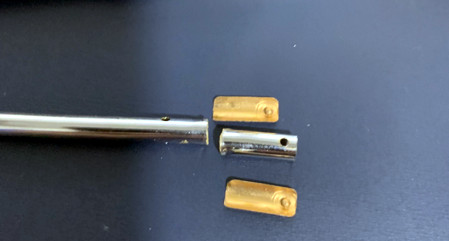
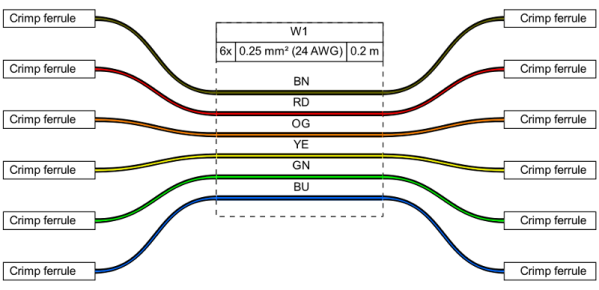
When [Charles Ouweland] found himself in need of a DIN connector that had a somewhat unusual pin arrangement, he figured he could fashion his own in less time than it would take to have a replacement shipped to him. In the end it sounds as though it took a lot longer than expected, but given the worldwide situation, we don’t doubt this bespoke connector was still put to work before its eBay counterpart would have arrived.

More importantly, the connector [Charles] produced looks fantastic. If we weren’t told otherwise, we’d have assumed the finished product was commercially produced. Although to be fair, he did have a little help there. The housing and pins themselves were pulled from a sacrificial connector; his primary contribution was the insulating block that holds the pins in their proper position.

So how did he make it? He had considered using a piece of scrap material and just putting the holes in it with a drill press, but he was worried getting the aliment right. Instead, he decided to call his cheap CNC router into service. By routing his design out of copper clad PCB, he was even able to tie the appropriate pins together right in the connector.

Admittedly, we don’t see a lot of hardware that still uses DIN connectors these days. But this tip is certainly worth filing away just in case. You never know when you might find an old piece of hardware that just needs a little TLC to get up and running again. Who knows, you might even find a dumpster full of them.

New Teensy 4.1 Arrives With 100 Mbps Ethernet, High-Speed USB, 8 MB Flash

It was only last August that PJRC released Teensy 4.0. At that time, the 4.0 became the fastest microcontroller development board on the planet, a title it still holds as of this writing — or, well, not exactly. Today the Teensy 4.1 has been released, and using the same 600 MHz ARM Cortex M7 under the hood, is now also the fastest microcontroller board. What the 4.1 brings to the table is more peripherals, memory, and GPIOs. While Teensy 4.0 used the same small form factor as the 3.2, Teensy 4.1 uses the larger board size of the 3.5/3.6 to expose the extra goodies.

The now slightly older Teensy 4.0 — released on August 7th of last year — is priced at $19.95, with the new 4.1 version offered at $26.85. It seems that the 4.1 isn’t intended as a replacement for the 4.0, as they serve different segments of the market. If you’re looking for an ultra-fast affordable microcontroller board that lives up to its Teensy name, the 4.0 fits the bill. On the other hand, if you need the additional peripherals broken out and can afford the space of the larger board, the not-as-teensy-sized 4.1 is for you. How big is it? The sample board I measured was 61 x 18 mm (2.4 x 0. 7″), not counting the small protrusion of the micro-usb jack on one end.

Let’s have a look at all the fun stuff PJRC was able to pack into this space. Continue reading “New Teensy 4.1 Arrives With 100 Mbps Ethernet, High-Speed USB, 8 MB Flash”

Arm Gives Gift To Startups: Zero Cost

Who hasn’t dreamed of pulling together some gadget in their garage and turning it into a big business? Of course, most gadgets today have a CPU in them, and Arm CPUs power just about any kind of embedded device you can think of. If you just want to use a chip, that’s easy. You buy them from a licensee and you use their tools for development. But if you want to integrate ARM’s devices into your own chips, that’s a different story. You have to pay fees, buy tools, and pay licenses on each chip you produce. Until now. Arm’s flexible access for startups program will let you apply to get all of that free.

To qualify, you have to be an “early stage silicon startup with limited funding.” Normally, flexible access costs about $75,000 to $200,000 a year and that doesn’t cover your license fees and royalties. The plan offered to qualifying startups is the $75,000 package, but that still includes access to nearly all Arm products, technical support, a few introductory training credits, and development tools. After your first tape-out, though, it looks as though you’ll have to pony up.

Continue reading “Arm Gives Gift To Startups: Zero Cost”

Take This Cylindrical Coupler Design For A Spin

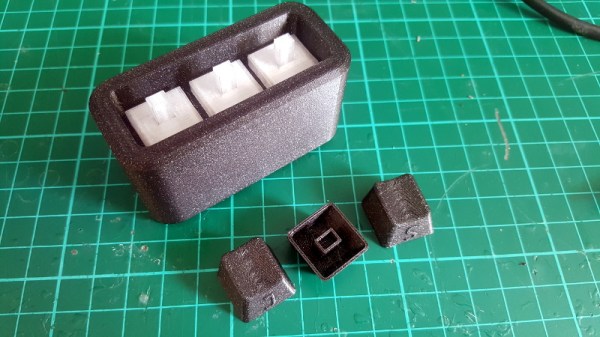
We’re not exactly sure what kind of shenanigans [Conrad Brindle] gets himself into, but apparently it often requires cylindrical couplings to attach 3D printed parts to each other. He found himself designing and redesigning this type of connector so often that he decided to just make a parametric version of it that could be scaled to whatever dimensions are necessary for that particular application.

In the video after the break, [Concrad] explains the concept behind the coupler and how he designed it. Put simply, the tabs inside of the coupler are designed to grab onto each other once the coupler is spun. When he demonstrates the action, you can see that both sides of the coupler are pulled together tightly with a satisfying little snap, but then can be easily removed just by rotating them back in the opposite direction.

The nature of desktop 3D printing means that the female side of the connection requires support when printing, and depending on your printer, that might mean a relatively rough mating surface. [Conrad] notes that you’ll need to experiment a bit to find how small your particular machine can print out the design before things get too gummed up.

We can see how this would be useful for some applications, but if you need a printed joint that can handle a decent amount of torque before giving up the ghost, you might want to look into (mis)using one half of a spider coupling.

Continue reading “Take This Cylindrical Coupler Design For A Spin”

Hardware Hacker’s Marie Kondo: How Many LM386s Is Too Many?

We’re running a contest on Making Tech at Home: building projects out of whatever you’ve got around the house. As a hacker who’s never had a lab outside of my apartment, house, or hackerspace, I had to laugh at the premise. Where the heck else would I hack?

The idea is that you’re constrained to whatever parts you’ve got on hand. But at the risk of sounding like Scrooge McDuck sitting on a mountain of toilet paper, I’ve got literally hundreds of potentiometers in my closet, a couple IMUs, more microcontrollers than you can shake a stick at, and 500 ml of etching solution waiting for me in the bathroom. Switches, motors, timing belts, nichrome wire…maybe I should put in an order for another kilogram of 3D printer filament. In short, unless it’s a specialty part or an eBay module, I’m basically set.

But apparently not everyone is so well endowed. I’ve heard rumors of people who purchase all of the parts for a particular project. That ain’t me. The guru of household minimalism asks us to weigh each object in our possession and ask “does it spark joy?”. And the answer, when I pull out the needed 3.3 V low-dropout regulator and get the project built now instead of three days from now, is “yes”.

And I’m not even a hoarder. (I keep telling myself.) The rule that keeps me on this side of sanity: I have a box for each type of part, and they are essentially fixed. When no more motors fit in the motor box, no more motors are ordered, no matter how sexy, until some project uses enough of them to free up space. It’s worked for the last 20 years, long before any of us had even heard of Marie Kondo.

So if you also sit atop a heap of VFD displays like Smaug under the Lonely Mountain, we want to see what you can do. If you do win, Digi-Key is sending you a $500 goodie box to replenish your stash. But even if you don’t win, you’ve freed up space in the “Robot Stuff” box. That’s like winning, and you deserve some new servos. Keep on hacking!

This article is part of the Hackaday.com newsletter, delivered every seven days for each of the last 200+ weeks. It also includes our favorite articles from the last seven days that you can see on the web version of the newsletter.

Want this type of article to hit your inbox every Friday morning? You should sign up!

Building A New RF Remote From Scratch

We’ve seen no shortage of projects that use the ESP8266 or ESP32 to add “smart” features to existing home appliances, often by pairing the microcontroller with a radio or IR transmitter. If your device has an existing remote, integrating it into a custom home automation system is often just a matter of getting a few cheap modular components and writing some simple code to glue it all together.

But what if the appliance you want to control doesn’t use a common frequency? That’s a question that [eigma] recently had to answer after finding the remote control for the bedroom ceiling fan was operating at a somewhat unusual 304 MHz. Something like the MAX1472 could probably have been tuned to this frequency, but the chip doesn’t seem to be available in a turn-key module as the popular 315 MHz transmitters are.

There were a few possible options, including using a software defined radio (SDR), but [eigma] didn’t want to spend a fortune on this project or wait months for parts to get shipped from overseas. The most straightforward solution was to design a custom transmitter tuned to the proper frequency using discrete components; something of a dark art to those of us who’ve been spoiled by the high availability of modular components.

What follows is an fascinating look at the design, testing, and troubleshooting of a truly scratch-built transmitter. You won’t find any ICs here, the carrier signal is generated with just a transistor, some carefully measured pieces of wire, and a handful of passive components. By modulating the signal with an ESP32, [eigma] successfully makes the oddball ceiling fan an honorary member of the Internet of Things.

The write-up that [eigma] has done is an absolutely invaluable resource if you ever find yourself in need of rolling a bespoke transmitter. It easily ranks among some of the most informative radio reverse engineering work we’ve covered, and you’d be wise to file this one away for future reference. That said, most of the newer hardware you’re going to run into will probably be utilizing a widely-supported frequency like 433 MHz.