A Mobius Strip Track For Superconductor Levitation

Superconductors are interesting things, though we don’t really rely on them for much in our day to day lives. They’d be supremely useful, if only they didn’t need to be so darned cold. While the boffins toil away in the lab on that problem however, there’s still some fun to be had, as demonstrated by the Möbius Strip levitation track at Ithaca College.  (Video, embedded below.)

The rig takes advantage of the fact that superconductors can levitate over magnets, and vice versa. Under certain conditions, the superconductor can even lock into position over a magnet, due to flux pinning, wherein flux “tubes” from the magnet’s field penetrate a superconductor and are pinned in place by currents in the superconductor. It’s an awe-inpsiring effect, with the superconducting material appearing to magically float at a locked height above the magnetic surface, quite distinct from traditional magnetic levitation.

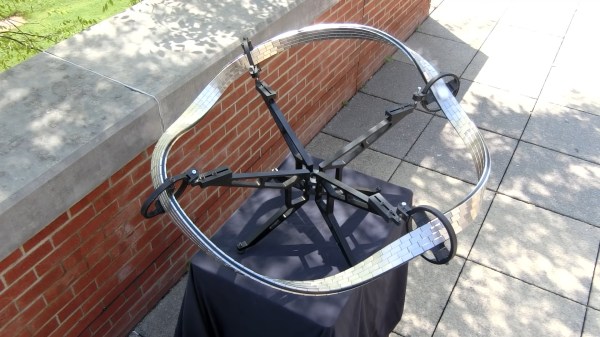
Construction of the track wasn’t straightforward. Early attempts at producing a Möbius Strip twisted through 540 degrees were unsuccessful in steel. The team then switched tack, using a flexible plastic which was much more pliable. This was then covered in neodymium magnets to create the necessary field, and the resulting visual effect is one of a silver-bricked magnetic road.

It’s a great display, and one that quite intuitively demonstrates the concepts of both a Möbius Strip and superconducting levitation. If room-temperature semiconductors become a real thing, there’s every possibility this could become an always-on installation. It’s also the trick behind one of the coolest hoverboards we’ve ever seen. Video after the break.

Continue reading “A Mobius Strip Track For Superconductor Levitation”

Science Officer…Scan For Elephants!

If you watch many espionage or terrorism movies set in the present day, there’s usually a scene where some government employee enhances a satellite image to show a clear picture of the main villain’s face. Do modern spy satellites have that kind of resolution? We don’t know, and if we did we couldn’t tell you anyway. But we do know that even with unclassified resolution, scientists are using satellite imagery and machine learning to count things like elephant populations.

When you think about it, it is a hard problem to count wildlife populations in their habitat. First, if you go in person you disturb the target animals. Even a drone is probably going to upset timid wildlife. Then there is the problem with trying to cover a large area and figuring out if the elephant you see today is the same one as one you saw yesterday. If you guess wrong you will either undercount or overcount.

The Oxford scientists counting elephants used the Worldview-3 satellite. It collects up to 680,000 square kilometers every day. You aren’t disturbing any of the observed creatures, and since each shot covers a huge swath of territory, your problem of double counting all but vanishes.

Continue reading “Science Officer…Scan For Elephants!”

The Devil Is In The Details For This Open Air Laser

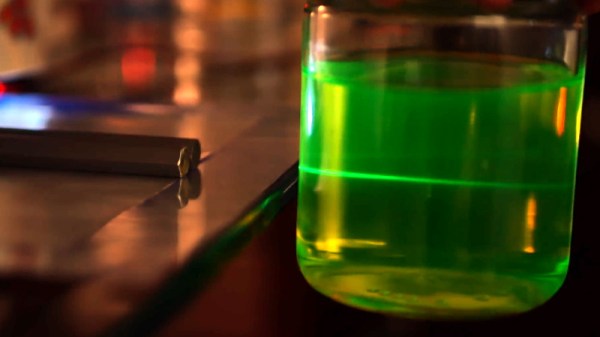
Normally, we think of lasers as pretty complex and fairly intimidating devices: big glass tubes filled with gas, carefully aligned mirrors, cooling water to keep the whole thing from melting itself, that sort of thing. Let’s not even get started on the black magic happening inside of a solid state laser. But as [Jay Bowles] shows in his latest Plasma Channel video, building a laser from scratch isn’t actually as difficult as you might think. Though it’s certainly not easy, either.

The transversely excited atmospheric (TEA) laser in question uses high voltage passed across a a pair of parallel electrodes to excite the nitrogen in the air at standard atmospheric pressure, so there’s no need for a tube and you don’t have to pull a vacuum. The setup shakes so many UV photons out of the nitrogen that it doesn’t even need any mirrors. In fact, you should be able to get almost all the parts for a TEA laser from the hardware store. For example, the hexagonal electrodes [Jay] ends up using are actually 8 mm hex keys with the ends cut off.

Continue reading “The Devil Is In The Details For This Open Air Laser”

Raspberry Pi Cosmic Ray Detector

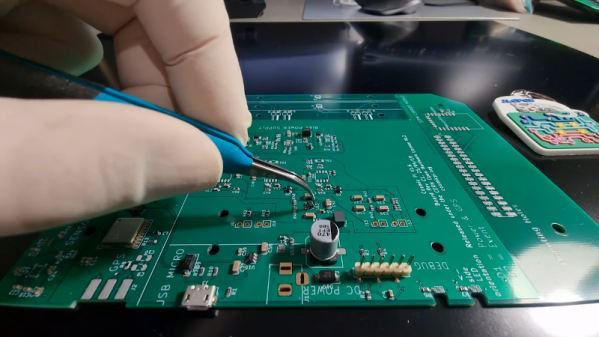
[Marco] has a sodium iodide detector that indicates cosmic radiation by scintillation. The material glows when hit by cosmic rays and, traditionally, a photomultiplier tube detects the photos from the detection. After a quick demonstration that you can see in the video below, he built the Cosmic Pi, a CERN project to create a giant distributed cosmic ray detector. The Cosmic Pi uses scintillation, but not from a crystal. It uses a plastic scintillator and silicon photodetectors, so it is much easier to work with than a traditional detector.

Using a four-layer board and some harvested components, the device detects muons. There are two scintillation detectors and muons striking both detectors presumably don’t have a local origin. The instrument has a GPS to get accurate time and position data. There are other sensors onboard, too, to collect data about the conditions of each detected event.

Continue reading “Raspberry Pi Cosmic Ray Detector”

Design Solutions For The Heat Crisis In Cities Around The World

It was 1999 when Smash Mouth dropped the smash hit All Star, stating “The ice we skate is getting pretty thin, the water’s getting warm so you might as well swim.” Since then, global temperatures have continued to rise, with no end in sight. Political will has been unable to make any grand changes, and the world remains on track to blow through the suggested hard limits set by scientists.

As a result, heatwaves have become more frequent, and of greater intensity, putting many vulnerable people at risk and causing thousands of deaths each year. This problem is worse in cities, where buildings and roads absorb more heat from the sun than natural landscapes do. This is referred to as the heat island effect, with cities often being several degrees warmer than surrounding natural areas. It’s significant enough that experts are worried some cities could become uninhabitable within decades. Obviously, that’s highly inconvenient for those currently living in said cities. How bad is the problem, and what can be done?

Continue reading “Design Solutions For The Heat Crisis In Cities Around The World”

Growing The World’s Largest Snowflake

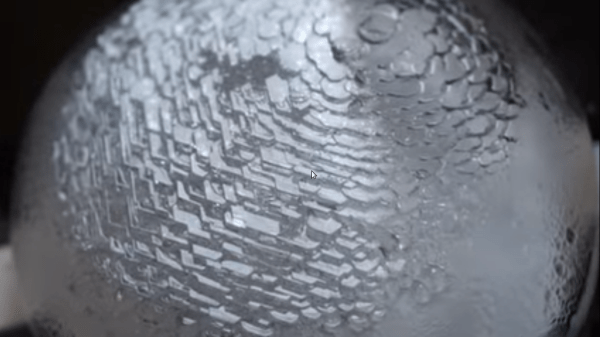
Plenty of areas around the world don’t get any snowfall, so if you live in one of these places you’ll need to travel to experience the true joy of winter. If you’re not willing to travel, though, you could make some similar ice crystals yourself instead. While this build from [Brian] aka [AlphaPhoenix] doesn’t generate a flurry of small ice crystals, it does generate a single enormous one in a very specific way.

The ice that [Brian] is growing is created in a pressure chamber that has been set up specifically for this hexagonal crystal. Unlike common ice that is made up of randomly arranged and varying crystals frozen together, this enormous block of ice is actually one single crystal. When the air is pumped out of the pressure chamber, the only thing left in the vessel is the seed crystal and water vapor. A custom peltier cooler inside with an attached heat sink serves a double purpose, both to keep the ice crystal cold (and growing) and to heat up a small pool of water at the bottom of the vessel to increase the amount of water vapor in the chamber, which will eventually be deposited onto the crystal in the specific hexagonal shape.

The build is interesting to watch, and since the ice crystal growth had to be filmed inside of a freezer there’s perhaps a second hack here which involved getting the camera gear set up in that unusual environment. Either way, the giant snowball of an ice crystal eventually came out of the freezer after many tries, and isn’t the first time we’ve seen interesting applications for custom peltier coolers, either.

Continue reading “Growing The World’s Largest Snowflake”

Got Oxygen? Future Mars Missions Are Relying On The MOXIE Of Perseverance

The rule of thumb with planetary exploration so far has been, “What goes up, stays up.” With the exception of the Moon and a precious few sample return missions to asteroids and comets, once a spacecraft heads out, it’s never seen again, either permanently plying the void of interplanetary or interstellar space, or living out eternity on the surface of some planet, whether as a monument to the successful mission that got it there or the twisted wreckage of a good attempt.

At the risk of jinxing things, all signs point to us getting the trip to Mars reduced to practice, which makes a crewed mission to Mars something that can start turning from a dream to a plan. But despite what some hardcore Martian-wannabees say, pretty much everyone who goes to Mars is going to want to at least have the option of returning, and the logistical problems with that are legion. Chief among them will be the need for propellants to make the return trip. Lugging them from Earth would be difficult, to say the least, but if an instrument the size of a car battery that hitched a ride to Mars on Perseverance has anything to say about it, future astronauts might just be making their own propellants, literally pulling them out of thin air.

Continue reading “Got Oxygen? Future Mars Missions Are Relying On The MOXIE Of Perseverance”