The Metal That Never Forgets: Nitinol And Shape-Memory

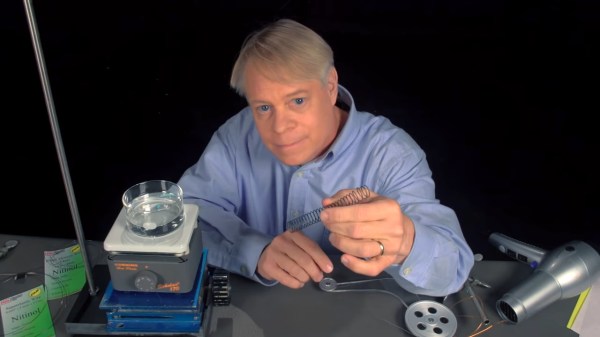
You’ve likely heard of Nitinol wire before, but we suspect the common base knowledge doesn’t go much beyond repeating that it’s a shape-memory alloy. [Bill Hammack], the Engineer Guy, takes us on a quick journey of all the cool stuff there is to know about Nitinol and shape-memory alloys.

The name itself is like saying Kleenex when you mean tissue, or using the V-word when you mean hook and loop fasteners. The first few letters of Nickel Titanium Naval Ordnance Laboratories combine to form the name of what is essentially a nickel-titanium alloy developed in 1962: Nitinol. It’s called shape-memory because you can stretch or bend it at room temperature and it will return to the original shape when heated at around 75 C (167 F). This particular metal can do that because its bonds form a “twinned structure” of rhombus shapes — bending or stretching moves those rhombuses (or rhombi, take your pick) but doesn’t change which atoms are bonded to one another.
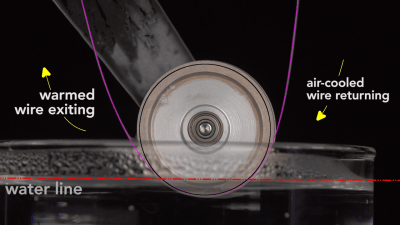
Has this material science excursion bored you to tears yet? That’s why we love [Bill’s] work. He has always done a fantastic job of demystifying common mysticism and this is no different. The video below does a much better job of illustrating what we’ve described above, but also pull out a Nitinol engine for added wow-factor. A straight piece of Nitinol is bent into a loop around two pulleys. The lower pulley is submerged in hot water, causing the Nitinol to want to straighten out, but it loops back to the top pulley, bending and cooling in the air and creating a lever effect that drives the engine. We saw a more complex version of this concept last year.

You know those eyeglass frames you can bend in any way and they’ll  pop back to the original shape? They’re taking advantage of the super-elasticity of Nitinol. [Bill] also recounts uses as stents for medical applications, and oddball engineering tricks in the automotive industry.

It’s great to see the Engineer Guy back. Favorites of ours have been the science behind disposable diapers and the aluminum beverage can. More recently he released Faraday’s lecture series, wrote a book on airships, appeared on Outlaw Tech on the Science Channel, and started a family. Thanks for fitting these illustrative videos in when you can [Bill]!

Continue reading “The Metal That Never Forgets: Nitinol And Shape-Memory”
The Kilogramme Will Cease To Be A Physical Entity

One of the most illuminating high school courses no doubt for many readers as much as for your scribe, was the series of physics lessons during which the SI units were explained. That glorious sense of having the order of the universe unlocked into an interlocking series of units whose definitions could all be derived in terms of a series of base units was mind-blowing in those early teen years, and even though the explanations might have been at a for-the-children level that has been blown out of the water by later tiers of learning it’s still a bedrock that will serve an engineer or scientist life-long.

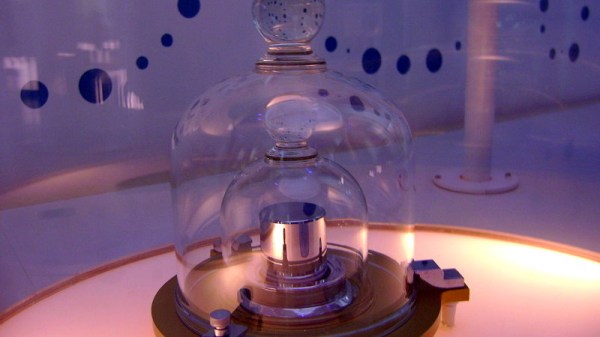
The definitions of the SI base units have evolved with scientific advancement to the point at which they are no longer tied to their original physical entity definitions. Of all the base units though there is still one that has resisted the urge to move away from the physical: the kilogramme (giving it its French spelling to preserve context) is still defined in terms of a metal cylinder in a laboratory just outside Paris. Kg diehards have not much time left to cling onto their platinum-iridium alloy though, for a new definition has been adopted in which it is derived from Planck’s Constant. From next May this will become the official kilogram, at which point concerns over microscopic erosion of the metal standard become irrelevant, and an SI kilogram can be replicated by any laboratory with the means to do so.

The piece of apparatus that makes this definition possible is the Kibble balance, a balance in which the force required to overcome the effect of gravitational force on a given mass is measured in terms of the electrical power required to do so. The gravitational force at a given point can be measured accurately and is defined in terms of the other SI units, while the electrical power can be derived from a Josephson junction, a superconducting junction whose current is defined in terms of Planck’s constant. As a result, the kilogram can be measured solely in terms of the constant and other SI units, consigning the metal cylinder to history.

This high-end metrology and physics make for interesting reading, but it’s fairly obvious that the de facto kilogram we all use will not change. Our everyday measures of everything from sugar to PLA filament will be the same today as they will be next May. But that’s not the point, everyday measurements do not need the extreme accuracy and reproducibility of a laboratory. The point of it all comes in as yet unforseen applications, as an example would the ability to synchronise timing to create GPS or digital radio have been possible were the second to be still defined in terms of astronomical movements rather than atomic states?

Standard kilogramme replica picture: Japs 88 [CC BY-SA 3.0]

Supercon: Designing Your Own Diffractive Optics

Kelly Peng is an electrical and optical engineer, and founder of Kura AR. She’s built a fusion reactor, a Raman spectrometer, a DIY structured light camera, a linear particle accelerator, and emotional classifiers for likes and dislikes. In short, we have someone who can do anything, and she came in to talk about one of the dark arts (pun obviously intended): optics.

The entire idea of Kura AR is to build an immersive augmented reality experience, and when it comes to AR glasses, there are two ways of doing it. You could go the Google Glass route and use a small OLED and lenses, but these displays aren’t very bright. Alternatively, you could use a diffractive waveguide, like the Hololens. This is a lot more difficult to manufacture, but the payoff will be a much larger field of view and a much more immersive experience.

Continue reading “Supercon: Designing Your Own Diffractive Optics”

How’s A Gyro Work?

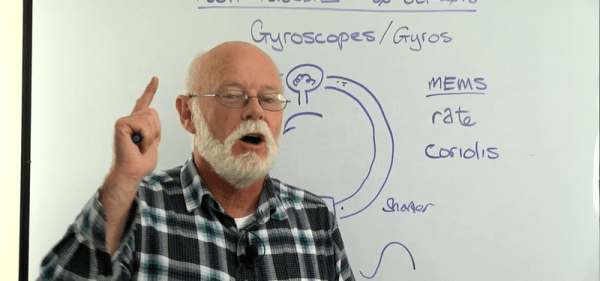
It wasn’t long ago that a gyro — or gyroscope — was an exotic piece of electronics gear. Most of us only saw them as children’s toys that would balance on your finger. That’s changed, though, thanks to microelectronics. Now your game controller, your phone, and your drone all probably use little ICs that are actually three-axis gyroscopes. Ever wonder how they work and what they do? [RCModelReviews] has a video that covers three kinds of gyros: old mechanical gyros, modern MEMS gyros, and even an exotic laser-based gyro. (YouTube, embedded below.)

Gyroscopes allow you to detect orientation by detecting linear forces on a rotating element. They are used in everything from spacecraft to submarines. The device has many origins dating back to antiquity. But the modern gyro showed up around 1800 or so. The children’s toy appeared in 1917 and is still made today.

Continue reading “How’s A Gyro Work?”

Cyborg Mushrooms

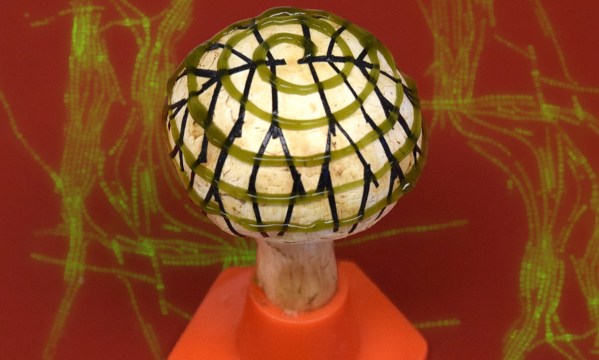
Of all the fictional cyborgs who turn against humanity to conquer the planet, this is as far from that possibility as you can get. These harmless mushrooms seem more interested in showing off their excellent fashion sense with a daring juxtaposition of hard grid lines with playful spirals. But the purpose of this bacteria-fungus-technology hybrid is to generate electricity. The mushrooms are there to play nurse to a layer of cyanobacteria, the green gel in the photo, while the straight black lines harvest electricity.

Cyanobacteria do not live very long under these kinds of conditions, so long-term use is out of the question, but by giving the cyanobacteria somewhere it can thrive, the usefulness grows. The interplay between bacterial and supportive organics could lead to advances in sensors and hydrogels as well. At some point, we may grow some of our hardware and a green thumb will be as useful as a degree in computer science.

Hydrogels could be the next medical revolution, and we’ve already made hydrogels into tattoos, used them as forms for artificial muscles, and hydrogels can be a part of soft tissue printing.

Pint-sized Jacob’s Ladder Packs 10,000 Volts In A Pickle Jar

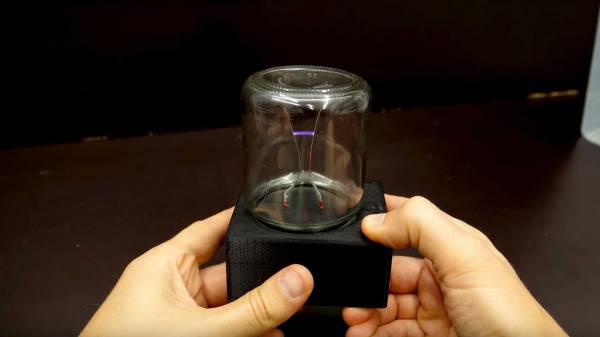
File this one away for your mad scientist costume next Halloween: [bitluni]’s Pocket Jacob’s Ladder is the perfect high voltage accessory for those folks with five dollars in parts, a 3D printer, and very big pockets.

[bitluni]’s video shows you all the parts you’ll need and guides you through the very simple build process. For parts, you’ll require a cheap and readily-available high-voltage transformer, a battery holder, some silver wire for the conductors, and a few other minor bits like solder and a power switch.

Once the electronics are soldered together, they’re stuffed inside a 3d printed case that [bitluni] designed with FreeCAD. The FreeCAD and STL files are all available on Thingiverse. We’re not sure what type of jar [bitluni] used to enclose the electrodes. If your jar isn’t a match, you’ll have to get familiar with FreeCAD or start from scratch with your favorite CAD package.

Either way, we enjoy the slight nod toward electrical safety and the reuse of household objects for project enclosures.

If you’re interested in a Jacob’s Ladder with significantly higher voltage we’ve got you covered, or we’ve also written about another tiny portable Jacob’s Ladder.

The full video is embedded after the break.

Continue reading “Pint-sized Jacob’s Ladder Packs 10,000 Volts In A Pickle Jar”

Oliver Heaviside: Rags To Recognition, To Madness

Like any complex topic, electromagnetic theory has its own vocabulary. When speaking about dielectrics we may refer to their permittivity, and discussions on magnetic circuits might find terms like reluctance and inductance bandied about. At a more practical level, a ham radio operator might discuss the impedance of the coaxial cable used to send signals to an antenna that will then be bounced off the ionosphere for long-range communications.

It’s everyday stuff to most of us, but none of this vocabulary would exist if it hadn’t been for Oliver Heaviside, the brilliant but challenging self-taught British electrical engineer and researcher. He coined all these terms and many more in his life-long quest to understand the mysteries of the electromagnetic world, and gave us much of the theoretical basis for telecommunications.

Continue reading “Oliver Heaviside: Rags To Recognition, To Madness”