It’s an unfortunate reality that for many of us, our air isn’t nearly as clean as we’d like. From smog to wildfires, there’s a whole lot of stuff in the air that we’d just as soon like to keep out of our lungs. But in order to combat this enemy, you first need to understand it. That means figuring out just what’s in the air you breathe, and how much of it. That’s where devices like the Dust Box from [The IoT GURU] can come in handy.
Inside the 3D printed enclosure is a Wemos D1 Mini ESP8266 development board, sitting on a custom breakout PCB. This board gives you some easy expandability to add your own sensors and hardware, though in this particular configuration, the Dust Box is using the BME280 sensor for general environmental monitoring and the SDS011 laser particle sensor to determine what’s in the air. Just plug it into a convenient USB power source, make sure it’s connected to the WiFi, and off it goes.
But where does all that lovely data end up? That’s up to you, but in this case, the [The IoT GURU] is pushing everything out to a web interface that allows the user to view yearly, monthly, and weekly historical data for each of the parameters the Dust Box can check. This is probably a bit more granular than most of us need, but it’s a good example of what’s possible should you need that much information.
As the open-source movement has brought its influence to more and more fields, we’ve seen an astonishing variety of things once only available at significant expense become accessible to anyone with access to the tools required to create them. One such arena is that of scientific instrumentation, and though we have seen many interesting developments there has been one which has so far evaded us. An analytical balance, a very specialised weighing machine designed to measure the tiniest of masses, remains available only as a new unit costing a fortune, or as a second-hand one with uncertain history and possible contamination. Fortunately, friend of Hackaday [Zach Fredin] is on the case, and as part of one of his MIT courses he chose to create an open-source analytical balance.
The write-up is interspersed with his course notes as he learns a series of fabrication techniques, but in addition to the milled Delrin finished model he treats us to his prototype and gives us an explanation of how these instruments work. It’s a technique that’s rather different to a traditional weighing machine: instead of measuring deformation of a spring in some way it produces a force from an electromagnet to oppose that exerted by gravity on the mass to be measured, and quantifies how much electrical energy is required to do that. The mechanism incorporates feedback through a vane and an optical sensor, which he admits he’s not yet had time to set up properly.
It’s an interesting project not least because it exposes some of the inner workings of an analytical balance, and we look forward to his completing it. If this whet your appetite for the topic it’s worth also looking at [Ben Krasnow’s] video of a balance made using a moving coil meter for an explanation of the technique.
Over the years, humans have come up with four forces that can be used to describe every single interaction in the physical world. They are gravity, electromagnetism, the weak nuclear force that causes particle decay, and the strong nuclear force that binds quarks into atoms. Together, these have become the standard model of particle physics. But the existence of dark matter makes this model seem incomplete. Surely there must be another force (or forces) that explain both its existence and the reason for its darkness.
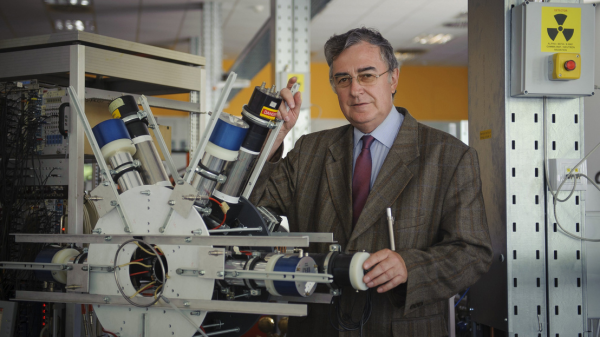
Hungarian scientists from the Atomki Nuclear Research Institute led by Professor Attila Krasznahorkay believe they have found evidence of a fifth force of nature. While monitoring an excited helium atom’s decay, they observed it emitting light, which is not unusual. What is unusual is that the particles split at a precise angle of 115 degrees, as though they were knocked off course by an invisible force.
The scientists dubbed this particle X17, because they calculated its mass at 17 megaelectronvolts (MeV). One electron Volt describes the kinetic energy gained by a single electron as it moves from zero volts to a potential of one volt, and so a megaelectronvolt is equal to the energy gained when an electron moves from zero volts to one million volts.
What Are Those First Four, Again?
Let’s start with the easy one, gravity. It gives objects weight, and keeps things more or less glued in place on Earth. Though gravity is a relatively weak force, it dominates on a large scale and holds entire galaxies together. Gravity helps us work and have fun. Without gravity, there would be no water towers, hydroelectric power plants, or roller coasters.
The electromagnetic force is a two-headed beast that dominates at the human scale. Almost everything we are and do is underpinned by this force that surrounds us like an ethereal soup. Electricity and magnetism are considered a dual force because they work on the same principle — that opposite forces attract and like forces repel.
This force holds atoms together and makes electronics possible. It’s also responsible for visible light itself. Each fundamental force has a carrier particle, and for electromagnetism, that particle is the photon. What we think of as visible light is the result of photons carrying electrostatic force between electrons and protons.
The weak and strong nuclear forces aren’t as easy to grasp because they operate at the subatomic level. The weak nuclear force is responsible for beta decay, where a neutron can turn into a proton plus an electron and anti-neutrino, which is one type of radioactive decay. Weak interactions explain how particles can change by changing the quarks inside them.
The strong nuclear force is the strongest force in nature, but it only dominates at the atomic scale. Imagine a nucleus with multiple protons. All those protons are positively charged, so why don’t they repel each other and rip the nucleus apart? The strong nuclear force is about 130x stronger than the electromagnetic force, so when protons are close enough together, it will dominate. The strong nuclear force holds both the nucleus together as well as the nucleons themselves.
The Force of Change
Suspicion of a fifth force has been around for a while. Atomki researchers observed a similar effect in 2015 when they studied the light emitted during the decay of a beryllium-8 isotope. As it decayed, the constituent electrons and positrons consistently repelled each other at another strange angle — exactly 140 degrees. They dubbed it a “protophobic” force, as in a force that’s afraid of protons. Labs around the world made repeated attempts to prove the discovery a fluke or a mistake, but they all produced the same results as Atomki.
Professor Attila Krasznahorkay and his team published their observations in late October, though the paper has yet to be peer-reviewed. Now, the plan at Atomki is to observe other atoms’ decay. If they can find a third atom that exhibits this strange behavior, we may have to take the standard model back to the drawing board to accommodate this development.
So what happens if science concludes that the X17 particle is evidence of a fifth force of nature? We don’t really know for sure. It might offer clues into dark matter, and it might bring us closer to a unified field theory. We’re at the edge of known science here, so feel free to speculate wildly in the comments.
For nearly as long as there has been radio, there have been antennas trained on the sky, looking at the universe in a different light than traditional astronomy. Radio astronomers have used their sensitive equipment to study the Sun, the planets, distant galaxies, and strange objects from the very edge of the universe, like pulsars and quasars. Even the earliest moments of the universe have been explored, a portrait in microwave radiation of the remnants of the Big Bang.
And yet with all these observations, there’s a substantial slice of the radio spectrum that remains largely a mystery to radio astronomers. Thanks to our planet’s ionosphere, most of the signals below 30 MHz aren’t observable by ground-based radio telescopes. But now, thanks to an opportunity afforded by China’s ambitious lunar exploration program, humanity is now listening to more of what the universe is saying, and it’s doing so from a new vantage point: the far side of the moon.
If you read the scientific literature, you see the familiar subatomic particles you learned about in school: protons, neutrons, and electrons. If you are young enough, you see others you probably heard about, too, like quarks and gluons. But recently there has been a lot of buzz about excitons and even some transistor circuits demonstrated that use them. But what is an exciton?
It actually sounds like a subatomic particle, but it is a little more complicated than that. An exciton is a bound state of an electron and an electron hole and is technically a boson. You are probably familiar with the idea of an electron hole from semiconductor physics. Technically, it is a quasiparticle. The reason scientists are interested in the beast is that it can transport energy without transporting net electric charge. That is, the state itself is neutral, but also contains energy. Continue reading “What’s An Exciton?”→
In the cold, dark recesses of ocean floors around the world, hagfish slither around like sea snakes, searching for food. When a hagfish finds a suitable carcass, it devours the dead fish in two different ways. As it burrows face-first through the tissue, eating with its jaw-less, tentacled mouth, the hagfish also absorbs nutrients through its skin.
Hagfish are not the unholy result of dumping toxic waste in the ocean. They’re one of the oldest creatures on Earth, having been around for more than 300 million years. How have they lasted this long?
These ancient creatures have no eyes, no backbones, and no scales. They are often misidentified as eel, and often called ‘slime eels’, but they are definitely fish. They just don’t look like conventional fish. In fact, when conventional, gill-faced fish come after hagfish, those guys are in for a surprise, because hagfish have a disgusting but ingenious defense mechanism.
Whenever hagfish are attacked or even just stressed by nearby fish or curious grabby humans, they immediately emit amazing amounts of mucus at an alarming rate. At the same time, the hagfish shoots out silky strands of protein that hold the slime together in a cohesive blob. Any predator that tries to bite down on one of these velvety frankfurters of the deep sea will find its mouth and gills covered in a wad of suffocating slime.
How is it that hagfish haven’t slimed themselves out of existence? Whenever they get get a taste of their own medicine, these boneless noodles quickly twist themselves into a pretzel. In the same motion, they use their paddle-shaped tails to squeegee off the slime.
The world of DIY circuits for STEM and wearables has a few options for conductors. Wire with Dupont connectors is a standard, as is adhesive copper tape. There’s also conductive nylon/steel thread or ribbon. Which you choose depends on your application, of course, but as a general rule wire is cheap and ubiquitous while making connections is more challenging; copper tape is cheap and simple to use, but delicate and rips easily, so is best used for flat surfaces that won’t see a lot of stress or temporary applications; and conductive nylon thread or tape is better for weaving into fabrics.


 Inside the 3D printed enclosure is a Wemos D1 Mini ESP8266 development board, sitting on a custom breakout PCB. This board gives you some easy expandability to add your own sensors and hardware, though in this particular configuration, the Dust Box is using the BME280 sensor for general environmental monitoring and the SDS011 laser particle sensor to determine what’s in the air. Just plug it into a convenient USB power source, make sure it’s connected to the WiFi, and off it goes.
 The write-up is interspersed with his course notes as he learns a series of fabrication techniques, but in addition to the milled Delrin finished model he treats us to