Pinning Tails On Satellites To Help Prevent Space Junk

Low Earth orbit was already relatively crowded when only the big players were launching satellites, but as access to space has gotten cheaper, more and more pieces of hardware have started whizzing around overhead. SpaceX alone has launched nearly 1,800 individual satellites as part of its Starlink network since 2019, and could loft as many as 40,000 more in the coming decades. They aren’t alone, either. While their ambitions might not be nearly as grand, companies such as Amazon and Samsung have announced plans to create satellite “mega-constellations” of their own in the near future.

At least on paper, there’s plenty of room for everyone. But what about when things go wrong? Should a satellite fail and become unresponsive, it’s no longer able to maneuver its way out of close calls with other objects in orbit. This is an especially troubling scenario as not everything in orbit around the Earth has the ability to move itself in the first place. Should two of these uncontrollable objects find themselves on a collision course, there’s nothing we can do on the ground but watch and hope for the best. The resulting hypervelocity impact can send shrapnel and debris flying for hundreds or even thousands of kilometers in all three dimensions, creating an extremely hazardous situation for other vehicles.

One way to mitigate the problem is to design satellites in such a way that they will quickly reenter the Earth’s atmosphere and burn up at the end of their mission. Ideally, the deorbit procedure could even activate automatically if the vehicle became unresponsive or suffered some serious malfunction. Naturally, to foster as wide adoption as possible, such a system would have to be cheap, lightweight, simple to integrate into arbitrary spacecraft designs, and as reliable as possible. A tall order, to be sure.

But perhaps not an impossible one. Boeing subsidiary Millennium Space Systems recently announced it had successfully deployed a promising deorbiting device developed by Tethers Unlimited. Known as the Terminator Tape, the compact unit is designed to rapidly slow down an orbiting satellite by increasing the amount of drag it experiences in the wispy upper atmosphere.

Continue reading “Pinning Tails On Satellites To Help Prevent Space Junk”

NASA Are Squaring Up Against The Asteroid Threat

The world faces many terrestrial crises right now, so it’s easy to forget that giant space rocks may one day threaten the very existence of entire civilizations. Yes, the threat of asteroid strikes is a remote one, but nevertheless something humanity may have to face one day, and one day soon.

NASA takes the issue seriously, and has staffed its Planetary Defence Coordination Office since 2016. In service to these efforts, it’s also developing a mission to research how dangerous androids may be deflected. The Double Asteroid Redirection Test, or DART, is set to launch within the next year. Continue reading “NASA Are Squaring Up Against The Asteroid Threat”

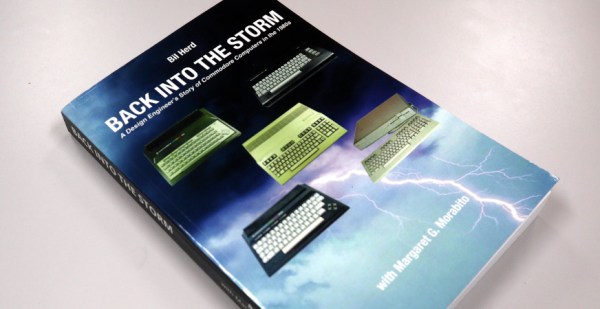
Books You Should Read: Bil Herd’s Back Into The Storm

It’s a morning ritual that we guess most of you share with us; before whatever work a new day will bring to sit down with a coffee and catch up with the tech news of the moment on Hackaday and other sites. Most of us don’t do many exciting things in our everyday lives, so reading about the coolest projects and the most fascinating new developments provides us with interest and motivation. Imagine just for a moment then that by a twist of fate you found yourself taking a job at the epicentre of the tech that is changing the world,  producing the objects of desire and pushing the boundaries, the place you’d give anything to work at.

This is the premise behind our Hackaday colleague Bil Herd’s autobiographical chronicle of time in the mid 1980s during which he worked at Commodore, maker of some of the most iconic home computers of the day. We follow him through the three years from 1983 to 1986 as hardware lead on the “TED” series of computers including the Commodore 16 and Plus/4, and then the Commodore 128, a dual-processor powerhouse which was arguably the last of the big-selling 8-bit home computers.

It’s an intertwined set of narratives peppered with personal anecdotes; of the slightly crazy high-pressure world of consumer videogames and computing, the fine details of designing a range of 8-bit machines, and a fascinating insight into how the culture at Commodore changed in the period following the departure of its founder Jack Tramiel.

Continue reading “Books You Should Read: Bil Herd’s Back Into The Storm”

The Dark Side Of Package Repositories: Ownership Drama And Malware

At their core, package repositories sound like a dream: with a simple command one gains access to countless pieces of software, libraries and more to make using an operating system or developing software a snap. Yet the rather obvious flip side to this is that someone has to maintain all of these packages, and those who make use of the repository have to put their faith in that whatever their package manager fetches from the repository is what they intended to obtain.

How ownership of a package in such a repository is managed depends on the specific software repository, with the especially well-known JavaScript repository NPM having suffered regular PR disasters on account of it playing things loose and fast with package ownership. Quite recently an auto-transfer of ownership feature of NPM was quietly taken out back and erased after Andrew Sampson had a run-in with it painfully backfiring.

In short, who can tell when a package is truly ‘abandoned’, guarantee that a package is free from malware, and how does one begin to provide insurance against a package being pulled and half the internet collapsing along with it?

Continue reading “The Dark Side Of Package Repositories: Ownership Drama And Malware”

New Engines Could Propel The B-52 Beyond Its 100th Birthday

First taking to the skies in April 1952, and introduced into the US Air Force in 1955, the B-52 Stratofortress has since become a mainstay of American air power. Originally developed as a nuclear bomber to carry out the critical deterrence role, changing realities saw it delivering solely conventional munitions in actual operations.

Of 744 B-52s originally built, 76 remain in service with the Air Force and Air Force Reserve. This fleet is set to go on flying beyond the type’s 100th birthday, into 2050 and beyond. To reach that milestone, a new engine package will be key to keeping these birds in the air.

Continue reading “New Engines Could Propel The B-52 Beyond Its 100th Birthday”

Hackaday Links Column Banner

Hackaday Links: September 5, 2021

Good news from Jezero crater as the Mars rover Perseverance manages to accomplish for the first time what it was sent to do: collect and cache core samples from rocks. Space buffs will no doubt recall that Perseverance’s first attempt at core sampling didn’t go as planned — the rock that planetary scientists selected ended up being too soft, and the percussive coring bit just turned the core sample into powder. The latest attempt went exactly as planned: the cylindrical coring bit made a perfect cut, the core slipped into the sample tube nested inside the coring bit, and the core broke off cleanly inside the sample tube when it was cammed off-axis. Operators were able to provide visible proof that the core sample was retained this time using the Mastcam-Z instrument, which clearly shows the core in the sample tube. What’s neat is that they then performed a “percuss to ingest” maneuver, where the coring bit and sample tube are vibrated briefly, so that the core sample and any dust grains left around the sealing rim slide down into the sample tube. The next step is to transfer the sample tube to the belly of the rover where it’ll be hermetically sealed after some basic analysis.

Did any Android users perhaps oversleep this week? If you did, you’re not alone — lots of users of the Google Clock app reported that their preset alarms didn’t go off. Whether it was an actual issue caused by an update or some kind of glitch is unclear, but it clearly didn’t affect everyone; my phone mercilessly reminded me when 6:00 AM came around every day last week. But it apparently tripped up some users, to the point where one reported losing his job because of being late for work. Not to be judgmental, but it seems to me that if your job is so sensitive to you being late, it might make sense to have a backup alarm clock of some sort. We all seem to be a little too trusting that our phones are going to “just work,” and when they don’t, we’re surprised and appalled.

There seem to be two kinds of people in the world — those who hate roller coasters, and those who love them. I’m firmly in the latter camp, and will gladly give any coaster, no matter how extreme, a try. There have been a few that I later regretted, of course, but by and large, the feeling of being right on the edge of bodily harm is pretty cool. Crossing over the edge, though, is far less enjoyable, as the owners of an extreme coaster in Japan are learning. The Dodon-pa coaster at the Fuji-Q Highland amusement park is capable of hitting 112 miles (180 km) per hour and has racked up a sizable collection of injuries over the last ten months, including cervical and thoracic spine fractures. The ride is currently closed for a safety overhaul; one has to wonder what they’re doing to assess what the problem areas of the ride are. Perhaps they’re sending crash test dummies on endless rides to gather data, a sight we’d like to see.

And finally, you may have thought that phone phreaking was a thing of the past; in a lot of ways, you’d be right. But there’s still a lot to be learned about how POTS networks were put together, and this phone switch identification guide should be a big help to any phone geeks out there. Be ready to roll old school here — nothing but a plain text file that describes how to probe the switch that a phone is connected just by listening to things like dial tones and ring sounds. What’s nice is that it describes why the switches sound the way they do, so you get a lot of juicy technical insights into how switches work.

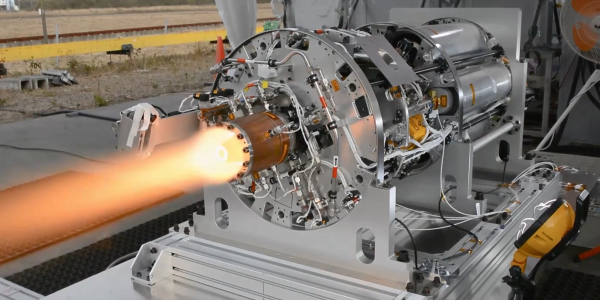
Image of detonation engine firing

Japanese Rocket Engine Explodes: Continuously And On Purpose

Liquid-fuelled rocket engine design has largely followed a simple template since the development of the German V-2 rocket in the middle of World War 2. Propellant and oxidizer are mixed in a combustion chamber, creating a mixture of hot gases at high pressure that very much wish to leave out the back of the rocket, generating thrust.

However, the Japan Aerospace Exploration Agency (JAXA) has recently completed a successful test of a different type of rocket, known as a rotating detonation engine. The engine relies on an entirely different method of combustion, with the aim to produce more thrust from less fuel. We’ll dive into how it works, and how the Japanese test bodes for the future of this technology.

Deflagration vs. Detonation

Humans love combusting fuels in order to do useful work. Thus far in our history, whether we look at steam engines, gasoline engines, or even rocket engines, all these technologies have had one thing in common: they all rely on fuel that burns in a deflagration. It’s the easily controlled manner of slow combustion that we’re all familiar with since we started sitting around campfires. Continue reading “Japanese Rocket Engine Explodes: Continuously And On Purpose”