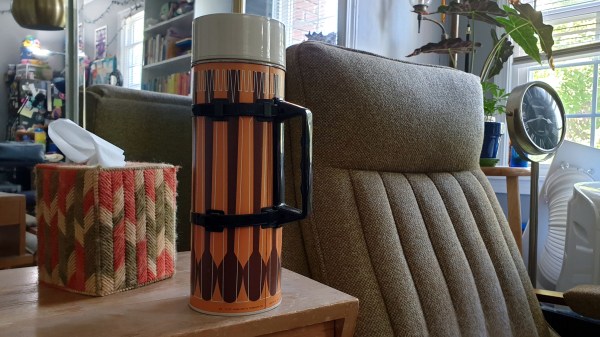
I recently started using a 50-year-old vacuum-seal flask that belonged to my Grandpa so that I don’t have to leave the dungeon as often to procure more caffeine. Besides looking totally awesome on my side desk, this thing still works like new, at least as far as I can tell — it’s older than I am.
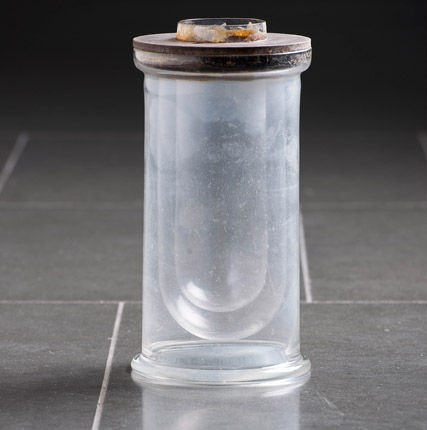
Of course this got me to wondering how exactly vacuum-seal flasks, better known in household circles as Thermoses work, and how they were invented. The vacuum-seal flask is surprisingly old technology. It was first invented by Scottish chemist Sir James Dewar and presented to the Royal Institute in 1892. Six years later, he would be the first person to liquefy hydrogen and is considered a founding father of cryogenics. Continue reading “The Incredible Tech Of The Vacuum-Seal Flask”→
If you or someone you know is diabetic, it is a good bet that a glucose meter is a regular fixture in your life. They are cheap and plentiful, but they are actually reasonably high tech — well, at least parts of them are.
The meters themselves don’t seem like much, but that’s misleading. A battery, a few parts, a display, and enough of a controller to do things like remember readings appears to cover it all. You wouldn’t be surprised, of course, that you can get the whole affair “on a chip.” But it turns out, the real magic is in the test strip and getting a good reading from a strip requires more metrology than you would think. A common meter requires a precise current measurement down to 10nA. The reading has to be adjusted for temperature, too. The device is surprisingly complex for something that looks like a near-disposable piece of consumer gear.
Of course, there are announcements all the time about new technology that won’t require a needle stick. So far, none of those have really caught on for one reason or another, but that, of course, could change. GlucoWatch G2, for example, was a watch that could read blood glucose, but — apparently — was unable to cope with perspiration.
For the purposes of this article, I’m only going to talk about the traditional meter: you insert a test strip, prick your finger, and let the test strip soak up a little bit of blood.
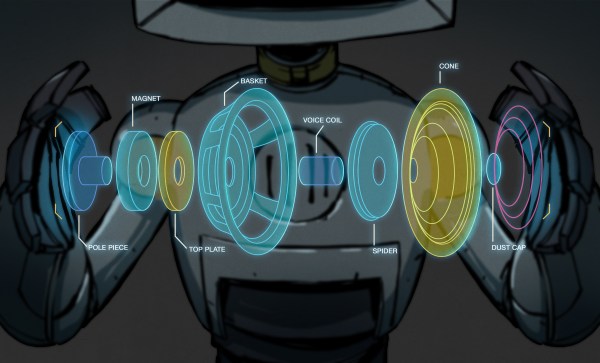
Our trip through the world of audio technology has taken us step-by step from your ears into a typical home Hi-Fi system. We’ve seen the speakers and the amplifier, now it’s time to take a look at what feeds that amplifier.
Here, we encounter the first digital component in our journey outwards from the ear, the Digital to Analogue Converter, or DAC. This circuit, which you’ll find as an integrated circuit, takes the digital information and turns it into the analogue voltage required by the amplifier.
There are many standards for digital audio, but in this context that used by the CD is most common. CDs sample audio at 44.1 kHz 16 bit, which is to say they express the level as a 16-bit number 44100 times per second for each of the stereo channels. There’s an electrical standard called i2s for communicating this data, consisting of a serial data line, a clock line, and an LRclock line that indicates whether the current data is for the left or the right channel. We covered i2s in detail back in 2019, and should you peer into almost any consumer digital audio product you’ll find it somewhere. Continue reading “Know Audio: It All Depends On The DAC”→
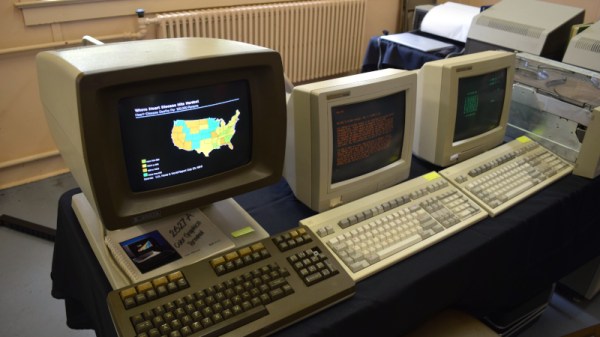
It didn’t take long to realize that the 2021 Vintage Computer Festival East — returning to the InfoAge Science and History Museum in Wall, New Jersey after being held virtually last year — was a massive success. In fact, the first clue came before I even got out of my car. When a volunteer came up to my window to apologetically explain that the primary parking lot was already full and I’d have to drive down the road to an overflow lot, there was no question about it; a whole lot of folks were more than ready to shake off those pandemic blues and get back to business.
They certainly picked a great event for it. While VCF East has always been a highlight of the East Coast hacker’s year, it was obvious things were really turned up to the max for this much-anticipated return to an in-person festival. With respect to all those involved in previous events, things just felt more cohesive and better organized this time around.
Veteran attendees I spoke to all felt like they were witnessing the event going through an evolutionary change into something bigger and better, while first time fliers were impressed with the buzz of activity and breadth of what was on display. In short, admiration for the event and the people working behind the scenes to make it possible was unanimous.
It’s simply not possible to adequately summarize a multi-day event like VCF East in a single post, so I won’t try to. This article, and the ones to follow it, serve only to document some of the highlights from my own personal time wandering through the sprawling InfoAge campus. Ultimately, there’s no real substitute for making the trip to Wall, NJ and experiencing this incredible event for yourself. But if that’s not an option for you, hopefully the following will give you a little taste of what the Vintage Computer Federation labors so hard over every year.
In the 125 years since Marconi made his first radio transmissions, the spectrum has been divvied up into ranges and bands, most of which are reserved for governments and large telecom companies. Amidst all of the corporate greed, the “little guys” managed to carve out their own small corner of the spectrum, with the help of organizations like the American Radio Relay League (ARRL). Since 1914, the ARRL has represented the interests of us amateur radio enthusiasts and helped to protect the bands set aside for amateur use. To actually take advantage of the wonderful opportunity to transmit on these bands, you need a license, issued by the FCC. The licenses really aren’t hard to get, and you should get one, but what if you don’t feel like taking a test? Or if you’re just too impatient?
Well, fear not because there’s some space on the radio spectrum for you, too.
Welcome to the wonderful world of (legal!) unlicensed radio experimentation, where anything goes. Okay, not anything but the possibilities are wide open. There are a few experimental radio bands, known as LowFER, MedFER, and HiFER where anyone is welcome to play around. And of the three, LowFER seems the most promising. Continue reading “The Low-Down On Long-Wave: Unlicensed Experimental Radio”→
You’ve no doubt heard of the many alternatives to cow’s milk that are available these days. Perhaps you’ve even tried a few of them in your quest to avoid lactose. Some coffeehouses have already moved on from soy milk, offering only oat or almond milk instead of 2% and whole. Their reasoning is that soy milk is a highly processed product that can’t be traced back to a single source, which stands in stark contrast to all those bags of single-origin coffee beans.
These nut-based alternatives kicked off what is known as the milk wars — the dairy industry’s fight against labeling plant-based dairy alternatives as ‘milk’ and so on. Well, now it’s getting even more interesting. A company called Perfect Day is making milk using microorganisms that secrete milk proteins. It may sound kind of gross, but it’s essentially microbial fermentation, which is the normal process by which bread, cheese, yogurt, wine, and beer are made.
To be fair, what Perfect Day and other companies are doing is precision fermentation using genetically engineered microorganisms in a bioreactor, so it’s a bit more involved than what you could probably pull off in the basement. Precision fermentation lies somewhere between two modern extremes — plant-based meat and cultured meat. The latter is actual animal tissue grown from stem cells, and is only available at high-end restaurants for exorbitant prices.
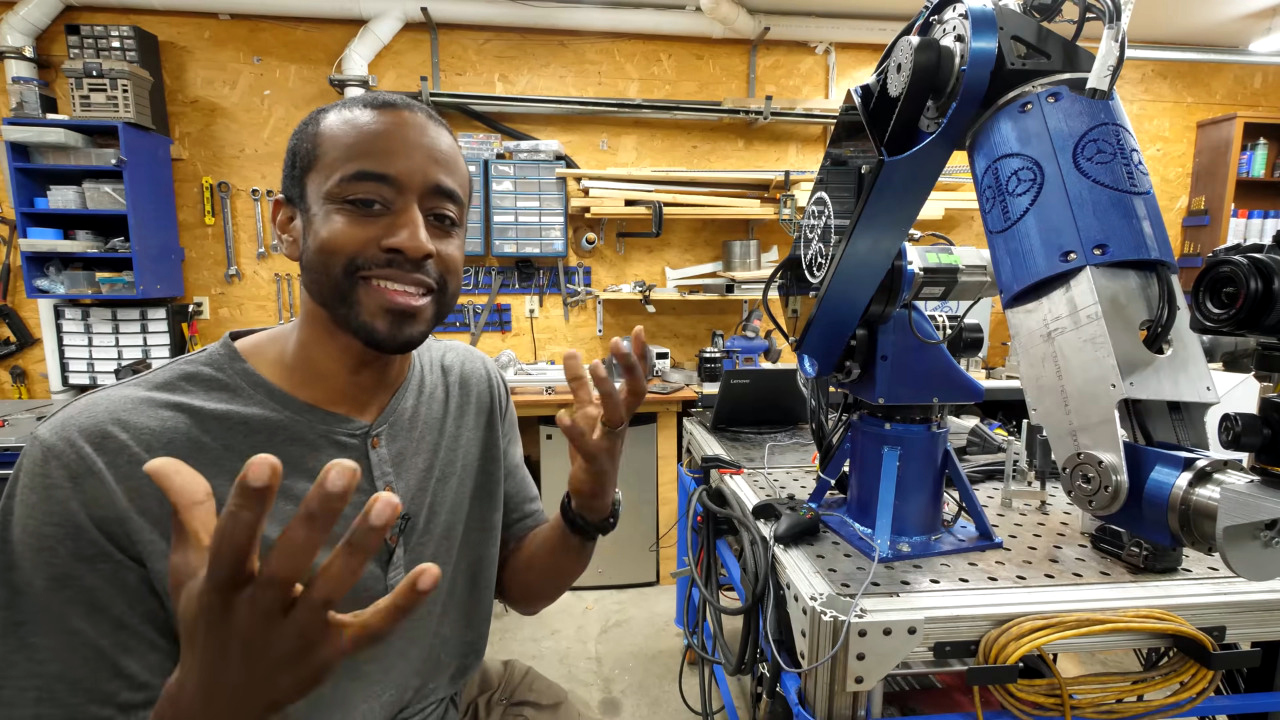
We’re really excited to announce that Jeremy Fielding will give a keynote address at Hackaday Remoticon in November! Get your free ticket now!
The projects we in this community choose to tackle often take a lot to see to completion. Parts, tools, expertise, time; all are critical to getting projects from concept to reality. But how deep your parts bin is or how well-equipped your shop may be matters not a whit unless you’ve got the one thing that makes it all go: passion. Passion is what keeps a project rolling ahead paste the inevitable roadblocks and diversions; it’s what keeps us going back to the bench to try something new when we think we’ve tried it all.
The passion to understand, to create, to innovate, is something that Jeremy Fielding clearly has. Anyone who has watched even a few of his YouTube videos knows how much he loves to make things move. His current project is a seven-axis industrial robot arm, and it’s a seriously impressive build that could easily be mistaken for a commercial product. What’s perhaps most impressive about this is that many of the skills needed to pull it off, like welding aluminum and machining, are skills that Jeremy has been teaching himself on the fly. Talk about passion!
For his keynote, Jeremy is going to focus on building hardware that moves. Most of us are reasonably good at putting together projects that flash a few lights or perhaps move a few small steppers or servos. But scaling that up, as Jeremy has done for his robot arm as well as other projects, introduces new challenges: what type of electric motor do I choose? How do I figure out the trade-offs between torque and speed? Do I even want to use electric motors — maybe pneumatics will be better? What are my control options? These questions can be just as daunting to the old hands as they are to beginners, and Jeremy is going to focus on how to handle these and other mechatronic challenges that crop up in our projects.
Aside from the (literal) nuts and bolts of mechanical engineering, there’s another place where Jeremy’s passion shines through: his passion for communicating what he has learned. His presentation style and enthusiasm are infectious, and we’re sure that’s going to come across in his keynote. Jeremy fancies himself a “contraption engineer,” which is both an apt and engaging way to look at what he does. Fellow contraption builders take note — you’re going to want to make sure you don’t miss this one!
Call for Proposals is Still Open!
We’re still on the hunt for great talks about hardware creation, so the Call for Proposals has been extended to October 20. And remember, get your tickets early — knowing how many people to expect really helps us with infrastructure planning so we can give everyone a quality experience.