Spacing Out: StarShip Explodes (Again), Passenger Space Flight, Space Bugs, Astronaut Bone, And Martian Water

This time I promise I only have a couple of stories from Elon Musk’s company. SpaceX’s latest Starship test launch ended in another explosion, proving that space hardware remains hard to get right. We’ll keep watching as they keep launching, and it can’t be long until they’ve ironed out all the problems. Meanwhile there’s brighter news from the company’s Crew Dragon, a modified version of the capsule with the forward docking ring replaced by a transparent dome is planned for launch in September with the company’s first flight carrying civilian passengers. It’s doubtless unwelcome news for Virgin Galactic, whose suborbital passenger flights are edging closer to reality with the unveiling of their first SpaceShip III craft. Finally, a Falcon 9 upper stage broke up on re-entry over the northwestern USA, giving observers on the ground a spactacular show.

Spectacular view of the Falcon 9 debris. Via Lu Jerz

Meanwhile up there in orbit there have been found on the ISS some strains of bacteria previously unknown to scientists on Earth, but it’s not yet time to panic about Mutant Bugs From Space. It seems these bacteria are of a type that is essential in the growing of plants, so it’s likely they originally hitched a ride up with one of the several plant-growing experiments that have taken place over the station’s lifetime. Staying on the ISS, astronauts visiting the station have been at the centre of a recently published study looking at loss of bone density over long periods in space. The bone experts found that bone density could still be lost despite the astronauts’ in-flight exercise programs, and concluded that exercise regimes pre-flight should be taken into account for future in-orbit exercise planning.

Further away from Earth, the ESA Mars Express satellite has been used for a multi-year study of water loss to space from the Martian atmosphere. The ESA scientists identified the seasonal mechanism that leads to the planet’s upper atmosphere having an excess of water and in particular the effect of the periodic planet-wide dust storms on accelerating water loss, but failed to account for the water that they estimate Mars must have lost over its history. From a study of water-created surface features they can estimate how much liquid the planet once had, yet the atmospheric losses fail to account for it all. Has it disappeared underground? More studies are required before we’ll have an answer.

The exciting news over the coming days will no doubt be the Ingenuity Martian helicopter, which we have seen slowly unfolding itself prior to unloading from the belly of the Perseverence rover. If all goes according to plan the little craft will be set down before the rover trundles off to a safe distance, and the historic flight will take place on April 8th. We’ll be on the edges of our seats, and no doubt you will be, too.


AI Upscaling And The Future Of Content Delivery

The rumor mill has recently been buzzing about Nintendo’s plans to introduce a new version of their extremely popular Switch console in time for the holidays. A faster CPU, more RAM, and an improved OLED display are all pretty much a given, as you’d expect for a mid-generation refresh. Those upgraded specifications will almost certainly come with an inflated price tag as well, but given the incredible demand for the current Switch, a $50 or even $100 bump is unlikely to dissuade many prospective buyers.

But according to a report from Bloomberg, the new Switch might have a bit more going on under the hood than you’d expect from the technologically conservative Nintendo. Their sources claim the new system will utilize an NVIDIA chipset capable of Deep Learning Super Sampling (DLSS), a feature which is currently only available on high-end GeForce RTX 20 and GeForce RTX 30 series GPUs. The technology, which has already been employed by several notable PC games over the last few years, uses machine learning to upscale rendered images in real-time. So rather than tasking the GPU with producing a native 4K image, the engine can render the game at a lower resolution and have DLSS make up the difference.

The current model Nintendo Switch

The implications of this technology, especially on computationally limited devices, is immense. For the Switch, which doubles as a battery powered handheld when removed from its dock, the use of DLSS could allow it to produce visuals similar to the far larger and more expensive Xbox and PlayStation systems it’s in competition with. If Nintendo and NVIDIA can prove DLSS to be viable on something as small as the Switch, we’ll likely see the technology come to future smartphones and tablets to make up for their relatively limited GPUs.

But why stop there? If artificial intelligence systems like DLSS can scale up a video game, it stands to reason the same techniques could be applied to other forms of content. Rather than saturating your Internet connection with a 16K video stream, will TVs of the future simply make the best of what they have using a machine learning algorithm trained on popular shows and movies?

Continue reading “AI Upscaling And The Future Of Content Delivery”

Python Will Soon Support Switch Statements

Rejoice! Gone are the long chains of ifelse statements, because switch statements will soon be here — sort of. What the Python gods are actually giving us are match statements. match statements are awfully similar to switch statements, but have a few really cool and unique features, which I’ll attempt to illustrate below.

Continue reading “Python Will Soon Support Switch Statements”

Hackaday Podcast 112: We Have An NFT, Racing A Möbius Strip, And Syncing Video With OpenCV And Blender

Hackaday editors Elliot Williams and Mike Szczys celebrate the cleverest projects from the week that was. We tried to catch a few fools on Thursday with our Lightmode™ and NFT articles — make sure you go back and read those for a good chuckle if you haven’t already.

While those fall under not a hack, many other features this week are world-class hacks, such as the 555 timer built from 1.5-dozen vacuum tubes, and the mechanical word-clock that’s 64 magnetic actuators built around PCB coils by Hackaday’s own [Mortiz v. Sivers].

A treat for the ears, [Linus Akesson] aka [lft] shows off a Commodore64 that seriously sounds as big as a cathedral organ. And a masterpiece of OpenCV and Blender, you can’t miss the project by [Matthew Earl] that overlays video of the Mars landing on still satellite photos… perfection!

Take a look at the links below if you want to follow along, and as always, tell us what you think about this episode in the comments!

Direct download (~60 MB)

Places to follow Hackaday podcasts:

Continue reading “Hackaday Podcast 112: We Have An NFT, Racing A Möbius Strip, And Syncing Video With OpenCV And Blender”

NFTs Are The Hope For A New Tomorrow!

Here at Hackaday, we’re always working as hard as we can to bring you the latest and most exciting technologies, and like so many people we’ve become convinced that the possibilities offered by the rise of the Blockchain present unrivaled opportunities for humanity to reinvent itself unfettered by the stifling regulations of a dying system. This is why today we’ve decided to join in with the digital cognoscenti and celebrities embracing Non-Fungible Tokens, or NFTs, as a new promise of non-corporeal digital investment cryptoasset that’s taking the world by storm.

Crypto Non-Fungible Investment Gains!

Imagine for a minute, yourself owning a very expensive car. Skievl, CC BY-SA 4.0.

An NFT is a digital token representing something in the real world, and coupled to a unique ID held in a secure entry in the Blockchain. It’s non-fungible, which means that it’s unique and not interchangeable in the manner of a traditional old-style cryptoasset such as Bitcoin. As it allows a real-world object to be tokenised in digital form it represents a way to own something that provides an irrefutable connection to it as as a digital cryptoasset.

It’s a complex system that’s maybe too difficult to explain fully in a single article, but think of an NFT as a way to invest in a cryptoasset in digital form with its uniqueness guaranteed by Blockchain security, without having the inconvenience of physically owning it. Instead your NFT is safely held on a server on the Internet, and can’t be physically stolen as it would from a bank vault because it has the Blockchain cryptosecurity baked in.

Non Fungible Blockchain Cryptoassets!

You don't own this. Yet.
You don’t own this. Yet.

NFTs have so far found a space in the creative markets, where they have provided a revolutionary opportunity for artists to expand their sales in the digital realm by selling NFTs of their work. A struggling artist can now access buyers all over the world, who can in turn now invest with confidence in creative talent to which they would never otherwise be exposed. It’s a win-win situation in which both cryptoinvestor and artist benefit from The Power of the Blockchain.

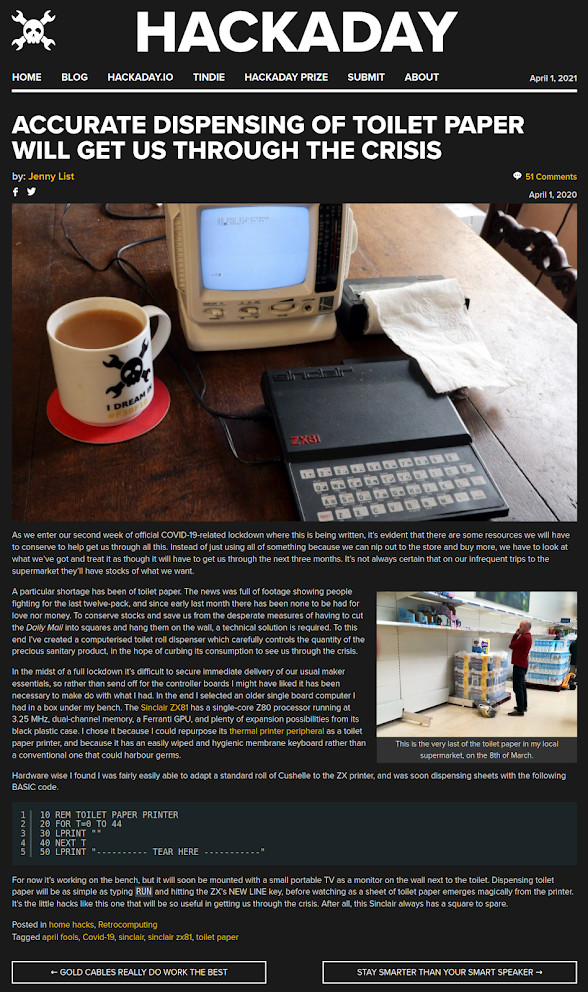
Hackaday is excited to offer a once-in-a-lifetime chance to acquire a Blockchain-cryptosecured NFT representing one of our own articles; our first ever NFT is the only officially sanctioned digital copy of a Hackaday article presenting a novel method of handling toilet paper shortages. The original article will continue to exist on Hackaday.com with all rights reserved, but we will not make any other NFTs of it. We may also decide to update the original article to let everyone know you are the lucky owner of the only digital copy of this piece of greatness. That’s right, this NFT will let you prove you own a screenshot!

Having today sold you on the incredible cryptoinvestment opportunity offered by NFTs, we’ll be back on another date with a more sober and in-depth technical examination of the technology behind them. Meanwhile should our brief foray into NFTs garner any interest (and we really hope it does not), we will donate proceeds to the excellent Girls Who Code, a truly solid investment with a tangible bright future.

Thanks [Micah Scott] for some NFT consultancy during the making of this piece.

Hackaday Forced Into Light Mode

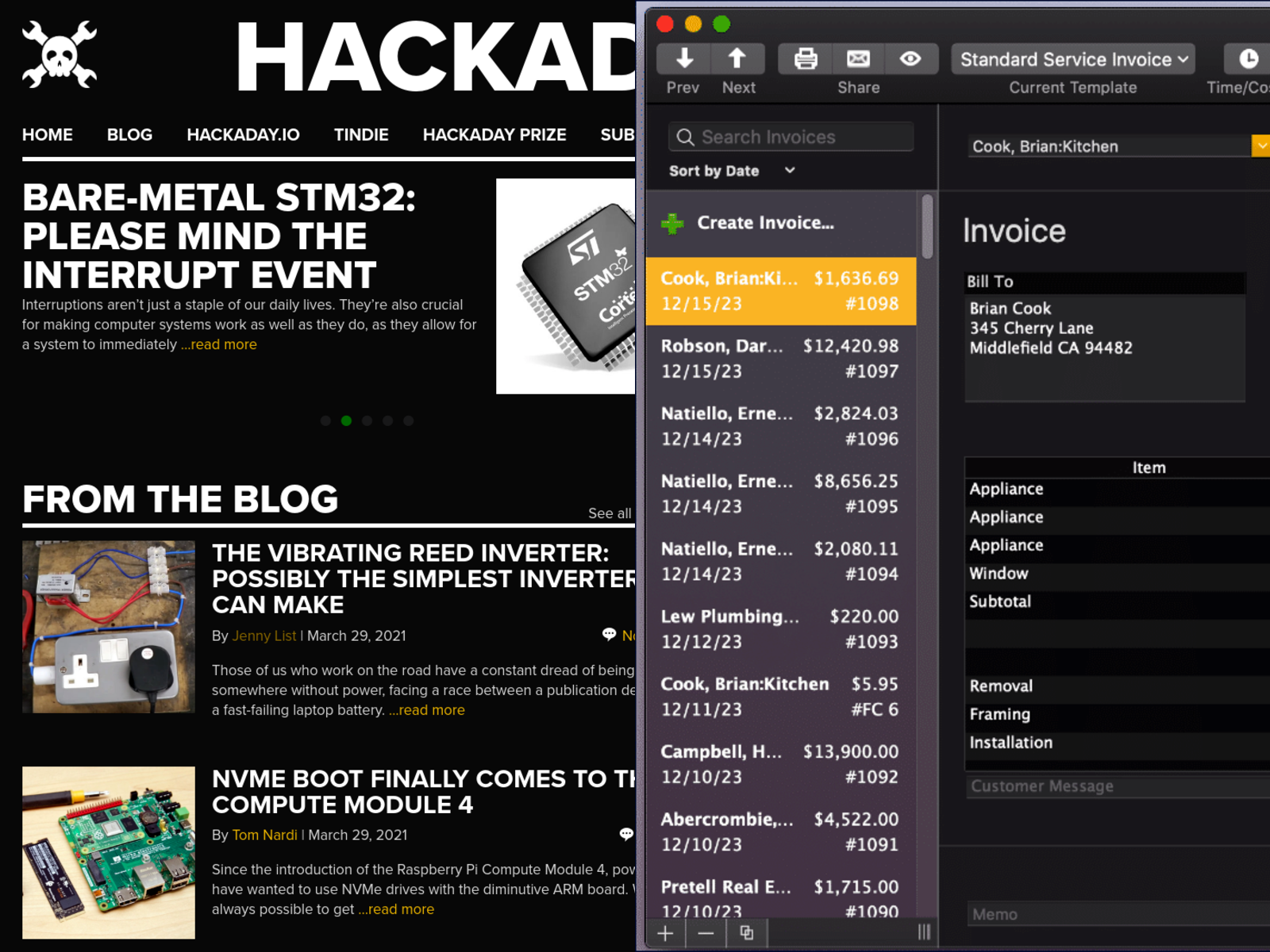
Hackaday has always been dark mode. Gray10 is less jarring when you’re burning the midnight oil on a project, so we give you a lot of it. Fifteen years ago, it was called “reverse video” or “trog mode“, and we were the freaks. We were doing it wrong. We had the colors “backwards”. Dark mode used to be edgy, outré, but dare we say it, a bit sexy.

Hackaday … QuickBooks. Just sayin’.
They even ripped our highlight yellow!

Flash forward, and everyone has come over to the dark side. Facebook has a dark mode. Google has dark mode. Across the Microsoft empire, from Windows 10 to GitHub, you can live your life in the dark. Heck, even the White House has a dark mode! (They call it high-contrast mode, but they’re not fooling anyone.)

Dark mode here, dark mode there. It’s mainstream. Dark mode has become corporate cool which is nobody’s idea of cool.

We’re not saying that all of the aforementioned institutions are biting the Hackaday style, but, well, they’re all biting our style. Where were they when we were the only website on the whole darn Internet with a sensible background color? Huh? Dark-mode-come-latelys!

But Hackaday doesn’t rest on its laurels. We have our fingers on the pulse on the modern hacker. Where previously you would be up late at night researching Hackaday for juicy nuggets of communal wisdom to help out with your current hack, you’re probably “telecommuting” these days — a euphemism for working on your private projects even while the fiery ball is still in the sky. (Wink, wink, nudge, nudge.) It’s only natural that you’d want a lighter background color to match your new lifestyle. We hear you!

So we present you, Hackaday Light Mode™. Enjoy!

[Editor’s note: For historical accuracy, we had phosphor green headings in the very beginning, in place of the jarring white. If you want to relive those glory days of yore, or just to go back to Hackaday in dark mode, there’s always CSS scripting.]

Hershey Fonts: Not Chocolate, The Origin Of Vector Lettering

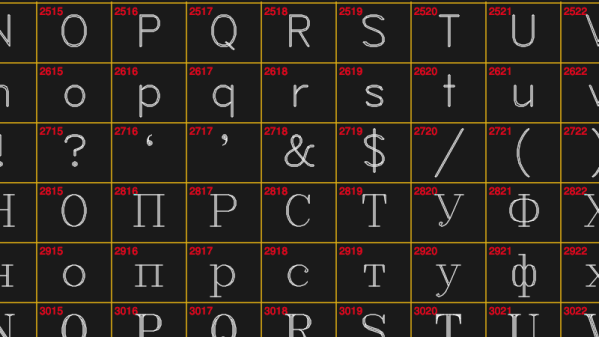
Over the past few years, I kept bumping into something called Hershey fonts. After digging around, I found a 1967 government report by a fellow named Dr. Allen Vincent Hershey. Back in the 1960s, he worked as a physicist for the Naval Weapons Laboratory in Dahlgren, Virginia, studying the interaction between ship hulls and water. His research was aided by the Naval Ordnance Research Calculator (NORC), which was built by IBM and was one of the fastest computers in the world when it was first installed in 1954.

The NORC’s I/O facilities, such as punched cards, magnetic tape, and line printers, were typical of the era. But the NORC also had an ultra-high-speed optical printer. This device had originally been developed by the telecommunications firm Stromberg-Carlson for the Social Security Administration in order to quickly print massive amounts of data directly upon microfilm.

Continue reading “Hershey Fonts: Not Chocolate, The Origin Of Vector Lettering”