Teardown: Bug Zapper Bulb

Up here in the Northern Hemisphere, mosquitoes and other flying pests are the last thing on anyone’s mind right now. The only bug that’s hindering gatherings at the moment goes by the name of COVID-19, but even if we weren’t social distancing, insects simply aren’t a concern at this time of year. So it’s little surprise that these months are often the best time to find a great deal on gadgets designed to deter or outright obliterate airborne insects.

Whatever PIC stands for…it’s not that.

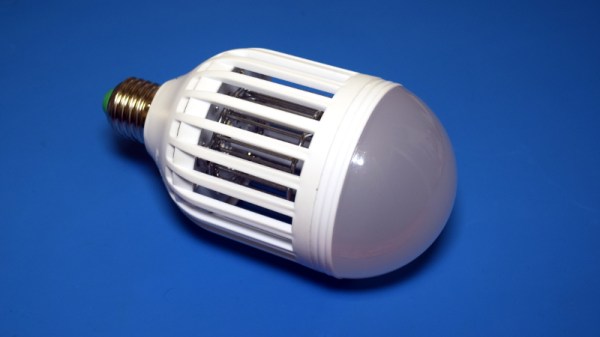
Case in point, I was able to pick up this “Bug Zapper LED Bulb” at the big-box hardware store for just a few bucks. This one is sold by PIC Corporation, though some press release surfing shows the company merely took over distribution of the device in 2017. Before then it was known as the Zapplight, and was the sort of thing you might see advertised on TV if you were still awake at 3 AM. It appears there are several exceptionally similar products on the market as well, which are likely to be the same internally.

In all fairness, it’s a pretty clever idea. Traditional zappers are fairly large, and need to be hoisted up somewhere next to an electrical outlet. But if you could shrink one down to the size of a light bulb, you could easily dot them around the porch using the existing sockets and wiring. Extra points if you can also figure out a way to make it work as a real bulb when the bugs aren’t out. Obviously the resulting chimera won’t excel at either task, but there’s certainly something to be said for the convenience of it.

Let’s take a look inside one of these electrifying illuminators and see how they’ve managed to squeeze two very different devices into one socket-friendly package.

Continue reading “Teardown: Bug Zapper Bulb”

Getting Ready For Mars: The Seven Minutes Of Terror

For the past seven months, NASA’s newest Mars rover has been closing in on its final destination. As Perseverance eats up the distance and heads for the point in space that Mars will occupy on February 18, 2021, the rover has been more or less idle. Tucked safely into its aeroshell, we’ve heard little from the lonely space traveler lately, except for a single audio clip of the whirring of its cooling pumps.

Its placid journey across interplanetary space stands in marked contrast to what lies just ahead of it. Like its cousin and predecessor Curiosity, Perseverance has to successfully negotiate a gauntlet of orbital and aerodynamic challenges, and do so without any human intervention. NASA mission planners call it the Seven Minutes of Terror, since the whole process will take just over 400 seconds from the time it encounters the first wisps of the Martian atmosphere to when the rover is safely on the ground within Jezero Crater.

For that to happen, and for the two-billion-dollar mission to even have a chance at fulfilling its primary objective of searching for signs of ancient Martian life, every system on the spacecraft has to operate perfectly. It’s a complicated, high-energy ballet with high stakes, so it’s worth taking a look at the Seven Minutes of Terror, and what exactly will be happening, in detail.

Continue reading “Getting Ready For Mars: The Seven Minutes Of Terror”

Hands-On: The RISC-V ESP32-C3 Will Be Your New ESP8266

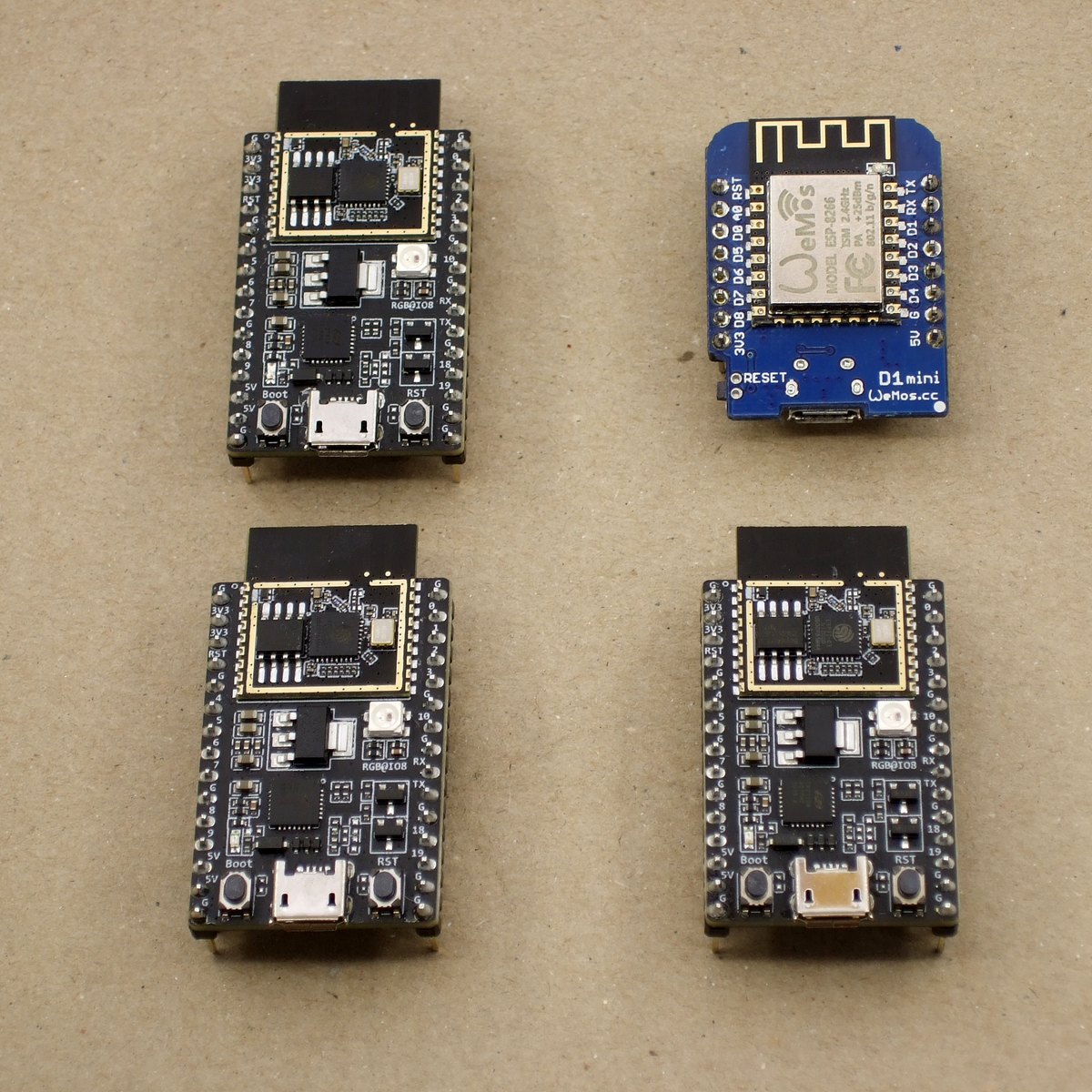
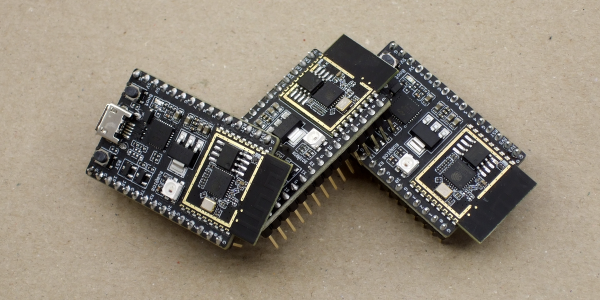
We just got our hands on some engineering pre-samples of the ESP32-C3 chip and modules, and there’s a lot to like about this chip. The question is what should you compare this to; is it more an ESP32 or an ESP8266? The new “C3” variant has a single 160 MHz RISC-V core that out-performs the ESP8266, and at the same time includes most of the peripheral set of an ESP32. While RAM often ends up scarce on an ESP8266 with around 40 kB or so, the ESP32-C3 sports 400 kB of RAM, and manages to keep it all running while burning less power. Like the ESP32, it has Bluetooth LE 5.0 in addition to WiFi.

Espressif’s website says multiple times that it’s going to be “cost-effective”, which is secret code for cheap. Rumors are that there will be eight-pin ESP-O1 modules hitting the streets priced as low as $1. We usually require more pins, but if medium-sized ESP32-C3 modules are priced near the ESP8266-12-style modules, we can’t see any reason to buy the latter; for us it will literally be an ESP8266 killer.

On the other hand, it lacks the dual cores of the ESP32, and simply doesn’t have as many GPIO pins. If you’re a die-hard ESP32 abuser, you’ll doubtless find some features missing, like the ultra-low-power coprocessor or the DACs. But it does share a lot of the ESP32 standouts: the LEDC (PWM) peripheral and the unique parallel I2S come to mind. Moreover, it shares the ESP-IDF framework with the ESP32, so despite running on an entirely different CPU architecture, a lot of code will run without change on both chips just by tweaking the build environment with a one-liner.

One of these things is not like the other

If you were confused by the chip’s name, like we were, a week or so playing with the new chip will make it all clear. The ESP32-C3 is a lot more like a reduced version of the ESP32 than it is like an improvement over the ESP8266, even though it’s probably destined to play the latter role in our projects. If you count in the new ESP32-S3 that brings in USB, the ESP32 family is bigger than just one chip. Although it does seem odd to lump the RISC-V and Tensilica CPUs together, at the end of the day it’s the peripherals more than the CPUs that differentiate microcontrollers, and on that front the C3 is firmly in the ESP32 family.

Our takeaway: the ESP32-C3 is going to replace the ESP8266 in our projects, but it won’t replace the ESP32 which simply has more of everything when we need it. The shared codebase and peripheral architecture makes it easier to switch between the two when we don’t need the full-blown ESP32. In that spirit, we welcome the newcomer to the family.

But naturally, we’ve got a lot more to say about it. Specifically, we were interested in exactly what the RISC-V core brought to the table, and ran the module through power and speed comparisons with the ESP32 and ESP8266 — and it beats them both by a small margin in our benchmarks. We’ve also become a lot closer friends with the ESP-IDF SDK that all of the ESP32 family chips use, and love how far it has come in the last year or so. It’s not as newbie-friendly as ESP-Arduino, for sure, but it’s a ton more powerful, and we’re totally happy to leave the ESP8266 SDK behind us.

Continue reading “Hands-On: The RISC-V ESP32-C3 Will Be Your New ESP8266”

Hackaday Podcast 104: Delicous AI, DVD Scanning Microscope, And Battery-Friendly Microcontroller Designs

Hackaday editors Elliot Williams and Mike Szczys spin the wheel of hardware hacking brilliance. We’re enamored with the quest for a root shell on a Nissan Xterra infotainment system, and smitten with a scanning microscope that uses a laser beam and precision positioning from DVD drives. We speculate on the future of artificial intelligence in the culinary arts. And this week turned up a clever way to monitor utility usage while only changing the battery on your sensor once per year.

Take a look at the links below if you want to follow along, and as always, tell us what you think about this episode in the comments!

Direct download (~65 MB)

Places to follow Hackaday podcasts:

Continue reading “Hackaday Podcast 104: Delicous AI, DVD Scanning Microscope, And Battery-Friendly Microcontroller Designs”

Sewage Maceration Is As Gross As It Sounds

Day to day, few of us really contemplate what’s happening on a deep, mechanical level when we use the toilet. The business is done, the toilet is flushed, and we go about our day. However, the magnificent technology of indoor sanitation should not be sniffed at, given the manner in which it facilitates a cleaner, more comfortable existence for us all.

The vast majority of flush toilets rely on the benefit of gravity to remove waste from the house. This necessitates that the toilet be installed above the sewage lines that exit the house. For most installations at ground floor and above, this isn’t a problem. However, on occasions you may encounter basements or houses with rooms at lower levels where a regular toilet simply won’t work. Obviously, a pump is in order, but human sewage being a mixture of liquids and solids makes this impractical. Instead, it must be turned into a slurry that can be pumped; a process known as sewage maceration. Buckle up!

Continue reading “Sewage Maceration Is As Gross As It Sounds”

Machine Learning In The Kitchen Makes For Tasty Mashup Desserts

What did you do during lockdown? A whole lot of people turned to baking in between trips to the store to search for toilet paper and hand sanitizer. Many of them baked bread for some reason, but like us, [Sara Robinson] turned to sweeter stuff to get through it.

The first Cakie ever made. Image via Google Cloud

Her pandemic ponderings wandered into the realm of baking existentialist questions, like what separates baked goods from each other, categorically speaking? What is the science behind the crunchiness of cookies, the sponginess of cake, and the fluffiness of bread?

As a developer advocate for Google Cloud, [Sara] turned to machine learning to figure out why the cookie crumbles. She collected 33 recipes each of cookies, cake, and bread and built a TensorFlow model to analyze them, which resulted in a cookie/cake/bread lineage for each recipe in a set of percentages. Not only was the model able to accurately classify recipes by type, [Sara] was able to use the model to come up with a 50/50 cookie-cake hybrid recipe. The AI delivered a list of ingredients to which she added vanilla extract and chocolate chips for flavor. From there, she had to wing it and come up with her own baking directions for the Cakie.

Continue reading “Machine Learning In The Kitchen Makes For Tasty Mashup Desserts”

Art of 3D printer in the middle of printing a Hackaday Jolly Wrencher logo

3D Printering: Why Aren’t Enclosures Easier?

For 3D printers that aren’t already enclosed, why is easily adding a cheap and effective enclosure still not a completely solved problem? The reason is simple: unless one’s needs are very basic, enclosures are more than just boxes.

Different people need different features, printers come in different shapes and sizes, and creating something that can be both manufactured and shipped cheaply is a challenge in itself. In this article I’ll explain how those things make boxing up your printer a tougher nut to crack then may seem at first glance.

Enclosures Have Different Jobs

People have different expectations of what an enclosure’s job should be, and that determines which features are important to them and which are not. Here is a list of meaningful features for 3D printer enclosures; not everything on this list is important to everyone, but everything on this list is important to someone. Continue reading “3D Printering: Why Aren’t Enclosures Easier?”