Imagine how hard it could be to add a touch screen to a Mac laptop. You’re thinking expensive and difficult, right? How could [Anish] and his friends possibly manage to upgrade their Mac with a touchscreen for only a dollar? That just doesn’t seem possible.
The trick, of course, is software. By mounting a small mirror over the machine’s webcam, using stiff card, hot glue, and a door hinge. By looking at the screen and deciding whether the image of a finger is touching its on-screen reflection, a remarkably simple touch screen can be created, and the promise of it only costing a dollar becomes a reality. We have to salute them for coming up with such an elegant solution.
They have a video which we’ve put below the break, showing a few simple applications for their interface. Certainly a lot less bother than a more traditional conversion.
There have been so many launches of very capable little single-board computers, that it is easy to forget an individual one among the crowd. You probably remember the C.H.I.P though, for its audacious claim back in 2015 to be the first $9 computer. It ran Linux, and included wireless connectivity, composite video output, and support for battery power. As is so often the case with ambitious startups, progress from the C.H.I.P’s creator Next Thing Co came in fits and starts.
A process called Assignment to the Benefit of Creditors is an alternative to bankruptcy proceedings yet still signals the end of a company as the service liquidates remaining assets. Despite the website and forum remaining online it appears that we may have seen the end of the C.H.I.P. and its stablemates. Hackaday has reached out to Next Thing Co for comment and will update this article if we hear back.
At the time it was launched, the C.H.I.P. was a pretty impressive product, and though it has since been eclipsed by products like the Raspberry Pi Zero, the board remains a useful item. The addition of the PocketCHIP all-in-one keyboard and display peripheral made it an instantly recognizable device, and it and its more powerful companion C.H.I.P. Pro module found their way into quite a few projects. For us the most impressive C.H.I.P. project is a retrocomputer, this miniature Apple II complete with monitor. If this really is the end for this particular little board, we’ll be sorry to see it go.
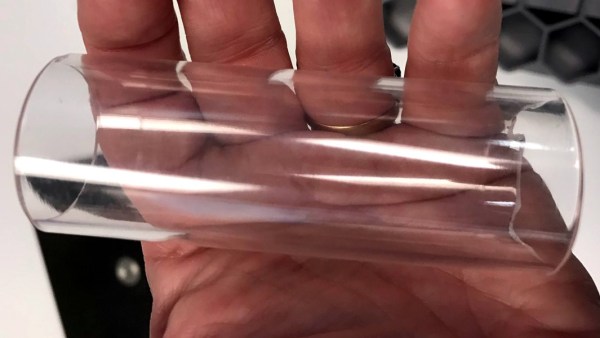
It looks like a tube made of glass but it’s actually aluminum. Well, aluminum with an asterisk beside it — this is not elemental aluminum but rather a material made using it.
We got onto the buzz about “transparent aluminum” as a result of a Tweet from whence the image above came. This Tweet was posted by [Jo Pitesky], a Science Systems Engineer at the Jet Propulsion Lab in Pasadena. [Jo] reported that at a recent JPL technology open house she had the chance to handle a tube of material that looks for all the world like a section of glass tubing, but was billed as transparent aluminum. [Jo] tweeted this because it was an interesting artifact that few people get to play with and she’s right, this is fascinating!
The the material itself is intriguing, and I immediately had practical questions like what is this stuff? What is it good for? How is it made? And is it really aluminum rendered transparent by some science fiction process?
[Christopher Foote] didn’t play quite as many games as he wanted to as a child. After years of catching up using the RetroPie and the PiGRRL 2, it was when he first picked up a Switch’s joy-cons that inspiration struck. Behold: the PiSwitch!
Realizing they operated on Bluetooth tech, [Foote] spent a fair chunk of time getting the joy-cons to properly pair to the Raspberry Pi 3 and function as one controller. Once done, he relied on Linux Joystick Mapper to manage the keybindings with some extra legwork besides to get the analog sticks working properly.
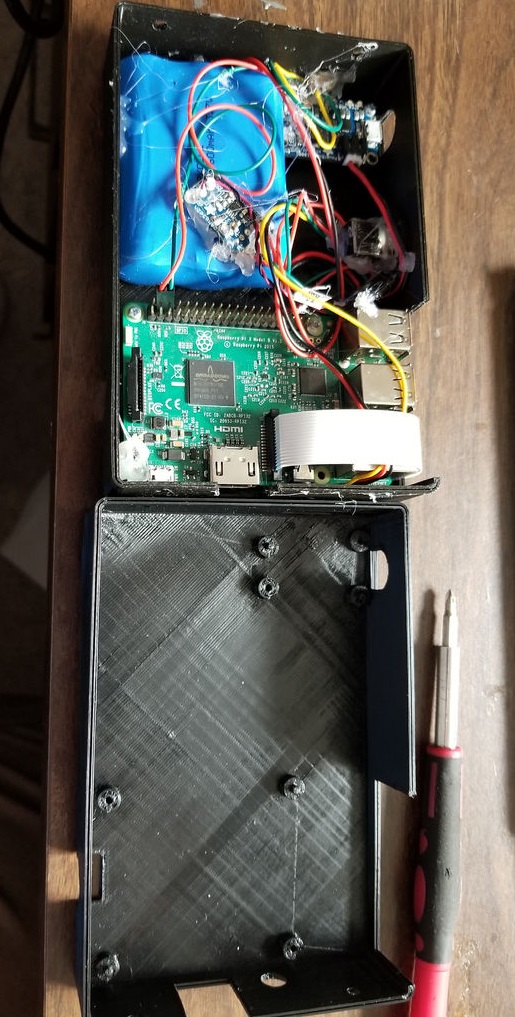
To make this console mobile, he’s packed a 6600mAh battery and Adafruit Powerboost 1000c into the device, added a second headphone jack and speaker for commuting and home enjoyment, and a Pi V2 camera module. A 3D printed case, encapsulating these components and a seven-inch touchscreen, also allows the joy-cons to be detached — though he plans on updating its design in the future.
The PiSwitch boots into a custom UI that lets you select different services — RetroPie, Kodi, Debian, and the terminal — while the joy-cons seamlessly function together or individually regardless of the activity. Check out the quick intro tour for this project after the break!
Self-driving cars have been in the news a lot in the past two weeks. Uber’s self-driving taxi hit and killed a pedestrian on March 18, and just a few days later a Tesla running in “autopilot” mode slammed into a road barrier at full speed, killing the driver. In both cases, there was a human driver who was supposed to be watching over the shoulder of the machine, but in the Uber case the driver appears to have been distracted and in the Tesla case, the driver had hands off the steering wheel for six seconds prior to the crash. How safe are self-driving cars?
Trick question! Neither of these cars were “self-driving” in at least one sense: both had a person behind the wheel who was ultimately responsible for piloting the vehicle. The Uber and Tesla driving systems aren’t even comparable. The Uber taxi does routing and planning, knows the speed limit, and should be able to see red traffic lights and stop at them (more on this below!). The Tesla “Autopilot” system is really just the combination of adaptive cruise control and lane-holding subsystems, which isn’t even enough to get it classified as autonomous in the state of California. Indeed, it’s a failure of the people behind the wheels, and the failure to properly train those people, that make the pilot-and-self-driving-car combination more dangerous than a human driver alone would be.
A self-driving Uber Volvo XC90, San Francisco.
You could still imagine wanting to dig into the numbers for self-driving cars’ safety records, even though they’re heterogeneous and have people playing the mechanical turk. If you did, you’d be sorely disappointed. None of the manufacturers publish any of their data publicly when they don’t have to. Indeed, our glimpses into data on autonomous vehicles from these companies come from two sources: internal documents that get leaked to the press and carefully selected statistics from the firms’ PR departments. The state of California, which requires the most rigorous documentation of autonomous vehicles anywhere, is another source, but because Tesla’s car isn’t autonomous, and because Uber refused to admit that its car is autonomous to the California DMV, we have no extra insight into these two vehicle platforms.
Nonetheless, Tesla’s Autopilot has three fatalities now, and all have one thing in common — all three drivers trusted the lane-holding feature well enough to not take control of the wheel in the last few seconds of their lives. With Uber, there’s very little autonomous vehicle performance history, but there are leaked documents and a pattern that makes Uber look like a risk-taking scofflaw with sub-par technology that has a vested interest to make it look better than it is. That these vehicles are being let loose on public roads, without extra oversight and with other traffic participants as safety guinea pigs, is giving the self-driving car industry and ideal a black eye.
If Tesla’s and Uber’s car technologies are very dissimilar, the companies have something in common. They are both “disruptive” companies with mavericks at the helm that see their fates hinging on getting to a widespread deployment of self-driving technology. But what differentiates Uber and Tesla from Google and GM most is, ironically, their use of essentially untrained test pilots in their vehicles: Tesla’s in the form of consumers, and Uber’s in the form of taxi drivers with very little specific autonomous-vehicle training. What caused the Tesla and Uber accidents may have a lot more to do with human factors than self-driving technology per se.
You can see we’ve got a lot of ground to cover. Read on!
The semiconductor devices were put to the test under different atmospheres in this chamber.
One of the humbling things about writing for Hackaday comes when we encounter our readership and learn the breadth of our community and the huge variety of skills and professions you represent. Among your number are a significant representation among scientists, and as a result we often receive fascinating previews of and insights into their work. Sometimes they deserve a little bit more attention than one of our normal short daily pieces, and such a moment has come our way this week.
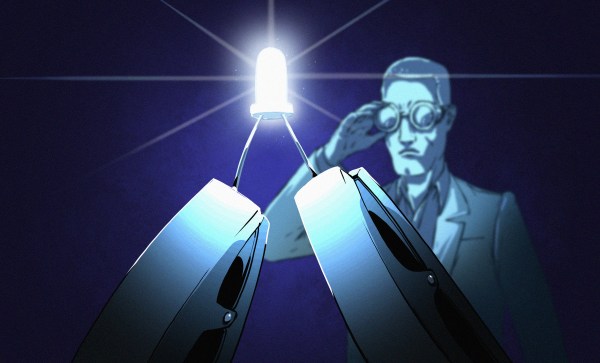
We’ve been fortunate enough to have an early look at a paper which makes detailed observations of a hitherto barely characterised property of semiconductor junctions that might have some interest for Hackaday readers in their work. In their paper, [Mellie], [Bacon] et al at Fulchester University in northeast England take a look at incandescent luminescence, a fleeting and curious effect exhibited by all semiconductor junctions in which they emit short-duration high-intensity infra-red and visible light with an extremely fast rise time when presented with high levels of current. This is a property which has been rarely exploited in commercial devices due to the large current densities required to reproduce it.
Incandescent Luminescence Explained
If you’ve never heard of incandescent luminescence before then you’re in good company, for neither had we until it was explained to us. It appears that there are a set of higher energy state conductivity bands in a semiconductor junction that can only be reached once the current passing through it breaches a threshold governed by the available quantum plasma dipole moment of the semiconductor material in question. At this point the junction assumes a plasma condition resulting in the abrupt emission of infra-red and visible radiation, the incandescent luminescence phase has been triggered.
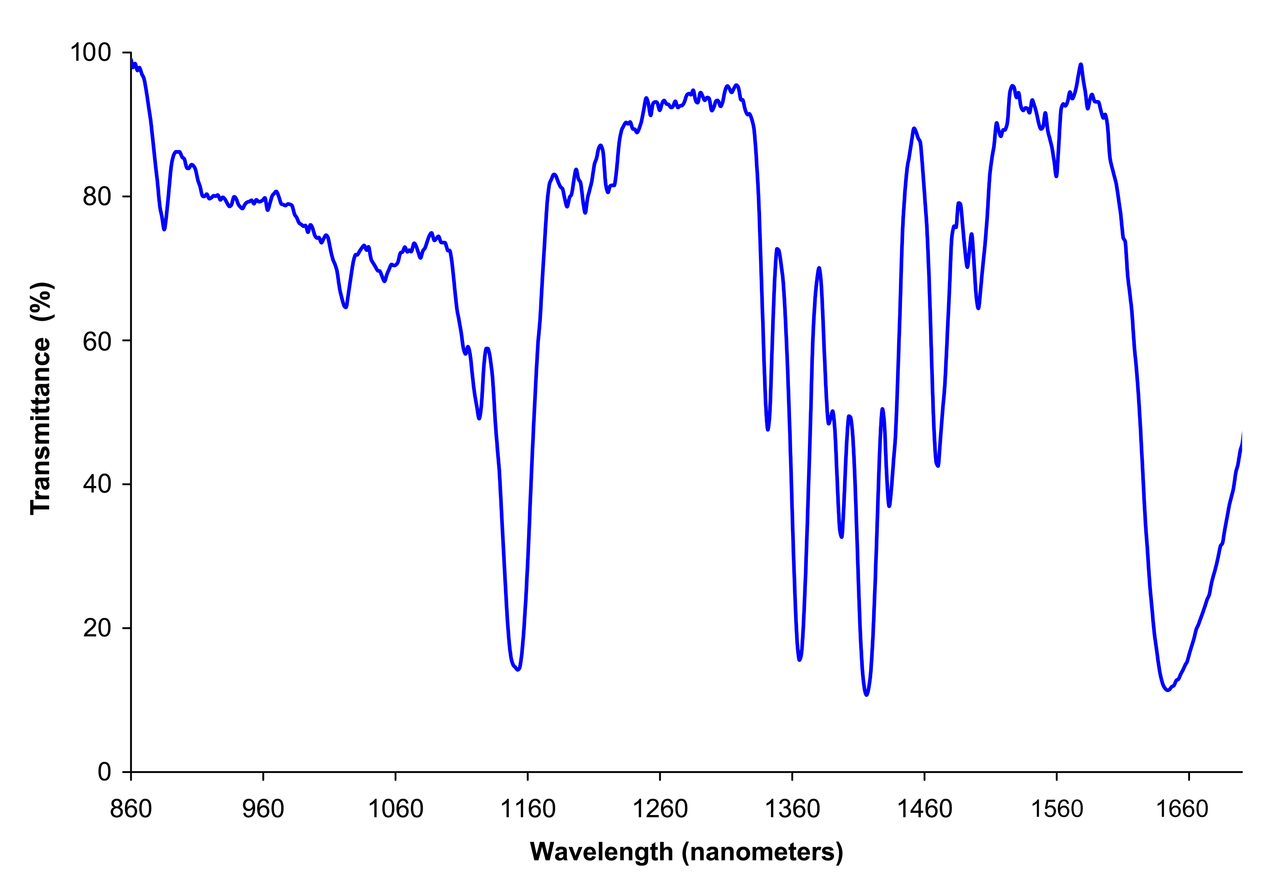
A near-infra-red spectrum of incandescent luminescence in a silicon semiconductor junction.
Though it has been known to science since first being observed in the early 20th century by the earliest experimenters in the field of semiconductor junctions, the transitory nature of the phenomenon has traditionally been a barrier to its proper examination. The British team took a selection of commercial semiconductor devices very similar to the types that might be used by Hackaday readers, placed them in a chamber, and used an array of photoelectric sensors coupled with ionising detectors using americium-241 alpha radiation sources to measure their emissions.
The resulting data was then harvested for processing through a stack of custom high-speed ADC cards. Current densities from as low as a few milliamps to hundreds of amps were tested across forward-biased PN diode junctions using a computer-controlled DC power supply, resulting in a variety of spectra and showing the resulting thermionic photon emission at higher currents to have a preponderance in the infra-red region.
Incandescent luminescence in action, through an infra-red pyrometer.
A series of experiments were conducted to investigate a related effect first described by those early scientists in the field: that the atmosphere in which the semiconductor junction sits has a significant effect on the way it exhibits incandescent luminescence. Bathing it in gaseous CO₂ or nitrogen was found to reduce the phenomenon by as much as 95%, while immersing it in liquid nitrogen resulted in it becoming completely unobservable. Oxygen-rich atmospheres by comparison served to enhance the luminescence observed, to the point that in one of pure oxygen it reached an efficiency level of 100%.
The high conversion efficiencies and rapid onset of incandescent luminescence once it has been triggered compares favourably to those of existing devices such as LEDs or wire-wound resistors used where either infra-red or visible light is required. The researchers expect the effect to be exploited in such product families as photographic flash generators, electronic igniters, and other short-duration high-intensity applications. Given their obvious advantages, we’d expect their effects on those particular markets to be nothing short of incendiary.
Thanks Ellie D. Martin-Eberhardt for some invaluable inspiration and technical help with covering this story.
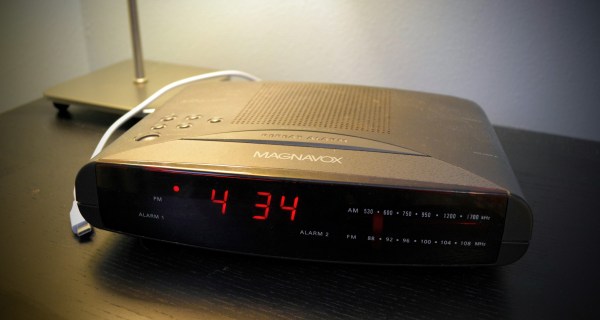
Earlier in March we heard about a quirk of the interconnected continental European electricity grid which caused clocks to lose about six minutes so far this year. This was due to a slight dip in the mains frequency. That dip didn’t put anything out of commission, but clocks that are designed to accumulate the total zero-crossings of the power grid frequency of 50 Hz don’t keep accurate time when that frequency is, say 49.985 Hz for an extended period of time.
An interesting set of conversations popped up from that topic. There were several claims that modern alarm clocks, and most devices connected to mains, no longer get their clock timing from mains frequency. I’ve looked into this a bit which I’ll go into below. But what we really want to know is: are your alarm clocks and other devices keeping time with the grid or with something else?