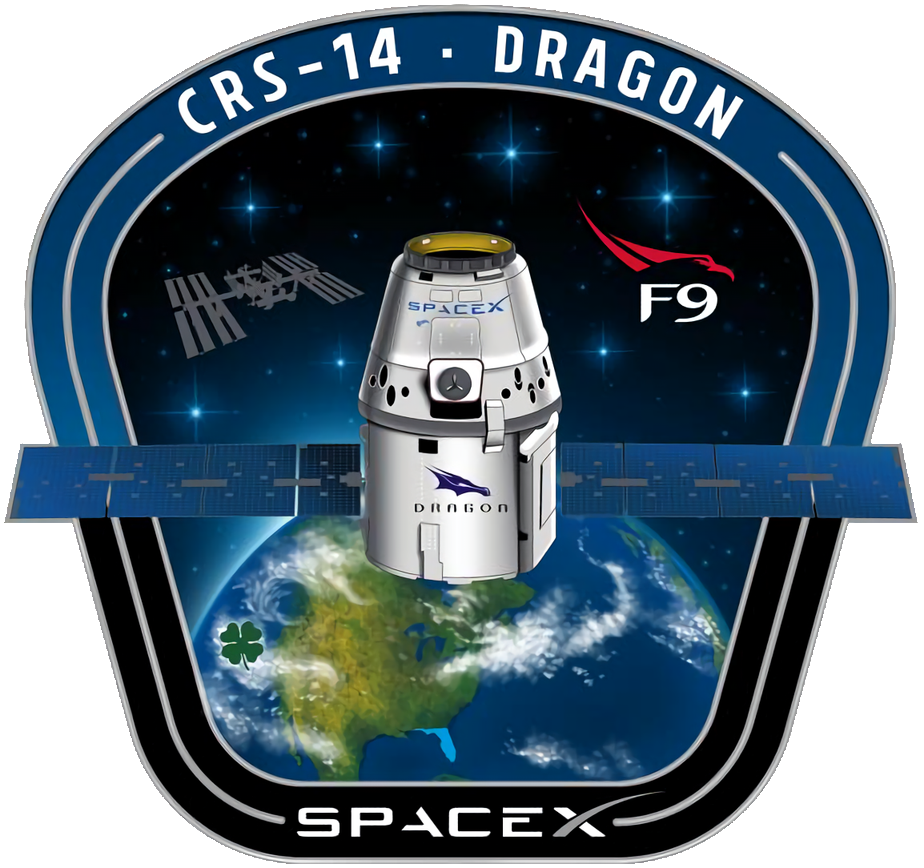
On April 2nd, 2018 a Falcon 9 rocketed skywards towards the International Space Station. The launch itself went off without a hitch, and the Dragon spacecraft delivered its payload of supplies and spare parts. But alongside the usual deliveries, CRS-14 brought a particularly interesting experiment to the International Space Station.
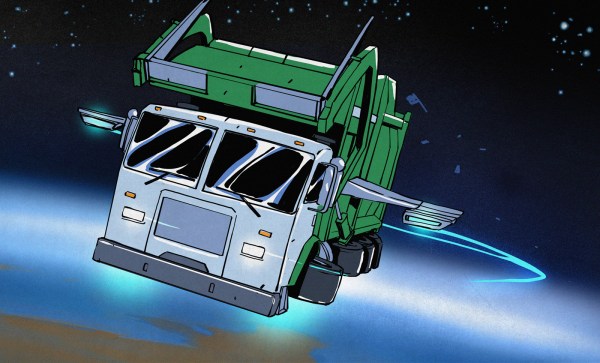
Developed by the University of Surrey, RemoveDEBRIS is a demonstration mission that aims to test a number of techniques for tackling the increasingly serious problem of “space junk”. Earth orbit is filled with old spacecraft and bits of various man-made hardware that have turned some areas of space into a literal minefield. While there have been plenty of ideas floated as to how to handle this growing issue, RemoveDEBRIS will be testing some of these methods under real-world conditions.
The RemoveDEBRIS spacecraft will do this by launching two CubeSats as test targets, which it will then (hopefully) eliminate in a practical demonstration of what’s known as Active Debris Removal (ADR) technology. If successful, these techniques could eventually become standard operating procedure on future missions.
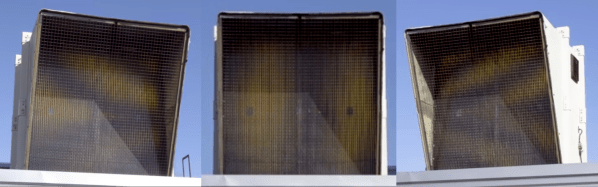
[Tom Scott] ran across an interesting visual effect created with Moiré patterns and used for guiding ships but we’re sure it can be adapted for hacks somewhere. Without the aid of any motors or LED animation, the image changes as the user views it from different angles. When viewed straight on, the user sees vertical lines, but from the left they see a right-pointing arrow and from the right, they see a left-pointing arrow. It’s used with shipping to guide ships. For example, one use would be to guide them to the center point of a bridge. When the pilots see straight, vertical lines then they know where to steer the ship.
US patent 4,629,325, Leading mark indicator, explains how it works and how to make one. Two screens are separated from each other. The one in front is vertical but the one behind is split in two and angled. It’s this angle which creates the slants of the arrows when viewed from the left or right. We had to convince ourselves that we understood it correctly and a quick test with two combs showed that we did. See below for the test in action as well as for [Tom’s] video of the real-world shipping one.
Imagine how hard it could be to add a touch screen to a Mac laptop. You’re thinking expensive and difficult, right? How could [Anish] and his friends possibly manage to upgrade their Mac with a touchscreen for only a dollar? That just doesn’t seem possible.
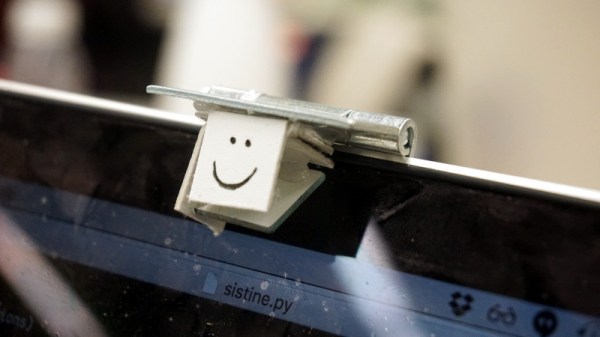
The trick, of course, is software. By mounting a small mirror over the machine’s webcam, using stiff card, hot glue, and a door hinge. By looking at the screen and deciding whether the image of a finger is touching its on-screen reflection, a remarkably simple touch screen can be created, and the promise of it only costing a dollar becomes a reality. We have to salute them for coming up with such an elegant solution.
They have a video which we’ve put below the break, showing a few simple applications for their interface. Certainly a lot less bother than a more traditional conversion.
There have been so many launches of very capable little single-board computers, that it is easy to forget an individual one among the crowd. You probably remember the C.H.I.P though, for its audacious claim back in 2015 to be the first $9 computer. It ran Linux, and included wireless connectivity, composite video output, and support for battery power. As is so often the case with ambitious startups, progress from the C.H.I.P’s creator Next Thing Co came in fits and starts.
A process called Assignment to the Benefit of Creditors is an alternative to bankruptcy proceedings yet still signals the end of a company as the service liquidates remaining assets. Despite the website and forum remaining online it appears that we may have seen the end of the C.H.I.P. and its stablemates. Hackaday has reached out to Next Thing Co for comment and will update this article if we hear back.
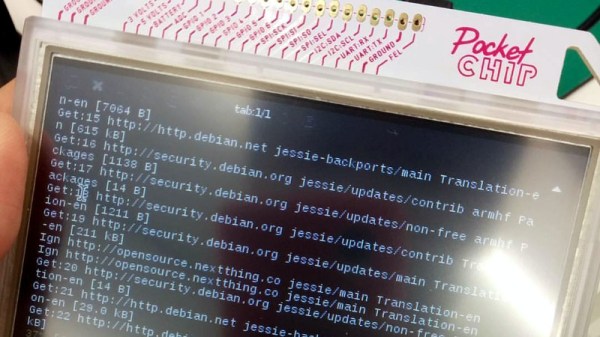
At the time it was launched, the C.H.I.P. was a pretty impressive product, and though it has since been eclipsed by products like the Raspberry Pi Zero, the board remains a useful item. The addition of the PocketCHIP all-in-one keyboard and display peripheral made it an instantly recognizable device, and it and its more powerful companion C.H.I.P. Pro module found their way into quite a few projects. For us the most impressive C.H.I.P. project is a retrocomputer, this miniature Apple II complete with monitor. If this really is the end for this particular little board, we’ll be sorry to see it go.
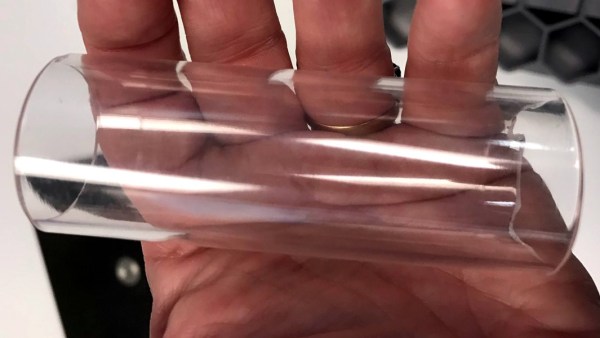
It looks like a tube made of glass but it’s actually aluminum. Well, aluminum with an asterisk beside it — this is not elemental aluminum but rather a material made using it.
We got onto the buzz about “transparent aluminum” as a result of a Tweet from whence the image above came. This Tweet was posted by [Jo Pitesky], a Science Systems Engineer at the Jet Propulsion Lab in Pasadena. [Jo] reported that at a recent JPL technology open house she had the chance to handle a tube of material that looks for all the world like a section of glass tubing, but was billed as transparent aluminum. [Jo] tweeted this because it was an interesting artifact that few people get to play with and she’s right, this is fascinating!
The the material itself is intriguing, and I immediately had practical questions like what is this stuff? What is it good for? How is it made? And is it really aluminum rendered transparent by some science fiction process?
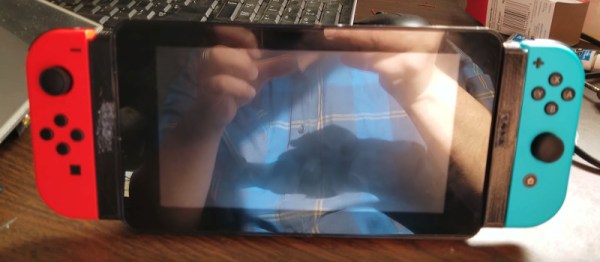
[Christopher Foote] didn’t play quite as many games as he wanted to as a child. After years of catching up using the RetroPie and the PiGRRL 2, it was when he first picked up a Switch’s joy-cons that inspiration struck. Behold: the PiSwitch!
Realizing they operated on Bluetooth tech, [Foote] spent a fair chunk of time getting the joy-cons to properly pair to the Raspberry Pi 3 and function as one controller. Once done, he relied on Linux Joystick Mapper to manage the keybindings with some extra legwork besides to get the analog sticks working properly.
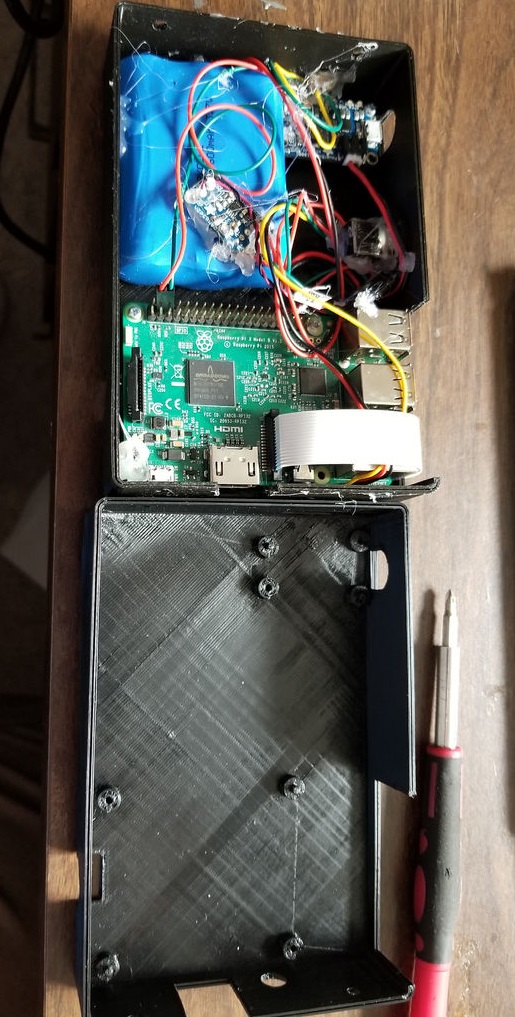
To make this console mobile, he’s packed a 6600mAh battery and Adafruit Powerboost 1000c into the device, added a second headphone jack and speaker for commuting and home enjoyment, and a Pi V2 camera module. A 3D printed case, encapsulating these components and a seven-inch touchscreen, also allows the joy-cons to be detached — though he plans on updating its design in the future.
The PiSwitch boots into a custom UI that lets you select different services — RetroPie, Kodi, Debian, and the terminal — while the joy-cons seamlessly function together or individually regardless of the activity. Check out the quick intro tour for this project after the break!
Self-driving cars have been in the news a lot in the past two weeks. Uber’s self-driving taxi hit and killed a pedestrian on March 18, and just a few days later a Tesla running in “autopilot” mode slammed into a road barrier at full speed, killing the driver. In both cases, there was a human driver who was supposed to be watching over the shoulder of the machine, but in the Uber case the driver appears to have been distracted and in the Tesla case, the driver had hands off the steering wheel for six seconds prior to the crash. How safe are self-driving cars?
Trick question! Neither of these cars were “self-driving” in at least one sense: both had a person behind the wheel who was ultimately responsible for piloting the vehicle. The Uber and Tesla driving systems aren’t even comparable. The Uber taxi does routing and planning, knows the speed limit, and should be able to see red traffic lights and stop at them (more on this below!). The Tesla “Autopilot” system is really just the combination of adaptive cruise control and lane-holding subsystems, which isn’t even enough to get it classified as autonomous in the state of California. Indeed, it’s a failure of the people behind the wheels, and the failure to properly train those people, that make the pilot-and-self-driving-car combination more dangerous than a human driver alone would be.
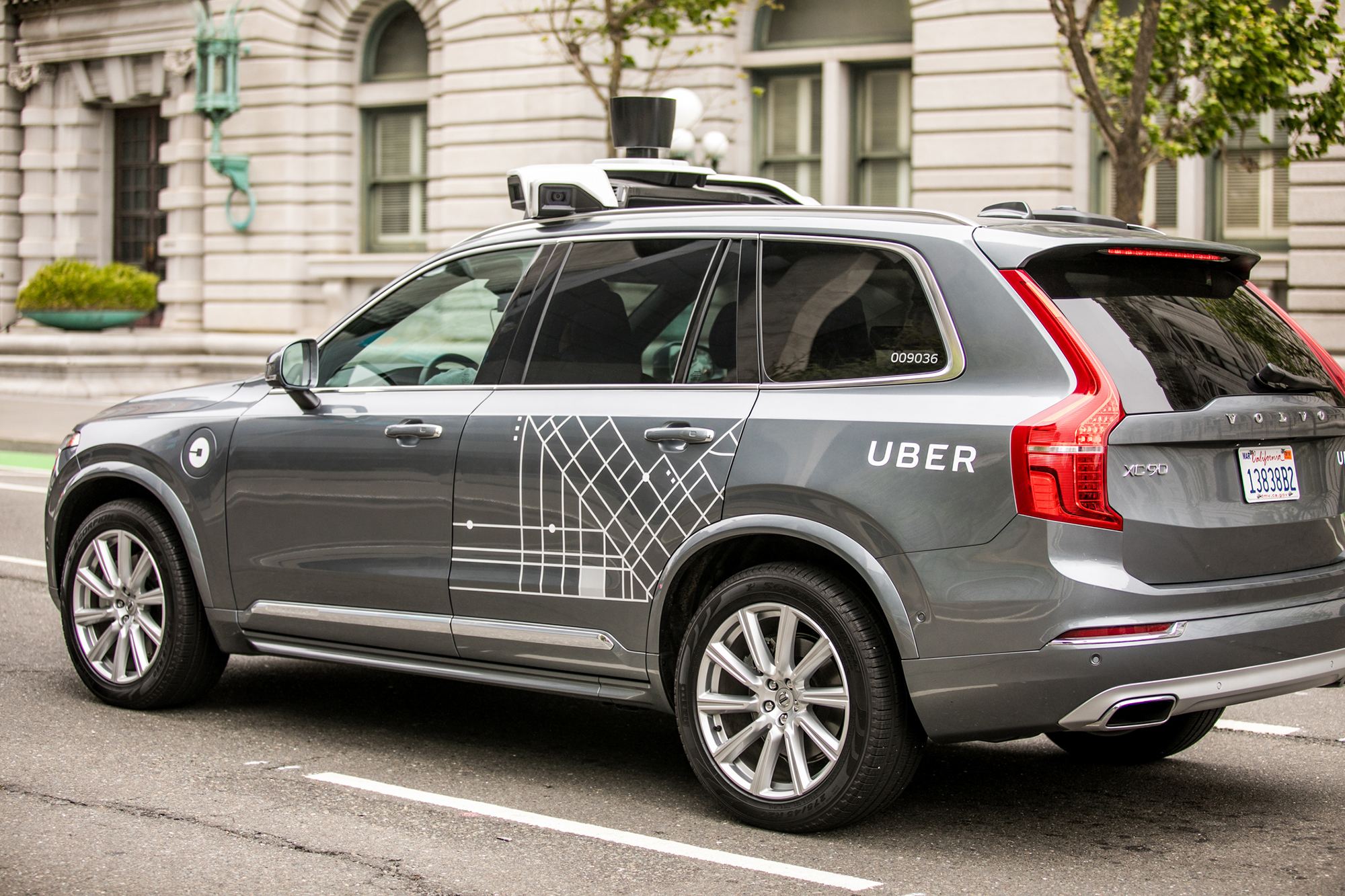
A self-driving Uber Volvo XC90, San Francisco.
You could still imagine wanting to dig into the numbers for self-driving cars’ safety records, even though they’re heterogeneous and have people playing the mechanical turk. If you did, you’d be sorely disappointed. None of the manufacturers publish any of their data publicly when they don’t have to. Indeed, our glimpses into data on autonomous vehicles from these companies come from two sources: internal documents that get leaked to the press and carefully selected statistics from the firms’ PR departments. The state of California, which requires the most rigorous documentation of autonomous vehicles anywhere, is another source, but because Tesla’s car isn’t autonomous, and because Uber refused to admit that its car is autonomous to the California DMV, we have no extra insight into these two vehicle platforms.
Nonetheless, Tesla’s Autopilot has three fatalities now, and all have one thing in common — all three drivers trusted the lane-holding feature well enough to not take control of the wheel in the last few seconds of their lives. With Uber, there’s very little autonomous vehicle performance history, but there are leaked documents and a pattern that makes Uber look like a risk-taking scofflaw with sub-par technology that has a vested interest to make it look better than it is. That these vehicles are being let loose on public roads, without extra oversight and with other traffic participants as safety guinea pigs, is giving the self-driving car industry and ideal a black eye.
If Tesla’s and Uber’s car technologies are very dissimilar, the companies have something in common. They are both “disruptive” companies with mavericks at the helm that see their fates hinging on getting to a widespread deployment of self-driving technology. But what differentiates Uber and Tesla from Google and GM most is, ironically, their use of essentially untrained test pilots in their vehicles: Tesla’s in the form of consumers, and Uber’s in the form of taxi drivers with very little specific autonomous-vehicle training. What caused the Tesla and Uber accidents may have a lot more to do with human factors than self-driving technology per se.
You can see we’ve got a lot of ground to cover. Read on!

 Developed by the University of Surrey, RemoveDEBRIS is a demonstration mission that aims to test a number of techniques for tackling the increasingly serious problem of “space junk”. Earth orbit is filled with old spacecraft and bits of various man-made hardware that have turned some areas of space into a literal minefield. While there have been plenty of ideas floated as to how to handle this growing issue, RemoveDEBRIS will be testing some of these methods under real-world conditions.