Incandescent Luminescence Of Semiconductor Junctions Characterised In The Lab

The semiconductor devices were put to the test under different atmospheres in this chamber.

One of the humbling things about writing for Hackaday comes when we encounter our readership and learn the breadth of our community and the huge variety of skills and professions you represent. Among your number are a significant representation among scientists, and as a result we often receive fascinating previews of and insights into their work. Sometimes they deserve a little bit more attention than one of our normal short daily pieces, and such a moment has come our way this week.

We’ve been fortunate enough to have an early look at a paper which makes detailed observations of a hitherto barely characterised property of semiconductor junctions that might have some interest for Hackaday readers in their work. In their paper, [Mellie], [Bacon] et al at Fulchester University in northeast England take a look at incandescent luminescence, a fleeting and curious effect exhibited by all semiconductor junctions in which they emit short-duration high-intensity infra-red and visible light with an extremely fast rise time when presented with high levels of current. This is a property which has been rarely exploited in commercial devices due to the large current densities required to reproduce it.

Incandescent Luminescence Explained

If you’ve never heard of incandescent luminescence before then you’re in good company, for neither had we until it was explained to us. It appears that there are a set of higher energy state conductivity bands in a semiconductor junction that can only be reached once the current passing through it breaches a threshold governed by the available quantum plasma dipole moment of the semiconductor material in question. At this point the junction assumes a plasma condition resulting in the abrupt emission of infra-red and visible radiation, the incandescent luminescence phase has been triggered.

A near-infra-red spectrum of incandescent luminescence in a halogen-doped silicon semiconductor junction.
A near-infra-red spectrum of incandescent luminescence in a silicon semiconductor junction.

Though it has been known to science since first being observed in the early 20th century by the earliest experimenters in the field of semiconductor junctions, the transitory nature of the phenomenon has traditionally been a barrier to its proper examination. The British team took a selection of commercial semiconductor devices very similar to the types that might be used by Hackaday readers, placed them in a chamber, and used an array of photoelectric sensors coupled with ionising detectors using americium-241 alpha radiation sources to measure their emissions.

The resulting data was then harvested for processing through a stack of custom high-speed ADC cards. Current densities from as low as a few milliamps to hundreds of amps were tested across forward-biased PN diode junctions using a computer-controlled DC power supply, resulting in a variety of spectra and showing the resulting thermionic photon emission at higher currents to have a preponderance in the infra-red region.

Incandescent luminescence in action, through an infra-red pyrometer.

A series of experiments were conducted to investigate a related effect first described by those early scientists in the field: that the atmosphere in which the semiconductor junction sits has a significant effect on the way it exhibits incandescent luminescence. Bathing it in gaseous CO₂ or nitrogen was found to reduce the phenomenon by as much as 95%, while immersing it in liquid nitrogen resulted in it becoming completely unobservable. Oxygen-rich atmospheres by comparison served to enhance the luminescence observed, to the point that in one of pure oxygen it reached an efficiency level of 100%.

The high conversion efficiencies and rapid onset of incandescent luminescence once it has been triggered compares favourably to those of existing devices such as LEDs or wire-wound resistors used where either infra-red or visible light is required. The researchers expect the effect to be exploited in such product families as photographic flash generators, electronic igniters, and other short-duration high-intensity applications. Given their obvious advantages, we’d expect their effects on those particular markets to be nothing short of incendiary.

Thanks Ellie D. Martin-Eberhardt for some invaluable inspiration and technical help with covering this story.

Near-IR spectrum: Deglr6328 [CC-BY-SA-3.0].

Test chamber: David Monniaux [CC-BY-SA-3.0].

Infra-red image: National Institute of Standards and Technology [Public domain].
Ask Hackaday: Is Your Clock Tied To Mains Frequency?

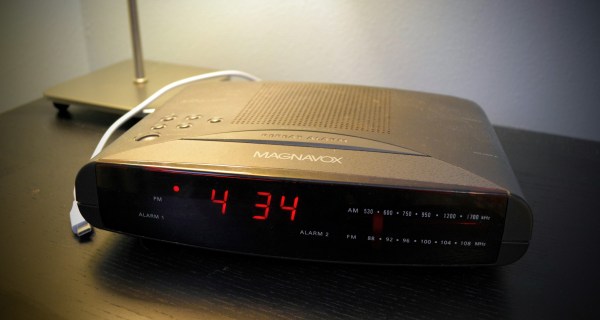
Earlier in March we heard about a quirk of the interconnected continental European electricity grid which caused clocks to lose about six minutes so far this year. This was due to a slight dip in the mains frequency. That dip didn’t put anything out of commission, but clocks that are designed to accumulate the total zero-crossings of the power grid frequency of 50 Hz don’t keep accurate time when that frequency is, say 49.985 Hz for an extended period of time.

An interesting set of conversations popped up from that topic. There were several claims that modern alarm clocks, and most devices connected to mains, no longer get their clock timing from mains frequency. I’ve looked into this a bit which I’ll go into below. But what we really want to know is: are your alarm clocks and other devices keeping time with the grid or with something else?

Continue reading “Ask Hackaday: Is Your Clock Tied To Mains Frequency?”

It’s Raining Chinese Space Stations: Tiangong-1

China’s first space station, Tiangong-1, is expected to do an uncontrolled re-entry on April 1st, +/- 4 days, though the error bars vary depending on the source. And no, it’s not the grandest of all April fools jokes. Tiangong means “heavenly palace”, and this portion of the palace is just one step of a larger, permanent installation.

But before detailing just who’ll have to duck when the time comes, as well as how to find it in the night sky while you still can, let’s catch up on China’s space station program and Tiangong-1 in particular.

Continue reading “It’s Raining Chinese Space Stations: Tiangong-1”

The Essential List Of 3D Printer Accessories

You’ve acquired your first 3D printer and are giddy with excitement. But like all new additive manufacturing adventurers, the more you do with your printer the more questions arise. Don’t worry, we’ve got your back.

Getting the most out of your time with a new 3D printer has a lot to do with the tools and accessories on hand and what you do with them. Let’s take a look at a few of the accessories that should accompany every 3D printer, be it in your home, school, or hackerspace. There’s already enough potential aggravation when it comes to 3D printing, the goal here is to ensure you won’t be without a tool or supply when you need it the most.

Continue reading “The Essential List Of 3D Printer Accessories”

Car Revival According To Tesla

Frankencars are built from the parts of several cars to make one usable vehicle. [Jim Belosic] has crossed the (finish) line with his Teslonda. In the most basic sense, it is the body of a Honda Accord on top of the drive train of a Tesla Model S. The 1981 Honda was the make and model of his first car, but it wasn’t getting driven. Rather than sell it, he decided to give it a new life with electricity, just like Victor Frankenstein.

In accord with Frankenstein’s monster, this car has unbelievable strength. [Jim] estimates the horsepower increases by a factor of ten over the gas engine. The California-emissions original generates between forty and fifty horsepower while his best guess places the horsepower over five-hundred. At this point, the Honda body is just holding on for dear life. Once all the safety items, like seatbelts, are installed, the driver and passengers will be holding on for the same reason.

This kind of build excites us because it takes something old, and something modern, and marries the two to make something in a class of its own. And we hate to see usable parts sitting idle.

Without a body, this electric car scoots around with its driver all day, and this Honda doesn’t even need the driver inside.

Continue reading “Car Revival According To Tesla”

How To Reverse Engineer Mechanical Designs For 3D Modeling

If you’re interested in 3D printing or CNC milling — or really any kind of fabrication — then duplicating or interfacing with an existing part is probably on your to-do list. The ability to print replacement parts when something breaks is often one of the top selling points of 3D printing. Want some proof? Just take a look at what people made for our Repairs You Can Print contest.

Of course, to do that you need to be able to make an accurate 3D model of the replacement part. That’s fairly straightforward if the part has simple geometry made up of a primitive solid or two. But, what about the more complicated parts you’re likely to come across?

In this article, I’m going to teach you how to reverse engineer and model those parts. Years ago, I worked for a medical device company where the business model was to duplicate out-of-patent medical products. That meant that my entire job was reverse engineering complex precision-made devices as accurately as possible. The goal was to reproduce products that were indistinguishable from the original, and because they were used for things like trauma reconstruction, it was critical that I got it right.

Continue reading “How To Reverse Engineer Mechanical Designs For 3D Modeling”

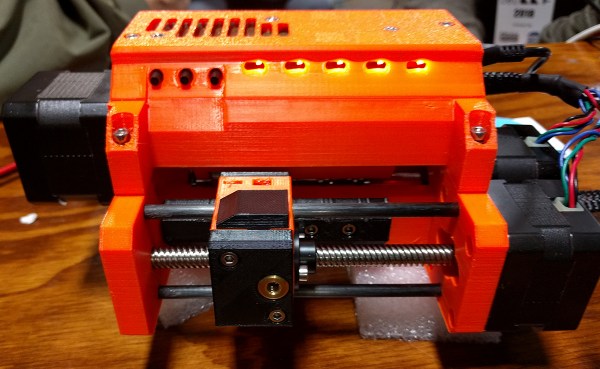
Cutting Edge Of 3D Printing Revealed At Last Weekend’s Midwest RepRap Festival

The last three days marked the 2018 Midwest RepRap Festival. Every year, the stars of the 3D printing world make it out to Goshen, Indiana for the greatest gathering of 3D printers and printing enthusiasts the world has ever seen. This isn’t like any other 3D printing convention — everyone here needs to take the time to get to Goshen, and that means only the people who want to be here make it out.

Over the weekend we covered some amazing hacks and printer builds from MRRF. The ‘BeagleBone On A Chip’ has become a complete solution for a 3D printer controller. This is a great development that takes advantage of the very under-used Programmable Real-Time Units found in the BeagleBone, and will make an excellent controller for that custom printer you’ve been wanting to build. E3D has announced they’re working on an automatic tool-changing printer. It’s a slight derivative of their now-defunct BigBox printer, but is quite possibly the best answer to multi-material filament printers we’ve ever seen. There’s some interest from the community, and if everything goes well, this printer may become a kit, or something of the sort. Filament splicing robots also made an appearance at this year’s MRRF, and the results are extremely impressive. Now you can create multi-color prints with the printer you already own. Is it expensive? Yes, but it looks so good.

This wasn’t all that could be found at MRRF. There were hundreds of printers at the event, and at last count, over 1300 attendees. That’s amazing for a 3D printer convention that is held every year in the middle of nowhere, Indiana. What were the coolest sights and sounds coming out of MRRF this year? Check out the best-of list below.

Continue reading “Cutting Edge Of 3D Printing Revealed At Last Weekend’s Midwest RepRap Festival”