Fix-A-Brick 2: Nexus 5X Rises From The Ashes

It was but two weeks ago when I told my story of woe —  the tale of an LG Nexus 5X that fell ill, seemingly due to a manufacturing fault at birth. I managed to disassemble it and made my way through a semi-successful attempt at repair, relying on a freezer and hairdryer to coax it back to life long enough to backup my data. Try as I might, however, I simply couldn’t get the phone running for more than ten minutes at a time.

All was not in vain, however! I was rewarded for documenting my struggles with the vast experience and knowledge of the wider Internet: “Hairdryers don’t get as hot as heatguns!”

It turned out I had just assumed that two similar devices, both relying on a hot bit of metal and a fan as their primary components, must be virtually identical if rated at a similar power draw. I was wrong! Apparently the average hairdryer stays well cooler than 150 degrees Celsius to avoid melting one’s silky locks or burning the skin. I even learned that apparently, wet hair melts at a lower temperature than dry hair. Who knew?

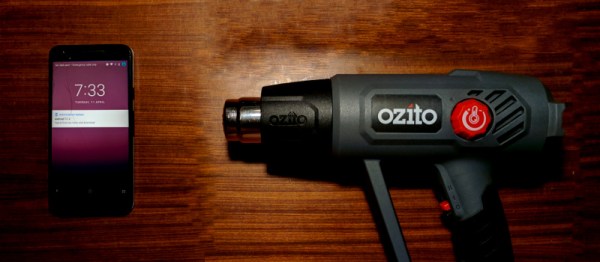
Armed with this knowledge, I rushed out and bought the cheapest heat gun I could find — around $50. Rated up to 600 degrees C, this was definitely going to be hotter than the hairdryer. With the prevailing opinion being that I had not applied enough heat in general, I decided to also increase the heating period to 90 seconds, up from a quick 30 second pass originally.

Continue reading “Fix-A-Brick 2: Nexus 5X Rises From The Ashes”
$10 Orange Pi 2G-IoT Released To Compete With Pi Zero W

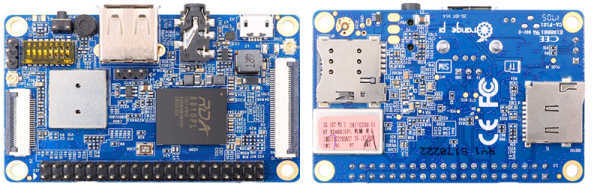
A new single-board computer by Orange Pi has popped up for sale on AliExpress. The Orange Pi 2G-IoT is designed to compete with the Raspberry Pi Zero, and if specs are anything to go by they have done a nice job.

There are a lot of options for extra small single board computers these days and there’s a growing list at the lowest price points. Let’s call it the sub-$20 cost range (to quell the argument of shipping fees). We have seen C.H.I.P., the Raspberry Pi Foundation released the Pi Zero W (an update to the Zero line that included WiFi and Bluetooth), the already available Orange Pi Zero (which was featured in a project on Monday), and now add to that list the unfortunately named Orange Pi 2G-IoT.

The 2g-IoT is sporting an ARM Cortex-A5 32bit clocked at 1GHz with 256MB DDR2 RAM. It’s nice to see 500 MB of on-board NAND to go along with an SD card slot for larger storage. It also has a CSI camera connector, WiFi, Bluetooth, an FM Radio and GSM/GPRS with a sim card slot on the bottom. It is pin compatible with Raspberry Pi’s almost standardized GPIO layout.

All this for $10 is quite impressive to say the least, especially the addition of GSM/GPRS. Will it kill Raspberry Pi Zero W sales? We think not. While the Orange Pi’s are great little computers, they don’t have the community support that is afforded to Raspberry Pi products making for less support online when you run into a problem. That’s if you can even get the thing running in the first place. The Orange Pi’s website has not yet been updated to reflect the new release. However if you are interested in getting one for yourself right now, head over to your favorite Chinese electronics supplier.

[via Geeky Gadgets and CNX]

Introduction To TensorFlow

I had great fun writing neural network software in the 90s, and I have been anxious to try creating some using TensorFlow.

Google’s machine intelligence framework is the new hotness right now. And when TensorFlow became installable on the Raspberry Pi, working with it became very easy to do. In a short time I made a neural network that counts in binary. So I thought I’d pass on what I’ve learned so far. Hopefully this makes it easier for anyone else who wants to try it, or for anyone who just wants some insight into neural networks.

Continue reading “Introduction To TensorFlow”

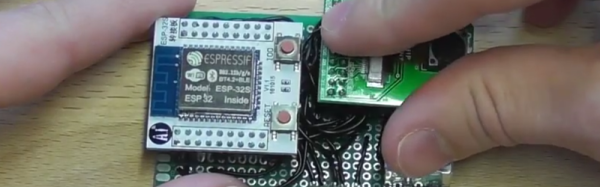
ESP32 WiFi Hits 10km With A Little Help

[Jeija] was playing with some ESP32s and in true hacker fashion, he wondered how far he could pull them apart and still get data flowing. His video answer to that question covers the Friis equation and has a lot of good examples of using the equation, decibels, and even a practical example that covers about 10km. You can see the video below.

Of course, to get that kind of range you need a directional antenna. To avoid violating regulations that control transmit power, he’s using the antenna on the receiving end. That also means he had to hack the ESP32 WiFi stack to make the device listen only on one side. The hack involves putting the device in promiscuous mode and only monitoring the signals being sent. You can find the code involved on GitHub (complete with a rickrolling application).

Continue reading “ESP32 WiFi Hits 10km With A Little Help”

Hackaday Trims Its Own Resistors

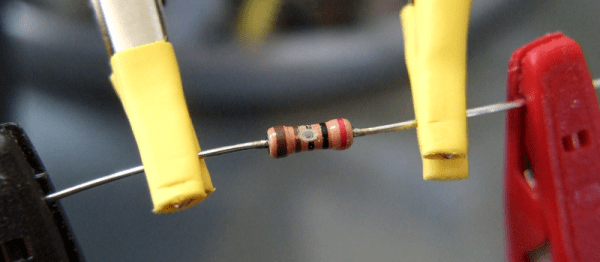
There are times when you might want an odd-value resistor. Rather than run out to the store to buy a 3,140 Ω resistor, you can get there with a good ohmmeter and a willingness to solder things in series and parallel. But when you want a precise resistor value, and you want many of them, Frankensteining many resistors together over and over is a poor solution.

Something like an 8-bit R-2R resistor-ladder DAC, for instance, requires seventeen resistors of two values in better than 0.4% precision. That’s just not something I have on hand, and the series/parallel approach will get tiresome fast.

Ages ago, I had read about trimming resistors by hand, but had assumed that it was the domain of the madman. On the other hand, this is Hackaday; I had some time and a file. Could I trim and match resistors to within half a percent? Read on to find out.

Continue reading “Hackaday Trims Its Own Resistors”

Lights Out In Québec: The 1989 Geomagnetic Storm

I found myself staring up at the sky on the night of March 13, 1989, with my girlfriend and her parents in the backyard of their house. The sky was on fire, almost literally. Red and pink sheets of plasma streamed out in a circle from directly overhead, with blue-white streaks like xenon flashes occasionally strobing across the sky. We could actually hear a sizzling, crackling sound around us. The four of us stood there, awestruck by the aurora borealis we were lucky enough to witness.

At the same time, lights were winking out a couple of hundred miles north in Québec province. The same solar storm that was mesmerizing me was causing fits for Hydro-Québec, the provincial power authority, tripping circuit breakers and wreaking havoc. This certainly wasn’t the first time the Sun threw a fit and broke systems on Earth, but it was pretty dramatic, and there are some lessons to be learned from it and other solar outbursts.

Continue reading “Lights Out In Québec: The 1989 Geomagnetic Storm”

PC in a mouse

PC In A Mouse

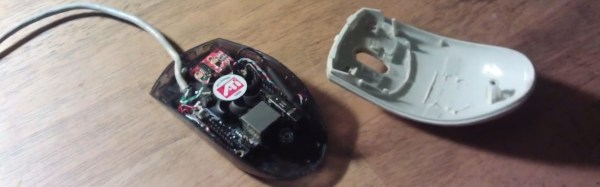
[Slider2732] got his Orange Pi Zero working with a 3 watt amplifier, wireless keyboard (with built-in mouse), and car reversing monitor. But he needed a case to house it in. He remembered that he used to make parameters for ghost hunting by filling PC mouse cases with all sorts of electronics. So why not put the Orange Pi Zero in a mouse too? Looking through his mouse collection, he picked out an old Logitech optical mouse and went to work.

We like that the Logitech has transparent bottom halves, perfect for proving to anyone who might be skeptical that the PC really is in the mouse. A great enhancement we think would be to make the mouse actually be the mouse too! But there doesn’t seem to be enough room left for that. What’s smaller than a Pi Zero that will also run the armbian Linux distribution, OpenELEC Mediacenter, Kodi and a bunch of games?

He even set up the wireless networking for watching YouTube videos. Check out the build and demo video after the break.

Continue reading “PC In A Mouse”