A Power Switch For The Chromecast

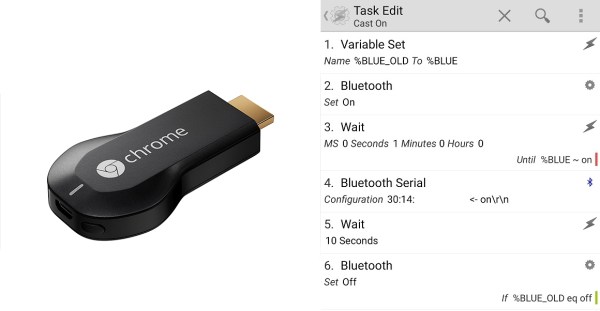
Chromecasts are fantastic little products, they’re basically little HDMI sticks you can plug into any monitor or TV, and then stream content using your phone or computer as the controller. They are powered by a micro USB port in the back, and if you’re lucky, your TV has a port you can suck the juice off. But what if you want to turn it off while you use a different input on your TV so that your monitor will auto-sleep? You might have to build a power switch.
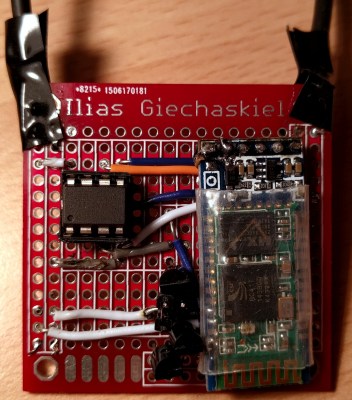
Now in all honesty, the Chromecast gets hot but the amount of power it draws when not in use is still pretty negligible compared to the draw of your TV. Every watt counts, and [Ilias] took this as an opportunity to refine his skills and combine a system using an Arduino, Bluetooth, and Android to create a robust power switch solution for the Chromecast.

The setup is rather simple. An HC-05 Bluetooth module is connected to an Attiny85, with some transistors to control a 5V power output. The Arduino takes care of a bluetooth connection and uses a serial input to control the transistor output. Finally, this is all controlled by a Tasker plugin on the Android phone, which sends serial messages via Bluetooth.

All the information you’ll need to make one yourself is available at [Ilias’] GitHub repository. For more information on the Chromecast, why not check out our review from almost three years ago — it’s getting old!


Drawn In By The Siren’s Song

When I say “siren” what do you think of? Ambulances? Air raids? Sigh. I was afraid you were going to say that. We’ve got work to do.

You see, the siren played an important role in physics and mathematics about 150 years ago. Through the first half of the 1900s, this fine apparatus was trivialized, used for its pure noise-making abilities. During the World Wars, the siren became associated with air raids and bomb shelters: a far cry from its romantic origins. In this article, we’re going to take the siren back for the Muses. I want you to see the siren in a new light: as a fundamental scientific experiment, a musical instrument, and in the end, as a great DIY project — this is Hackaday after all.

Continue reading “Drawn In By The Siren’s Song” →

Misleading Tech: Kickstarter, Bomb Sights, And Medical Rejuvinators

Every generation thinks it has unique problems and, I suppose, sometimes it is true. My great-grandfather didn’t have to pick a cell phone plan. However, a lot of things you think are modern problems go back much further than you might think. Consider Kickstarter. Sure, there have been plenty of successful products on Kickstarter. There have also been some misleading duds. I don’t mean the stupid ones like the guy who wants to make a cake or potato salad. I mean the ones that are almost certainly vaporware like the induced dream headgear or the Bluetooth tag with no batteries.

Overpromising and underdelivering is hardly a new problem. In the 30’s The McGregor Rejuvenator promised to reverse aging with magnetism, radio waves, infrared and ultraviolet light. Presumably, this didn’t work. Sometimes products do work, but they don’t live up to their marketing hype. The Segway comes to mind. Despite the hype that it would revolutionize transportation, the scooter is now a vehicle for tourists and mall cops.

One of my favorite examples of an overhyped product comes from World War II: The Norden Bomb Sight. What makes the Norden especially interesting is that even today it has a reputation for being highly accurate. However, if you look into it, the Norden–although a marvel for its day–didn’t always live up to its press.

Continue reading “Misleading Tech: Kickstarter, Bomb Sights, And Medical Rejuvinators” →

Giant Mersenne Prime Found

Ever hear of a Mersenne prime? These are prime numbers that are one less than a power of two. Named after Marin Mersenne, a French Minim friar, who studied them in the early 17th century, there is a distributed computing project on the Internet to find Mersenne primes called GIMPS (Great Internet Mersenne Prime Search). The project recently announced they have found the largest known prime.

Continue reading “Giant Mersenne Prime Found” →

Lady Ada Turns NeXT Equipment Into Something Useful

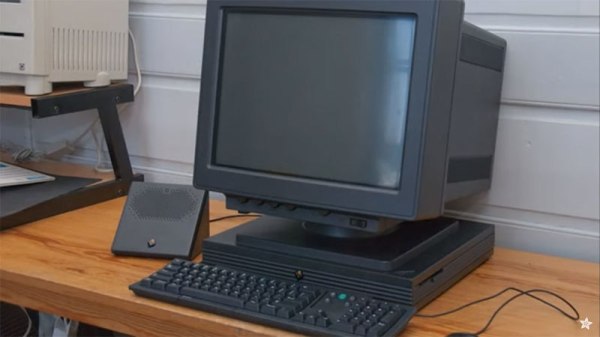
From the late 80s to the early 90s, [Steve Jobs] wasn’t at Apple. He built another company in the meantime, NeXT Computer, a company that introduced jet black workstations to universities and institutions, developed an incredible emphasis on object-oriented programming, and laid the groundwork for the Unix-ey flavor of Apple’s OS X. Coincidently, there is a lot of old NeXT gear at the Adafruit clubhouse – not that there’s anything wrong with that, we all have our own strange affectations and proclivities. Recently, [Lady Ada] turned one of the strangest components of the NeXT computer ecosystem into something useful: a computer speaker.

The item in question for this build is the NeXT ‘sound box’. When not using the very special NeXT monitor, the NeXT computer connects the monitor, keyboard, and speakers through this odd little box. There are two versions of the NeXT sound box, and peripherals from either version are incompatible with each other. ([Jobs] was known for his sense of design and a desire for a simplified user experience, you know.)

In [Lady Ada]’s initial teardown of the sound box, she discovers a few interesting things about this peripheral. There’s an I2S DAC inside there, connected to an unobtanium DB19 connector. Theoretically, that I2S device could be used to drive the speaker with digital audio. The only problem is the DB19 connector – they’re rare, and [Steve] from Big Mess o’ Wires bought the world’s supply.

Without these connectors, and since it’s only an hour-long show, [Lady Ada] went with the most effective hack. She grabbed a USB audio dongle/card, added a small amplifier, and soldered a few wires onto the power and ground pins of an IC. It’s simple, effective, fast, and turns an awesome looking 30-year-old peripheral into a useful device.

Cleanest Rasberry Pi NES Mod

[ModPurist] sent us his Raspberry-Pi-in-a-Nintendo casemod. Before you go hitting the back button, this is a good one because it’s so well executed. And it’s actually a two-fer: he’d previously built up a wireless NES controller that completes the setup.

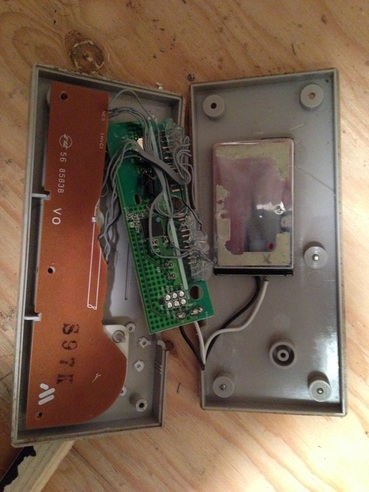
7058802Both of these mods are hacks in the purest sense of the word. The controller mod took a wireless keyboard’s sending circuit board and wedged it inside the NES controller. The original NES controller reads out the buttons into a shift register and sends that down a wire. That’s all gone. [ModPurist] just wired up each button to the sender PCB and figured out which keys they corresponded to on the PC by pressing the buttons. Simple.

The best part of his video about building the controller? After about a minute in, he forgets that he’s filming a technical how-to video and plays Pokemon for the remaining four minutes. That’s the sign of success.

Then there’s the NES hack itself. He stripped everything out, added a Raspberry Pi 2 and a fan, made it all work with the power switch and the original TV outs, and it’s done. Again, nothing more than needs doing, but nothing less. It looks just right plugged up to the CRT monitor (from a C64, no less), and there’s no doubt that being able to play wirelessly on an original NES controller is cool.

This isn’t [ModPurist]’s first time here on Hackaday either, and his “Cold Boy” fridge-turned-Gameboy is a work of art.

Continue reading “Cleanest Rasberry Pi NES Mod” →

Sort Faster With FPGAs

Sorting. It’s a classic problem that’s been studied for decades, and it’s a great first step towards “thinking algorithmically.” Over the years, a handful of sorting algorithms have emerged, each characterizable by it’s asymptotic order, a measure of how much longer an algorithm takes as the problem size gets bigger. While all sorting algorithms take longer to complete the more elements that must be sorted, some are slower than others.

For a sorter like bubble sort, the time grows quadradically longer for a linear increase in the number of inputs; it’s of order O(N²).With a faster sorter like merge-sort, which is O(N*log(N)), the time required grows far less quickly as the problem size gets bigger. Since sorting is a bit old-hat among many folks here, and since O(N*log(N)) seems to be the generally-accepted baseline for top speed with a single core, I thought I’d pop the question: can we go faster?

In short — yes, we can! In fact, I’ll claim that we can sort in linear time, i.e a running time of O(N). There’s a catch, though: to achieve linear time, we’ll need to build some custom hardware to help us out. In this post, I’ll unfold the problem of sorting in parallel, and then I”ll take us through a linear-time solution that we can synthesize at home on an FPGA.

Need to cut to the chase? Check out the full solution implemented in SystemVerilog on GitHub. I’ve wrapped it inside an SPI communication layer so that we can play with it using an everyday microcontroller.

To understand how it works, join us as we embark on an adventure in designing algorithms for hardware. If you’re used to thinking of programming in a stepwise fashion for a CPU, it’s time to get out your thinking cap!

Continue reading “Sort Faster With FPGAs” →