This Week In Security: Annoyed Researchers, Dangling DNS, And Hacks That Could Have Been Worse

The author of the BlueHammer exploit, which was released earlier this month and addressed in the last Patch Tuesday, continues to be annoyed with the responses from the Microsoft security research and vulnerability response team, and has released another Windows zero-day attack against Windows Defender.

The RedSun exploit targets a logic and timing error in Windows Defender, convincing it to install the target file in the system, instead of quarantining the file and protecting the system. Not, generally, what you would hope would happen.

Since the RedSun attack requires local access in the first place, it seems unlikely Microsoft will release an out-of-sequence patch for it, however with public code available, we can probably expect to see malware leveraging it to establish higher permissions on an infected system.

Releasing exploits out of spite feels like a return to the late 1990s, and I almost don’t hate it.

University Domains Hijacked

Reported in Bleeping Computer, a group tracked as “Hazy Hawk” has been hijacking unmaintained DNS records of universities and government institutions to serve ad click spam.

The attack seems simple and doesn’t even require compromising the actual institution, using dangling DNS “CNAME” records. A “CNAME” entry in DNS acts essentially as an alias, pointing one domain name at another, which can be used to provide content from an official domain that is hosted on a cloud service where the IP address of the service might change.

A DNS “A” (or “AAAA” if you speak IPv6) record points a hostname – like “foo.example.com” – to an IP address – like “1.1.1.1”. A “CNAME” record points a hostname to another hostname, like “foo.some_cloud_host.com”. Scanning “high value” domains (like Ivy League universities) for “CNAME” records which point to expired domains (or domains on cloud hosted providers which no longer exist) lets anyone able to register that domain (or create an account with the proper naming scheme on the cloud host) to post any content they wish, and still appear to be the original name.

At least 30 educational institutions have been impacted, along with several government agencies including the CDC.


Continue reading “This Week In Security: Annoyed Researchers, Dangling DNS, And Hacks That Could Have Been Worse”

VCF East And Maker Faire Make For A Busy Weekend

For those of us with an interest in hacking and making, events where we can meet up with like minded folks and check out the projects they’re working on don’t exactly happen every day. Unless you’re able to travel around the country (or even better, the world), you usually have to make do with the handful of annual events that are within a reasonable distance of your home. If you’re lucky that may give you two or three opportunities during the year to look forward to, generally spaced out enough that you’ve got adequate time to prepare ahead of the event and decompress afterwards.

But occasionally, the planets and geekdoms align. Such was the case this past weekend in the Northeastern United States, with Vintage Computer Festival East and the Philadelphia Maker Faire taking place simultaneously. Both are established must-see events for their respective communities and cover roughly the same geographical area, so if you happened to have a foot in each camp, this presented quite a difficult decision.

That is unless you took the third option. As the Philly Maker Faire was on Sunday and VCF took place over the span of the whole weekend, there was a narrow path to attend both events. It wouldn’t be ideal, of course. For one thing it would mean speed running VCF East, and there was a couple hundred miles of travel to contend with. We won’t even talk about the physical toll incurred — while there doesn’t appear to be any official dosage recommendation from the Surgeon General, surely this level of exposure to non-conforming technologists carries with it some risks.

But sometimes such sacrifices must be made, especially if you’re being paid to make them. So I packed up twice the normal number of Wrencher stickers, and hit the road in an effort to deliver a condensed version of my experience at these two fantastic events.

Continue reading “VCF East And Maker Faire Make For A Busy Weekend”

FLOSS Weekly Episode 868: Remove The Noodles

This week Jonathan chats with Johannes Millan about Super Productivity and Parallel Code! Those are two very different projects, but both aiming for helping us get our work done. Super Productivity is a scheduling and time tracking suite, while Parallel Code is an almost-IDE for managing and isolating AI coding agents. This episode has something for everybody, so check it out!

Continue reading “FLOSS Weekly Episode 868: Remove The Noodles”

AI For The Skeptics: The Universal Function For Some Things Only

It’s a phrase we use a lot in our community, “Drink the Kool-Aid”, meaning becoming unreasonably infatuated with a dubious idea, technology, or company. It has its origins in 1960s psychedelia, but given that it’s popularly associated with the mass suicide of the followers of Jim Jones in Guyana, perhaps we should find something else. In the sense we use it though, it has been flowing liberally of late with respect to AI, and the hype surrounding it. This series has attempted to peer behind that hype, first by examining the motives behind all that metaphorical Kool-Aid drinking, and then by demonstrating a simple example where the technology does something useful that’s hard to do another way. In that last piece we touched upon perhaps the thing that Hackaday readers should find most interesting, we saw the LLM’s possibility as a universal API for useful functions.

It’s Not What An LLM Can Make, It’s What It Can Do

When we program, we use functions all the time. In most programming languages they are built into the language or they can be user-defined. They encapsulate a piece of code that does something, so it can be repeatedly called. Life without them on an 8-bit microcomputer was painful, with many GOTO statements required to make something similar happen. It’s no accident then that when looking at an LLM as a sentiment analysis tool in the previous article I used a function GetSentimentAnalysis(subject,text) to describe what I wanted to do. The LLM’s processing capacity was a good fit to my task in hand, so I used it as the engine behind my function, taking a piece of text and a subject, and returning an integer representing sentiment. The word “do” encapsulates the point of this article, that maybe the hype has got it wrong in being all about what an LLM can make. Instead it should be all about what it can do. The people thinking they’ve struck gold because they can churn out content slop or make it send emails are missing this. Continue reading “AI For The Skeptics: The Universal Function For Some Things Only”

What Have We Dumped On The Moon?

If you read a headline that signs of intelligent life were found on the moon, you might suspect a hoax. But they are there! Humans have dumped a lot of stuff on the moon, both in person and via uncrewed rockets. So after the apocalypse, what strange things will some alien exo-archaeologist find on our only natural satellite?

The Obvious

Of course, we’ve left parts of rockets, probes, and rovers. Only the top part of the Apollo Lunar Excursion Module left the moon. (See for yourself in the Apollo 17 ascent video below.) The bottoms are still there, along with the lunar rovers and a bunch of other science instruments and tools. There are boots and cameras, as you might expect.

But what about the strange things? As of 2012, NASA compiled a list of all known lunar junk that originated on Earth. The list starts with material from the non-Apollo US programs like the Surveyor and Lunar Prospector missions. Next up is the Apollo stuff, which is actually quite a bit: an estimated 400,000 pounds, we’ve heard. This ranges from the entire descent stage and lunar overshoes to urine bags. There are even commemorative patches and a gold olive branch.

After that, the list shows what’s known to be on the surface from the Russian space program, along with objects of Chinese, Indian, Japanese, and European origin.

Continue reading “What Have We Dumped On The Moon?”

The Splice Must Flow

There are plenty of electronic components out there, but the one we tend to forget is the most basic: wire. Sure, PC boards have largely replaced wire with copper traces, but most projects still need some kind of wire somewhere. Once you need any wire, there’s a good bet you will need longer wire, and that means splicing one wire to another. Simple, right? Not really. There are a variety of ways to splice wires, and which one you use depends on what you want to do and the type of wire you are using.

If the wires touch, good enough, right? Not necessarily. You need enough contact area for the current you are drawing through the wire to flow. It is also nice if the splice can survive some amount of mechanical strain, vibration, and survive getting hot and cold repeatedly.

Usually, after splicing, you’d like to solder the connection, although depending on the application, you don’t always see that. At the very least, you’d want to wrap it in electrical tape, use heat-shrink tubing, or otherwise insulate the bare wires and maybe provide a little mechanical support or strain relief.

Keep in mind that there are connector options, either mechanical, crimped, or soldered, that allow you to avoid splices. Soldering to a terminal strip, for example, or scewing wires into a barrier strip will get the job done. So will a butt connector, a wire nut, or a WAGO connector. But sometimes, for whatever reason, you just need to attach two wires to each other. It’s been done before.

Continue reading “The Splice Must Flow”

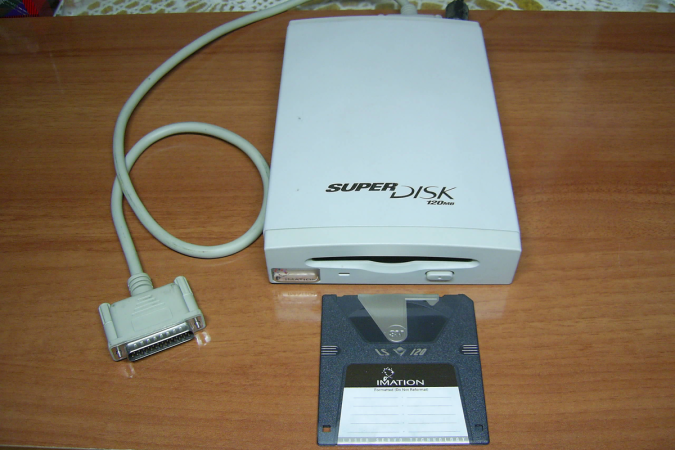
SuperDisk: The Better Floppy That Never Caught On

Once the microcomputer era got going in earnest, the floppy disk quickly supplanted the tape as the portable storage method of choice. They were never particularly large, but they were fine for the average user to get by.

At the same time, it wasn’t long before heavier-duty removable storage solutions hit the market for power users who needed to move many megabytes at a time. In the 1980s, these were primarily the preserve of big print shops, corporate users, and governments. By the 1990s, even the mildly savvy computerist was starting to chafe against the tyrannical 1.44 MB limit of the regular 3.5″ diskette. Against this backdrop launched the SuperDisk—the product which hoped to take the floppy format to the next level, yet faltered all the same.

Continue reading “SuperDisk: The Better Floppy That Never Caught On”