Exploring The World Of Nintendo 3DS Homebrew

When Nintendo officially ended production of the 3DS in September 2020, it wasn’t exactly a surprise. For one thing, some variation of the handheld system had been on the market since 2011. Which is not to say the product line had become stagnant: the system received a considerable mid-generation refresh, and there was even a more affordable variant introduced that dropped the eponymous stereoscopic 3D effect, but nearly a decade is still a fairly long life in the gaming industry. Of course Nintendo’s focus on the Switch, a hybrid device that blurs the line between console and handheld games, undoubtedly played a part in the decision to retire what could effectively be seen as a competing product.

While putting the 3DS out to pasture might have been the logical business move, a quick check on eBay seems to tell a different story. Whether it’s COVID keeping people indoors and increasing the demand for at-home entertainment, or the incredible library of classic and modern games the system has access to, the fact is that a used 3DS in good condition is worth more today than it was when it was brand new on the shelf this time last year.

I’ve certainly made more expensive mistakes.

In short, this was the worst possible time for me to decide that I finally wanted to buy a 3DS. Then one day I noticed the average price for a Japanese model was far lower than that of its American counterpart. I knew the hardware was identical, but could the firmware be changed?

An evening’s worth of research told me the swap was indeed possible, but inadvisable due to the difficulty and potential for unexpected behavior. Of course, that’s never stopped me before.

So after waiting the better part of a month for my mint condition 3DS to arrive from the land of the rising sun, I set out to explore the wide and wonderful world of Nintendo 3DS hacking.

Continue reading “Exploring The World Of Nintendo 3DS Homebrew”

Compute Like It Is 1975: 6th Edition Unix Reborn

If you crave experiencing or reliving what computing was like “back then” you have a lot of options. One option, of course, is to load an emulator and pretend like you have the hardware and software you are interested in. Another often expensive option is to actually buy the hardware on the used market. However, [mit-pdos] has a different approach: port the 6th edition of Unix to RISC-V and use a modern CPU to run an old favorite operating system.

It isn’t an exact copy, of course, but Xv6 was developed back in 2006 as a teaching operating system at MIT. You can find resources including links to the original Unix source code, commentary on the source code, and information about the original PDP 11/40 host computer on the project’s main page.

Continue reading “Compute Like It Is 1975: 6th Edition Unix Reborn”

Camera Hack Peels Back Layers Of Embedded Linux

Embedded Linux devices are everywhere these days, and sooner or later, you’re going to want to poke around in one of them. But how? That’s where posts like this one from [Felipe Astroza] come in. While his work is focused on the Foscam C1 security camera, the techniques and tools he outlines here will work on all sorts of gadgets that have a tiny penguin at their core.

Rather than trying to go in through the front door, [Felipe] starts his assault with the nuclear option: removing the SPI MX25L12835F flash chip from the camera’s PCB and dumping its contents with a Raspberry Pi. From there he walks through the use of different tools to determine the partition scheme of the chip and eventually extract passwords and other interesting bits of information from the various file systems within.

Getting ready to remove the flash chip.

That alone would be worth the read, but things really get interesting once [Felipe] discovers the FirmwareUpgrade program. Since the Foscam’s software updates are encrypted, he reasons that reverse engineering this binary would uncover the key and allow for the creation of custom firmware images that can be flashed through the stock interface.

Further investigation with Ghidra and friends identifies an interesting shared library linked to the executable in question, which is then disassembled in an effort to figure out how the key is being obfuscated. We won’t ruin the surprise, but [Felipe] eventually gets what he’s after.

This isn’t the first time [Felipe] has played around with the firmware on these Internet connected cameras, and we dare say it won’t be his last. For those who are really into tinkering with these sort of devices, it’s not unheard of to install a socket for the flash chip to make software modifications faster and easier.

Guide To Mastering OpenSCAD Costs Roughly The Same As OpenSCAD

OpenSCAD is a fantastic free tool for 3D modeling, but it’s far less intuitive to use for non-programmers than mouse-driven programs such as Tinkercad. Powerful as it may be, the learning curve is pretty steep. OpenSCAD’s own clickable cheat sheet and manual comes in handy all the time, but those are really more of a reference than anything else. Never fear, because [Jochen Kerdels] had quite the productive lockdown and wrote a free comprehensive guide to mastering OpenSCAD.

[Jochen]’s book opens with a nice introduction to OpenSCAD and it’s user environment and quickly moves into 10 useful projects of increasing complexity that start with simple stuff like wall anchors and shelf brackets and ends with recursive trees.

There are plenty of printing tips along the way to help realize these projects with minimum frustration, and the book wraps up by covering extra functions not expressly used in the projects.

Of course, you could always support [Jochen]’s Herculean effort by buying the print edition and forcing yourself to type everything in instead of copy/pasting, or give it to someone to introduce them to all the program has to offer.

Need help mastering OpenSCAD workflow? We’ve got that. Just want to make some boxes or airfoils? We have those in stock, too.

Main and thumbnail images via [Devlin Thyne]

E.T. Video Game Gets Re-Imagined In 10 Lines Of BASIC

Most people would recognize E.T. The Extra-Terrestrial for the Atari 2600 by its reputation as one of the worst video games of all time. We’ll have more to say about that in a moment, but E.T. was nevertheless chosen as the inspiration behind [Martin Fitzpatrick]’s re-imagining of the game in ten lines of BASIC code for a contest that encourages and celebrates games written in ten lines of BASIC, or less.

Ten lines of BASIC is a big limitation, even when getting clever by stacking multiple statements into a single line, so [Martin]’s game has a much narrower scope than the original Atari 2600 version. Still, the core elements are present: E.T. must find and gather all the parts of the phone in order to contact his ship, after which he must meet the ship in time to escape. All the while, FBI agents attempt to interfere. The game was written in SAM BASIC, used by the SAM CoupĂ©, a British Z80-based home computer from the late 80s with an emulator available for download.

Now, for lovers of “um, actually” topics, do we have a treat for you! Let’s take this opportunity to review a few things about E.T. The Extra-Terrestrial. That it was a commercial flop is no doubt, but the game itself is often badly misunderstood. Way back in 2013 we covered an extraordinary effort to patch improvements into the binary for the 2600 game, and in the process there’s a compelling case made that the game was in many ways far ahead of its time, and actually quite significant in terms of game design. You can jump right in on an analysis of the hate the game receives, and while reading that it’s helpful to keep in mind that In 1982, many of its peers were games like Space Invaders, with self-evident gameplay that simply looped endlessly.

3D Animation For All Thanks To Google AI

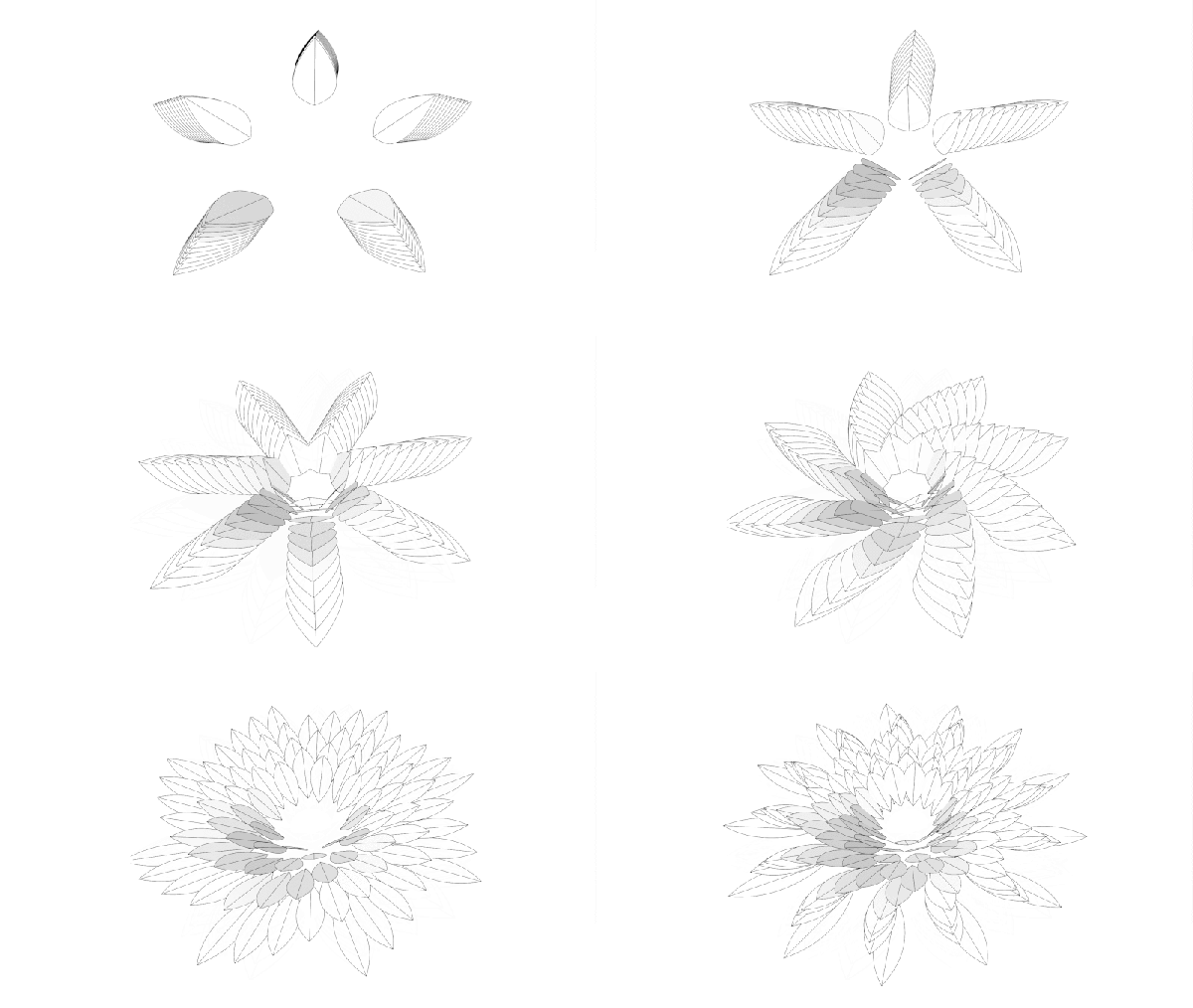
Google rarely fails to impress with technology demos. Their latest — Monster Mash — is aimed at using artificial intelligence to allow the creation of simple 3D animations without a lot of training or trouble. We’ll warn you: we aren’t artists so we didn’t get the results the demos were showing, but then again, if you are even a little artistic, you’ll probably have better luck than we did. You might want to start watching the video, below.

There’s also a research paper if you are more interested in the technology. The idea is to make simple line drawings in 2D. Then you inflate the object to 3D. The final step is to trace out animation paths.

Continue reading “3D Animation For All Thanks To Google AI”

Exhuming An Ancient Game From A Government Warehouse

Many readers will be familiar with the final scene of Raiders Of The Lost Ark, in which the Ark of the Covenant, having been retrieved by Indiana Jones, is placed in a crate and wheeled off to be lost in the seemingly infinite depths of a dusty Government warehouse. Who knows what treasures lurk in such fabled taxpayer-funded repositories, and as if to prove their vast potential, [Arthur O’Dwyer] relates a tale of digital archaeology in which the entire source code of a game thought long-lost was regurgitated with the help of a civil servant.

The game in question is Castlequest, which he had played in the 1980s on the now-defunct GEnie online service. One of very few online references to it came via an entry in the copyright catalog of the US Copyright Office, where copyright holders can choose to register their works. Eventually after some detective work and a conversation with one of the game’s authors, he received copies of the entry. But instead of the expected summary, he was pleasantly surprised to find the full Fortran code of the game. The snag was that it came as a PDF scan of printed pages rather than as code itself, so there followed a tedious process of transcription before it could be published in a GitHub repository and eventually made compilable. The code remains copyrighted as an important part of its story, but should you be interested you can transport yourself back four decades and try your luck at text adventuring.

Maybe there’s more to be found in those dusty copyright warehouses, and searching for it has to be more pleasant than digging up landfills.