Project Egress: Two Ways To Latch The Hatch

With July slipping away and the deadline approaching, the Project Egress builds are pouring in now. And we’re starting to see more diversity in the choice of materials and methods for the parts being made, like these two latches made with very different methods by two different makers.

For the uninitiated, Project Egress is a celebration of both the 50th anniversary of Apollo 11 and the rise of the maker movement. Spearheaded by [Adam Savage], the idea is to engage 44 prominent makers to build individual parts from the Unified Crew Hatch (UCH) from the Apollo Command Module. The parts will be used to create a replica of this incredibly complex artifact, which will be assembled by [Adam] before a live audience at the National Air and Space Museum next week.

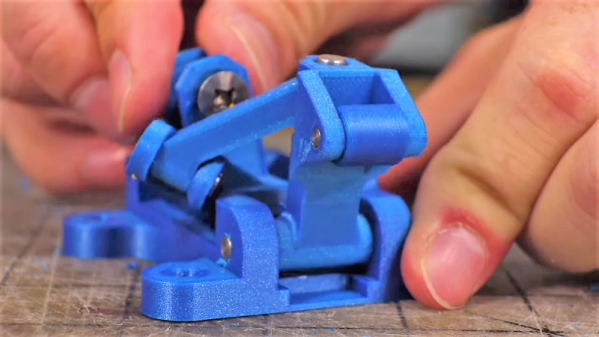
Both [Joel] from the “3D Printing Nerd” channel and [Bill Doran] from “Punished Props Academy” got the nod for one of the 15 latches needed, and both played to their respective strengths. [Joel]’s latch was executed in PLA on a Prusa I3 printer. [Bill] went a different route for his latch. He used a Form 2 SLA printer to print the parts, but used them only to make silicone molds. He then cast the parts from urethane resin, which should prove much stronger than the original SLA prints. We suspect the ability to quickly cast more latches could prove handy if any of the other latch makers should fail to deliver.

The latches [Joel] and [Bill] made joins the other parts, like the wooden latch being made by [Fran Blanche] and the hatch handle [Paul] cast in aluminum. We’re looking forward to more part builds, as well as the final assembly.

Continue reading “Project Egress: Two Ways To Latch The Hatch”

Ask Hackaday: What Are Your Apollo Memories?

This month will mark the 50th anniversary of the Apollo 11 mission that brought to a successful conclusion the challenge laid down by President Kennedy only eight years earlier. Three men went to the Moon, two walked on it, and they all came back safely, in a dramatic eight-day display of engineering and scientific prowess that was televised live to the world.

If you’ve made more than 50 trips around the sun, chances are good that you have some kind of memories of the first Moon landing. An anniversary like this is a good time to take stock of those memories, especially for something like Apollo, which very likely struck a chord in many of those that witnessed it and launched them on careers in science and engineering. We suspect that a fair number of Hackaday readers are in that group, and so we want to ask you: What are your memories of Apollo?

A Real American Hero

My memory of the Moon landing is admittedly vague. I had just turned five the month before, hadn’t even started kindergarten yet, but I had already caught the space bug in a big way. I lived and breathed the space program, and I knew everything about the Mercury missions that were over by the time I was born, and the Gemini missions that had just wrapped up. Apollo was incredibly exciting to me, and I was pumped to witness the landing in the way that only a five-year-old can be.
Continue reading “Ask Hackaday: What Are Your Apollo Memories?”

Space Age Bitcoin Mining On An Apollo AGC

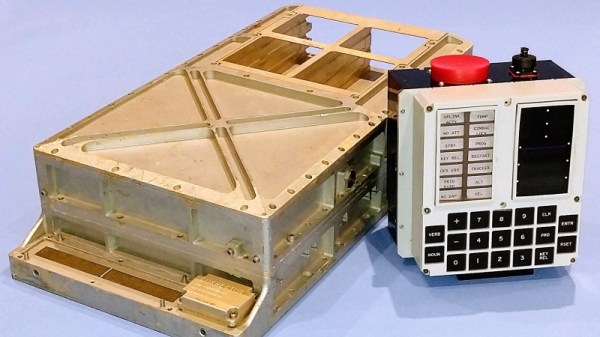
Imagine you’ve got an Apollo Guidance Computer, the machine that took men to the Moon 50 years ago. You’ve spent ages restoring it, and now it’s the only working AGC on the planet. It’s not as though you’re going to fly to the Moon with it, so what do you do with it? Easy – turn it into a perfectly awful Bitcoin mining rig.

The AGC that [Ken Shirriff] and others have been restoring barely resembles a modern computer. The AGC could only do about 40,000 operations per second, but raw speed was far less important than overall reliability and the abundant IO needed to run a crewed spacecraft. It was a spectacular success on the Apollo missions, but [Ken] wanted to know if turning it into a Bitcoin mining rig was possible.

[Ken] gives a great overview of how Bitcoin mining works, with one of the best explanations of the hashing algorithm we’ve seen. Getting that to run on the AGC was no mean feat, especially with limits imposed by the memory addressing scheme and the lack of machine instructions for manipulating words. He eventually got it working, though, clocking in at a screaming 10.3 seconds per Bitcoin hash. [Ken] estimates that the first coin will be successfully mined in a mere 400 zettaseconds, which is about a billion times older than the universe. With about 13 quadrillion years to the first ka-ching, you have plenty of time to watch a block mined in the video below; alas, it was an old block, so no coins were awarded to compensate the team for their efforts.

This isn’t the first time [Ken] has implemented a useless Bitcoin mine. The Xerox Alto mine was actually fast compared to the AGC, but it sure beats the IBM mainframe and punchcards.

Continue reading “Space Age Bitcoin Mining On An Apollo AGC”

It’s NICER In Orbit

Given the sheer volume of science going on as the International Space Station circles above our heads every 90 minutes or so, it would be hard for any one experiment to stand out. ISS expeditions conduct experiments on everything from space medicine to astrophysics and beyond, and the instruments needed to do the science have been slowly accreting over the years. There’s so much stuff up there that almost everywhere you turn there’s a box or pallet stuck down with hook-and-loop fasteners or bolted to some bulkhead, each one of them doing something interesting.

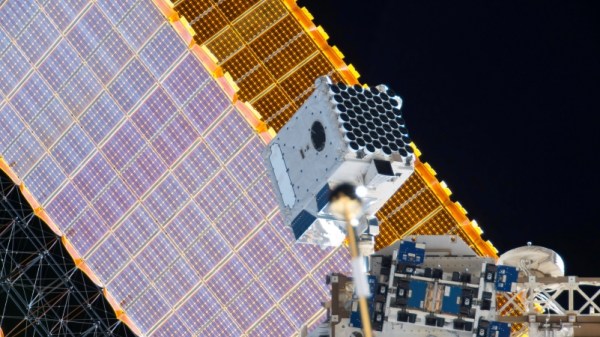
The science on the ISS isn’t contained completely within the hull, of course. The outside of the station fairly bristles with science, with packages nestled in among the solar panels and other infrastructure needed to run the spacecraft. Peering off into space and swiveling around to track targets is an instrument with the friendly name NICER, for “Neutron Star Interior Composition Explorer.” What it does and how it does it is interesting stuff, and what it’s learning about the mysteries of neutron stars could end up having practical uses as humanity pushes out into the solar system and beyond.

Continue reading “It’s NICER In Orbit”

Fly A Pi On Your Next Model Rocket

From time to time, we see electronics projects for model rocket instrumentation. Those who have been involved in the hobby for many years may remember when 8-bit microcontrollers like the PIC16F84 were the kind of hardware you might fly on a mission. These days, however, there’s little reason not to send a high-powered processor. This is exactly what [Mohamed Elhariry] has done with his PiX project, which turns a Raspberry Pi Zero W into a neat little flight data recorder.

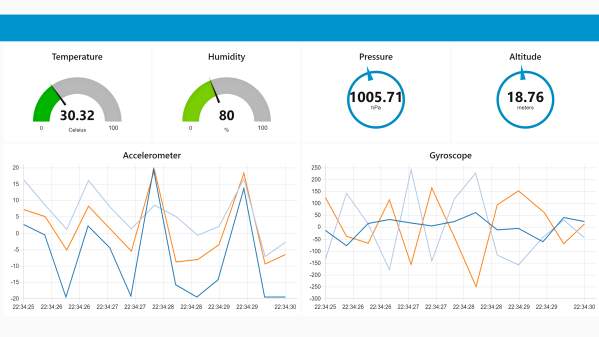
The hardware has what you might expect from a flight recorder, including accelerometer, gyroscope, and pressure sensor. In addition, it carries temperature and humidity sensors, and of course, a camera. A 64 GB microSD card provides the storage, while a LiPo SHIM board allows the whole thing to run from a 150 mAh battery. All of the components are off-the-shelf breakouts, which makes assembly as easy as soldering a few connections and securing the modules with a little tape.

The project is in GitHub, including python code, schematics for the hardware, and detailed instructions. If you ever wanted to get started with instrumenting a model rocket, this looks like a great resource. Also in the repo is a captured video from an actual flight [34 MB GIF] if you just want to see the view from one launch.

Using commercial modules seems pretty convenient, but if custom hardware is more your thing, check out these 22 mm round PCBs designed to fit inside rockets.

Project Egress: Casting The Hatch Handle

Every door needs a handle, even – especially – the door of a spaceship. And [Paul] from “Paul’s Garage” got the nod to fabricate the handle for the Apollo 11 Command Module hatch being built as part of Project Egress.

For those not familiar with Project Egress, it’s a celebration of the 50th anniversary of the first Moon landing that aims to recreate an important artifact from the mission: the Unified Crew Hatch, or UCH, from the Apollo 11 Command Module Columbia. Forty-four makers from various disciplines have been tasked with making the various pieces of the UCH, and each one is free to use whatever materials and methods he or she wants. [Paul] chose what will probably turn out to be the consensus material – aluminum – and decided to play to his strengths by casting the part.

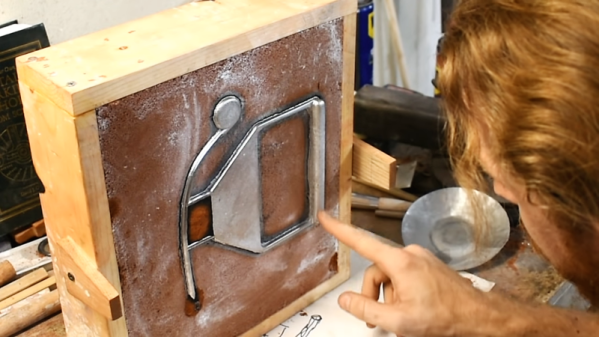
The handle itself is a chunky affair, as one would expect from something designed to be handled by an astronaut. [Paul] started with a 3D-printed version of the handle and created a two-piece mold in casting sand. The original part was probably machined, which meant that it didn’t have the draft angle that cast parts are supposed to have to make removal from the molding medium easier. [Paul] lucked out and got a perfect mold, and a perfect pour from silicon aluminum to boot. All the casting needed was a little cleanup and some holes to bolt it to the door.

[Paul]’s handle will get shipped to the Smithsonian along with the other parts, like [Fran Blanche]’s latch assembly, so that [Adam] can assemble the hatch live during the 50th-anniversary celebration later this month. Stay tuned for more Project Egress coverage as the parts keep rolling in.

Continue reading “Project Egress: Casting The Hatch Handle”

Project Egress: [Fran] Makes A Latch

[Fran Blanche] is on the team of elite hackers that has been offered a chance to contribute to [Adam Savage]’s Project Egress, a celebration of the engineering that got humanity to the Moon 50 years ago this month. By the luck of the draw, she landed a great assignment: building a replica of one of the fifteen latches that kept the Apollo Command Module hatch dogged down against the vacuum of space, and she’s doing a great job documenting her build with some interesting videos.

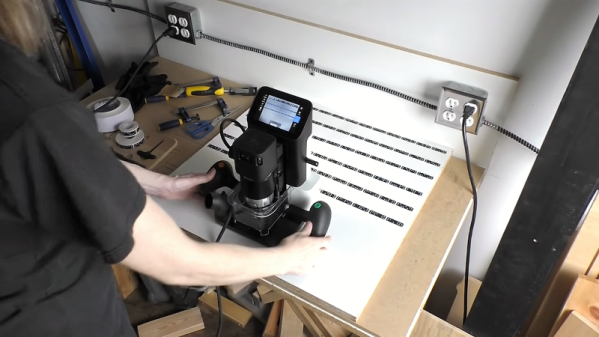
The first video below is mostly her talking through her design process, materials choices, and ideas about fabricating the somewhat intricate pieces of the latch. All 44 makers involved in the project get to choose what materials and methods they’ll use to make their parts, and [Fran] decided to use wood. Her first inclination was to use oak and brass, a nice combination with an 80s vibe, but in the second video, which covers more of the initial fabrication, she explains her switch to walnut. Unfortunately, the only CNC option she has is a Shaper Origin, which presents some difficulties; the handheld tool requires some complicated fixturing to safely machine the small parts needed, and its inability to read STL files means that [Fran] is stuck with a complicated software toolchain to drive the tool.

There are more videos to come as [Fran] gets further into the build, and we’re looking forward to seeing how her part and the rest of the makers’ builds come out.

Continue reading “Project Egress: [Fran] Makes A Latch”