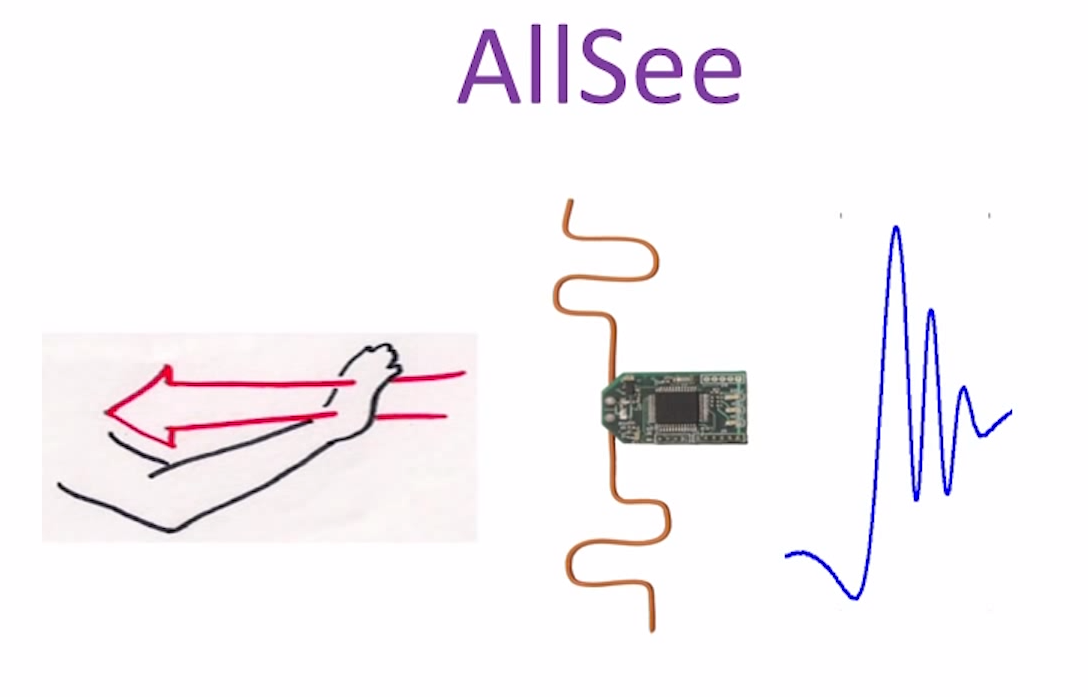
A team at the University of Washington recently developed Allsee, a simple gesture recognition device composed of very few components. Contrary to conventional Doppler modules (like this one) that emit their own RF signal, Allsee uses already existing wireless signals (TV and RFID transmissions) to extract any movement that may occur in front of it.
Allsee’s receiver circuit uses a simple envelope detector to extract the amplitude information to feed it to a microcontroller Analog to Digital Converter (ADC). Each gesture will therefore produce a semi-unique footprint (see picture above). The footprint can be analyzed to launch a dedicated action on your computer/cellphone. The PDF article claims that the team achieved a 97% classification accuracy over a set of eight gestures.
Obviously the main advantage of this system is its low power consumption. A nice demonstration video is embedded after the break, and we’d like to think [Korbi] for tipping us about this story.
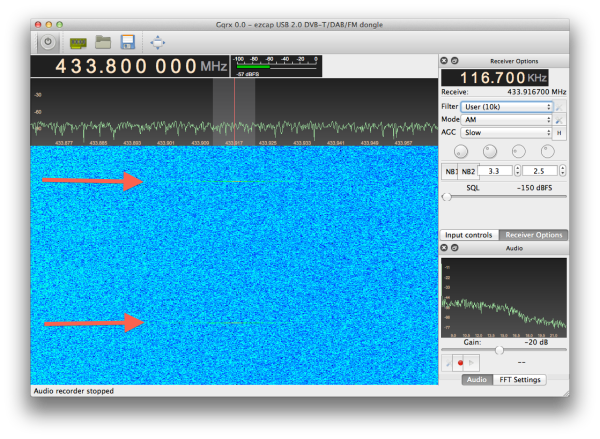
For about a week [Justin] had a wireless acidity level sensor in his esophagus and a pager-looking RF receiver in his pocket. So he naturally decided to use an RTL-SDR dongle to sniff the signals coming out of him. As most of our Hackaday readers know, these cheap RTL2382U-based DVB-T receivers are very handy when it comes to listening to anything between 50MHz and 1800MHz. [Justin] actually did a great job at listing all the things these receivers can be used for (aircraft traffic monitoring, weather images download, electric meter reading, pacemaker monitoring…).
After some Googling he managed to find his Bravo pH sensor user’s guide and therefore discovered its main frequency and modulation scheme (433.92MHz / ASK). [Justin] then used gqrx and Audacity to manually decode the packets before writing a browser-based tool which uses an audio file. Finally, a few additional hours of thinking allowed him to extract his dear esophagus’ pH value.
Atmel has just announced a new product line: SmartConnect. This moves beyond the point-to-point nature of WiFi Direct, and enables connections to standard access points. The SmartConnect series is designed for embedding in low cost devices that need to connect to a network.
The first devices in the SmartConnect line will be modules based on two chips: an Atmel SAMD21 Cortex-M0+ microcontroller and an Ozmo 3000 WiFi System on Chip. There’s also an on-board antenna and RF shielding can. It’s a drop in WiFi module, which is certified by the FCC. You can hook up your microcontroller to this device over SPI, and have a fully certified design that supports WiFi.
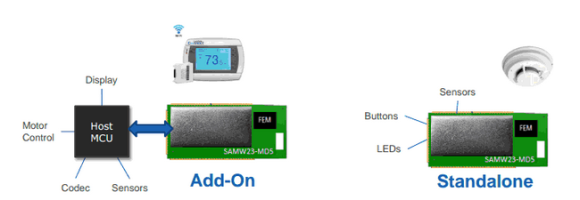
There’s two ways to use the module. The first is as an add-on, which is similar to existing modules. A host microcontroller communicates with the module over SPI and utilizes its command set. The second method uses the module as a standalone device, with application code running on the internal SAMD21 microcontroller. Atmel has said that the standalone option will only be available on a case to case basis, but we’re hoping this opens up to everyone. If the Arduino toolchain could target this microcontroller, it could be a great development platform for cheap WiFi devices.
The Add-On and Standalone Architectures
At first glance, this module looks very similar to other WiFi modules, including the CC3000 which we’ve discussed in the past. However there are some notable differences. One major feature is the built in support for TLS and HTTPS, which makes it easier to build devices with secure connections. This is critical when deploying devices that are connected over the internet.
Atmel is claiming improvements in power management as well. The module can run straight from a battery at 1.8 V to 3.3 V without external regulation, and has a deep sleep current of 5 nA. Obviously the operating power will be much higher, but this will greatly assist devices that sporadically connect to the internet. They also hinted at the pricing, saying the modules will come close to halving the current price of similar WiFi solutions. SmartConnect is targeting a launch date of June 15, so we hope to learn more this summer.
We’re always excited to see better connectivity solutions. If Atmel comes through with a device allowing for cheaper and more secure WiFi modules, it will be a great part for building Internet of Things devices. With a projected 50 billion IoT devices by 2020, we expect to see a lot of progress in this space from silicon companies trying to grab market share.
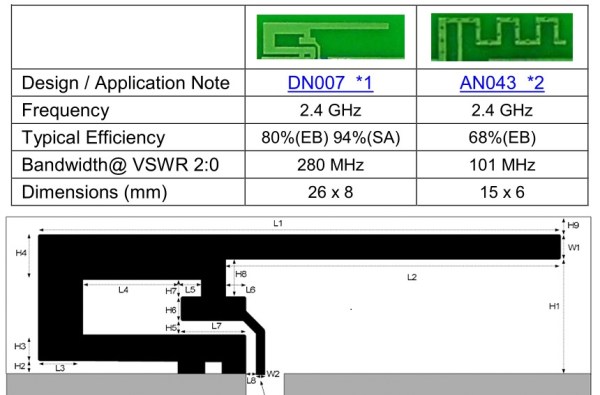
Have you ever built a wireless project and weren’t sure how to make one of those awesome (and cheap!) PCB antennas? “What low-cost solutions does our Antenna Board #referencedesign contain?” said Texas Instruments (TI) recently via Twitter. This older reference design contains some comprehensive designs for sub-1 GHz and 2.4 GHz antennas.
While TI’s documentation can be difficult to navigate, there are many hidden gems, and this is one of them. While TI created these designs for use with their wireless products, they will work on any device which utilizes the same wireless base frequency. For example, you could use any of the 2.4 GHz antennas with any Bluetooth, WiFi (2.4 GHz), or Bluetooth Low Energy chips. Simply open up their Antenna Selection Quick Guide document and navigate to the specific design for whichever antenna you would like to build.
For a more detailed overview of what goes into designing and testing a PCB antenna, check out this hack which we featured back in 2010. With the internet of things coming into its own, wireless projects will become more and more prolific, making PCB antennas more important than ever.
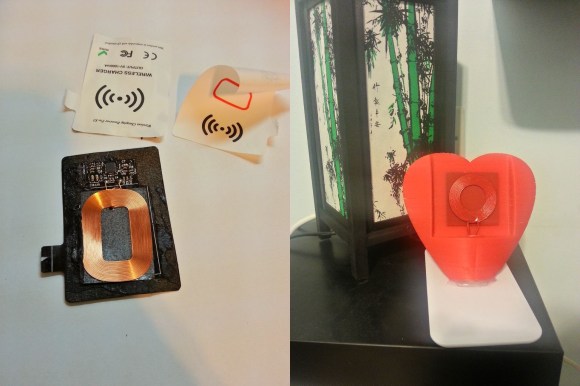
He already had the Qi wireless charger but wasn’t much of a fan as it “looks so boring”. So he took it apart to salvage the charging circuit for his new project. As luck would have it, the Qi is very simple on the inside — all he had to do was lengthen the power wires to the coil. He then designed his heart in SolidWorks — Don’t forget to check out our 3D Printering tutorials on this — and printed it out in a nice candy apple red. To maximize the charging current he’s left the inductive loop on the outside so it can be as close to the phone as possible — he spray painted it red and it actually looks pretty cool!
The next step was adding the wireless charging capability to the phone, we’ve covered how to add this to any phone before, but for [Gal] it was as simple as cutting down the Qi Receiver card to fit in the phone.
“Its hard to find people that actually WANT to mow their lawn.” A more true statement has never been made. [Kurt’s] project turns an old lawn mower into a remote control lawn mower.
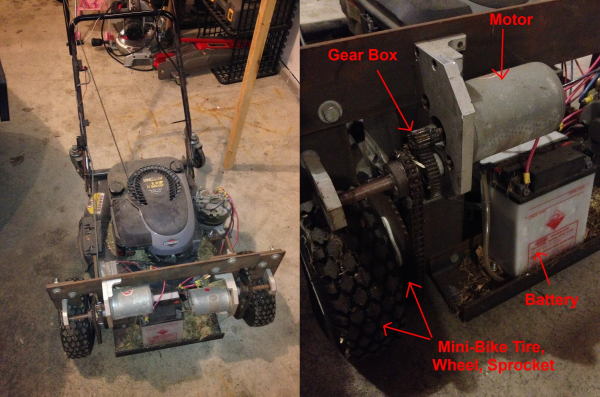
The first step of this build is to replace the front drive wheels with mini-bike tires which have built-in gear tooth sprockets. The rear wheels were then replaced with large caster wheels. The 12-24V DC motors and gear boxes used come from National Power Chair. While we have seen more complicated RC lawn mowers before, this project is a great way to get started. All that [Kurt] wanted was to make lawn mowing more fun, we believe that he has succeeded. This thing is very mobile and can turn on a dime. Check out the demo video after the break.
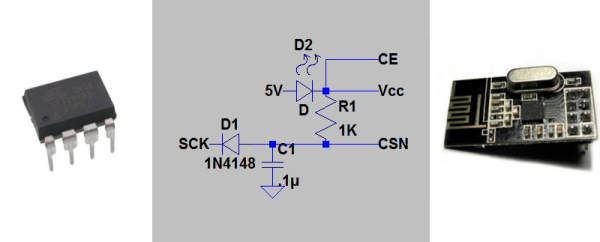
One of the key components was to effectively drive the chip select (CSN) line from the clock (SCK) line. The nrf24l01+ needs the CSN line to transition from high to low on the beginning of a communication. [Ralph] put the SCK line behind a diode, put a capacitor in parallel with the CSN line and altered the arduino-nrf24l01 library to encode extra delays for the clock line. This allowed the CSN line to be driven by the SCK line. Subsequent line transitions during transmission happen too fast to charge the capacitor, leaving the CSN line in a low state.
After tying the chip enable line high and dropping the 5V power line to 1.9-3.6V across a red LED, [Ralph] had an ATtiny85 controlling a nrf24l01+ module.
Though deceptively simple, a very cool hack that opens up a couple more lines on the ATtiny85.