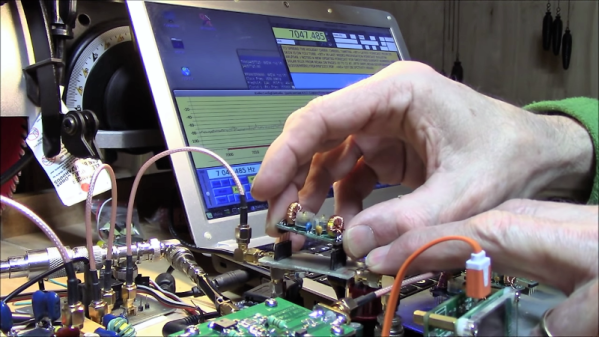
EBay Modules And Custom PCBs Make A Plug And Play Ham Transceiver

Many of us have fond memories of our introduction to electronics through the “200-in-1” sets that Radio Shack once sold, or even the more recent “Snap Circuits”-style kits. Most of eventually us move beyond these kits to design our circuits; still, there’s something to be said for modular designs. This complete amateur radio transceiver is a great example of that kind of plug and play construction.

The rig is the brainchild of [jmhrvy1947], who set out to build a complete transceiver using mostly eBay-sourced modules. Some custom PCBs are used, but those are simple boards that can be etched and drilled easily. The transceiver is only for continuous-wave (CW) use, which would normally mean you’d need to know Morse, but thanks to some clever modifications to open-source apps like Quisk and FLDigi, Morse can be received and sent directly from the desktop. That will no doubt raise some hackles, but we think it’s a great way to learn code. The rig is QRP, or low power, transmitting only 100 mW with the small power amp shown. Adding eBay modules can jack that up to a full 100 Watts, which also requires adding a 12-volt power supply, switchable low-pass filters, a buck-boost converter, and some bandpass filters for band selection. It ends up looking very experimental, but it works well enough to make contacts.

We really like the approach here, and the fact that the rig can be built in stages. That makes it a perfect project for our $50 Ham series, which just kicked off. Perhaps we’ll be seeing it again soon.

Continue reading “EBay Modules And Custom PCBs Make A Plug And Play Ham Transceiver”

The $50 Ham: Entry-Level Transceivers For Technicians

Last week , I covered the ridiculously low barriers to entry to amateur radio, both in terms of financial outlay and the process of studying for and passing the FCC examination. You’ve had seven days, so I assume that you’ve taken the plunge and are a freshly minted amateur radio operator. The next big question may be: Now what?

We briefly mentioned the image that ham radio is a rich old person’s hobby, and that reputation is somewhat deserved. For ham gear, there really is no upper limit on what you can spend. Glossy brochures and slick web pages hawk transceiver bristling with knobs and switches and loaded with the latest features, all of which will probably be obsolete within a few years when the Next Big Thing comes along and manufacturers respond with new, must-have models – looking at you, ICOM IC-7300. It’s no different than any other technology market, and enough people fall for that marketing to make it a going concern.

But thankfully, while there is no apparent ceiling on what you can spend on ham gear, there certainly is a floor, and it can be very, very low. Our $50 budget can go quite a long way to getting a new Technician on the air, if you’re willing to make some compromises and can forego the latest and greatest for a while.

Continue reading “The $50 Ham: Entry-Level Transceivers For Technicians”

The $50 Ham: Getting Your Ticket Punched

Today we start a new series dedicated to amateur radio for cheapskates. Ham radio has a reputation as a “rich old guy” hobby, a reputation that it probably deserves to some degree. Pick up a glossy catalog from DX Engineering or cruise their website, and you’ll see that getting into the latest and greatest gear is not an exercise for the financially challenged. And thus the image persists of the recent retiree, long past the expense and time required to raise a family and suddenly with time on his hands, gleefully adding just one more piece of expensive gear to an already well-appointed ham shack to “chew the rag” with his “OMs”.

Not a $50 ham. W9EVT’s shack. Source: QRZ.com

As I pointed out a few years back in “My Beef With Ham Radio”, I’m an inactive ham. My main reason for not practicing is that I’m not a fan of talking to strangers, but there’s a financial component to my reticence as well – it’s hard to spend a lot of money on gear when you don’t have a lot to talk about. I suspect that there are a lot of would-be hams out there who are turned off from the hobby by its perceived expense, and perhaps a few like me who are on the mic-shy side.

This series is aimed at dispelling the myth that one needs buckets of money to be a ham, and that jawboning is the only thing one does on the air. Each installment will feature a project that will move you further along your ham journey that can be completed for no more than $50 or so. Wherever possible, I’ll be building the project or testing the activity myself so I can pursue my own goal of actually using my license for a change.

Continue reading “The $50 Ham: Getting Your Ticket Punched”

Does WiFi Kill Houseplants?

Spoiler alert: No.

To come to that conclusion, which runs counter to the combined wisdom of several recent YouTube videos, [Andrew McNeil] ran a pretty neat little experiment. [Andrew] has a not inconsiderable amount of expertise in this area, as an RF engineer and prolific maker of many homebrew WiFi antennas, some of which we’ve featured on these pages before. His experiment centered on cress seeds sprouting in compost. Two identical containers were prepared, with one bathed from above in RF energy from three separate 2.4 GHz transmitters. Each transmitter was coupled to an amplifier and a PCB bi-quad antenna to radiate about 300 mW in slightly different parts of the WiFi spectrum. Both setups were placed in separate rooms in east-facing windows, and each was swapped between rooms every other day, to average out microenvironmental effects.

After only a few days, the cress sprouted in both pots and continued to grow. There was no apparent inhibition of the RF-blasted sprouts – in fact, they appeared a bit lusher than the pristine pot. [Andrew] points out that it’s not real science until it’s quantified, so his next step is to repeat the experiment and take careful biomass measurements. He’s also planning to ramp up the power on the next round as well.

We’d like to think this will put the “WiFi killed my houseplants” nonsense to rest – WiFi can even help keep your plants alive, after all. But somehow we doubt that the debate will die anytime soon.

Continue reading “Does WiFi Kill Houseplants?”

When Will Our Cars Finally Speak The Same Language? DSRC For Vehicles

At the turn of the 21st century, it became pretty clear that even our cars wouldn’t escape the Digital Revolution. Years before anyone even uttered the term “smartphone”, it seemed obvious that automobiles would not only become increasingly computer-laden, but they’d need a way to communicate with each other and the world around them. After all, the potential gains would be enormous. Imagine if all the cars on the road could tell what their peers were doing?

Forget about rear-end collisions; a car slamming on the brakes would broadcast its intention to stop and trigger a response in the vehicle behind it before the human occupants even realized what was happening. On the highway, vehicles could synchronize their cruise control systems, creating “flocks” of cars that moved in unison and maintained a safe distance from each other. You’d never need to stop to pay a toll, as your vehicle’s computer would communicate with the toll booth and deduct the money directly from your bank account. All of this, and more, would one day be possible. But only if a special low-latency vehicle to vehicle communication protocol could be developed, and only if it was mandated that all new cars integrate the technology.

Except of course, that never happened. While modern cars are brimming with sensors and computing power just as predicted, they operate in isolation from the other vehicles on the road. Despite this, a well-equipped car rolling off the lot today is capable of all the tricks promised to us by car magazines circa 1998, and some that even the most breathless of publications would have considered too fantastic to publish. Faced with the challenge of building increasingly “smart” vehicles, manufacturers developed their own individual approaches that don’t rely on an omnipresent vehicle to vehicle communication network. The automotive industry has embraced technology like radar, LiDAR, and computer vision, things which back in the 1990s would have been tantamount to saying cars in the future would avoid traffic jams by simply flying over them.

In light of all these advancements, you might be surprised to find that the seemingly antiquated concept of vehicle to vehicle communication originally proposed decades ago hasn’t gone the way of the cassette tape. There’s still a push to implement Dedicated Short-Range Communications (DSRC), a WiFi-derived protocol designed specifically for automotive applications which at this point has been a work in progress for over 20 years. Supporters believe DSRC still holds promise for reducing accidents, but opponents believe it’s a technology which has been superseded by more capable systems. To complicate matters, a valuable section of the radio spectrum reserved for DSRC by the Federal Communications Commission all the way back in 1999 still remains all but unused. So what exactly does DSRC offer, and do we really still need it as we approach the era of “self-driving” cars?

Continue reading “When Will Our Cars Finally Speak The Same Language? DSRC For Vehicles”

EF50: The Tube That Changed Everything

From today’s perspective, vacuum tubes are pretty low tech. But for a while they were the pinnacle of high tech, and heavy research followed the promise shown by early vacuum tubes in transmission and computing. Indeed, as time progressed, tubes became very sophisticated and difficult to manufacture. After all, they were as ubiquitous as ICs are today, so it is hardly surprising that they got a lot of R&D.

Prior to 1938, for example, tubes were built as if they were light bulbs. As the demands on them grew more sophisticated, the traditional light bulb design wasn’t sufficient. For one, the wire leads’ parasitic inductance and capacitance would limit the use of the tube in high-frequency applications. Even the time it took electrons to get from one part of the tube to another was a bottleneck.

There were several attempts to speed tubes up, including RCA’s acorn tubes, lighthouse tubes, and Telefunken’s Stahlröhre designs. These generally tried to keep leads short and tubes small. The Philips company started attacking the problem in 1934 because they were anticipating demand for television receivers that would operate at higher frequencies.

Dr. Hans Jonker was the primary developer of the proposed solution and published his design in an internal technical note describing an all-glass tube that was easier to manufacture than other solutions. Now all they needed was an actual application. While they initially thought the killer app would be television, the E50 would end up helping the Allies win the war.

Continue reading “EF50: The Tube That Changed Everything”

Drone Gives Up Its Wireless Secrets To Zigbee Sniffer

There’s something thrilling about decoding an unknown communications protocol. You start with a few clues, poke at the problem with some simple tools, and eventually work your way up to that first breakthrough that lets you crack the code. It can be frustrating, but when you eventually win, it can be very rewarding.

It seems that [Jason] learned this while decoding the wireless conversation between his mass-market quad and its controller. The quad in question, a Yuneec Q500, is one of those mid-range, ready-to-fly drones that’s targeted at those looking to get in the air easily and take some cool pictures. Unsure how the drone and controller were talking, [Jason] popped the covers and found a Zigbee chipset within. With the help of a $14 Zigbee USB dongle and some packet sniffing software from TI, [Jason] was able to see packets flowing, but decoding them was laborious. Luckily, the sniffer app can be set up to stream packets to another device, so [Jason] wrote a program to receive and display packets. He used that to completely characterize each controller input and the data coming back from the drone. It’s a long and strange toolchain, but the upshot is that he’s now able to create KML in real time and track the drone on Google Earth as it flies. The video below shows the build and a few backyard test flights.

Congratulations to [Jason] for breaking the protocol and opening up drones like this for other hackers. If you’re interested in learning more about Zigbee sniffing, you can actually hack a few smarthome gadgets into useful sniffers.

Continue reading “Drone Gives Up Its Wireless Secrets To Zigbee Sniffer”